How to dropship kitchen products in 2026?
Best niche products dropshipping
Author:
Contents
To dropship kitchen products successfully in 2026, keep it simple and structured:
Choose a clear micro-niche
Select 15 to 25 solid kitchen accessories
Validate your supplier (shipping time, packaging, returns)
Create clear, detailed product pages
Build bundles to increase average order value
Launch with short demo videos, then test and scale
Kitchen is a powerful niche. But it’s also more technical than many other niche categories. Some items come into contact with food, so materials must be verified. Others are exposed to heat, which means real durability matters. And many products trigger returns due to incorrect dimensions or damage during shipping.
Without structure, you’ll quickly deal with complaints, refunds, and chargebacks. That’s why a smart approach to kitchen products dropshipping is critical from day one.

Step 1: Understand your goal and choose your direction

Before choosing products or suppliers, decide what you’re actually selling. In kitchen products dropshipping, a wide catalog creates confusion. Confusion creates unclear product pages, more returns, and weak marketing.
Your direction must make execution easier from products to bundles to content.
Define what “dropshipping kitchen” means for your store
The goal isn’t to sell “a little bit of everything.”
The goal is to build a clear store with a simple promise: useful products that work well together and are easy to buy.
The more confusing your catalog, the more trust you lose, and the more returns you get.
Before you dropship kitchen products, choose one main category and define your positioning:
Baking (kits, precision, visible results) → ideal if you want to dropship baking supplies
Food prep tools (time-saving, clear problem → solution)
Storage & organization (strong before/after visuals)
Tech accessories like Air fryer (recipes, daily usage)
Cookware-related accessories (protection, storage, maintenance) → perfect if you want to dropship cookware
Stick to:
1 main category + 1 secondary category maximum.
For example: organization + prep tools. Not five different directions.
Think in terms of results
Your direction should help you achieve four things:
Reduce refunds
Keep shipping fast and manageable
Sell products that are easy to demonstrate in short videos
Increase AOV through bundles
This is the foundation of strong kitchen products dropshipping.
Avoid beginner mistakes
Many beginners try to test by uploading 100 products at once. That makes the store messy.
Visitors won’t understand:
What you actually sell
Why they should buy from you
What your store specializes in
The result?
Low trust, fewer add-to-carts, weak conversions.
Instead, when you dropship kitchen products, start small. Choose a focused selection. Make it cohesive. Make it easy to understand.
Step 2: Choose a profitable micro-niche

Once your direction is clear, make it profitable by narrowing it down.
With a micro-niche, you:
Speak to one target audience
Select more coherent products
Create bundles that almost sell themselves
It also simplifies your content strategy. You repeat the same angles instead of reinventing the wheel every time.
This is key if you’re learning How to start kitchen dropshipping products the right way.
How to choose the right niche?
Pick a micro-niche that sells well and is easy to show visually.
If your product needs 30 seconds of explanation, it’s probably too complicated.
Kitchen accessories should be understandable in:
One image
Or one short demo video
If you want to dropship kitchen products, choose items with instant clarity.
Profitable kitchen niches for 2026
Here are strong micro-niches to consider:
Baking accessories: Perfect if you enjoy tutorial-style content. Results are visible: smoother dough, cleaner icing, better-shaped cookies. UGC works extremely well with before/after content. Great category if you want to focus on dropship baking supplies or dropshipping baking supplies.
Everyday kitchen tools: The easiest path to start. You sell problem-solving products that save time, reduce mess, and simplify cooking. Demand stays stable all year long.
Kitchen organization with home decor: Marketing becomes almost automatic. A restock video or a drawer transformation turns a basic product into an impulse buy. Perfect for simple, repeatable content.
Air fryer accessories: This niche sells through recipes. A product becomes credible when shown in action. You can build repeatable content series like “Recipe of the Day.” Excellent if you want to dropship cookware add-ons or complementary accessories.
Choose one persona and write for them
Always define your primary target:
Everyday cooks (time-saving focus)
Baking enthusiasts (precision + aesthetics)
Small kitchen owners (space-saving solutions)
Gift buyers (bundles + seasonal angles)
A simple positioning formula could be:
“We help [persona] get [result] with kitchen accessories that make cooking easier, cleaner, and more organized.”
When you dropship kitchen products, clarity beats variety every time
Step 3: Build your product strategy

You’ve chosen your micro-niche like safety equipment? Now decide exactly what you will sell at launch, and just as importantly, what you will refuse to sell.
When you dropship kitchen products, your product strategy protects your margins. A strong structure reduces returns (size, material, breakage) and helps you build a solid average order value through bundles.
The “low-risk kitchen product” filter
To succeed in kitchen products dropshipping, choose products that are easy to ship, easy to explain, and unlikely to generate returns.
Before adding an item, rate it from 1 to 5 on these five criteria:
Durability: Avoid fragile products.
Shipping: Prioritize lightweight and compact items.
Demo potential: The benefit must be visible in 3 seconds. If not, it’s harder to sell.
Compliance risk: If it touches food or heat, materials and usage must be clearly defined.
Bundle potential: Can it be sold as a pack to increase AOV?
This filter prevents emotional decisions. It secures your store before you scale.
If you’re learning How to start kitchen dropshipping products, this step alone can save you months of trial and error.
What to avoid
In kitchen accessories, like handbags, returns rarely come from a “bad” product. They usually come from unclear details.
Avoid:
Unclear dimensions or vague package content
Products with too many variants (size, model, included pieces)
Low-quality silicone (odor, deformation)
Heavy, bulky sets (high shipping cost, higher breakage risk)
Start with compact, robust accessories. Expand later when your base is stable.
When you dropship kitchen products, stability beats variety.
Using Minea to choose the right product
If you want to dropship kitchen products strategically, avoid guessing. Use data.
With Minea, you can:
Ads Library (Meta, TikTok, Pinterest): Filter by country, date, format, and engagement to identify ads that are truly running long-term.
AI Magic Search: Type “kitchen accessories,” “kitchen organization,” or “air fryer” to uncover validated angles and products.
Success Radar (Business plan): Spot top-performing products updated every 8 hours before saturation.
Trending Shops: Analyze Shopify stores selling the product (range, bundles, creative angles).
AI Creative Finder: Generate variations for faster A/B testing.
Supplier search: Compare AliExpress prices, delivery times, and variants directly.
This allows you to move from idea → validation → execution without using multiple disconnected tools.

Step 4: Handle cookware safely
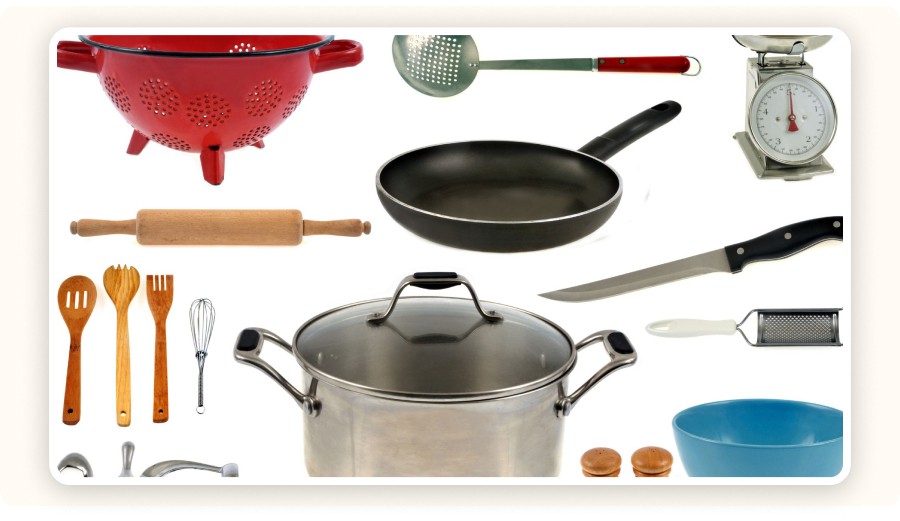
If you plan to dropship cookware, understand that it carries more risk than standard kitchen accessories.
Cookware is:
Heavier
Bulkier
Easier to damage in transit
A scratched pan or dented pot almost guarantees a return. And since shipping costs are higher, one refund can wipe out multiple sales.
The “cookware-safe” approach
Instead of selling cookware directly, start by selling accessories around cookware.
You keep kitchen intent, but reduce risk.
Examples:
Pan protectors
Trivets
Splatter guards
Lid organizers
Handle covers
Durable utensil sets
These products are lighter, less fragile, and highly bundle-friendly.
If you want to dropship cookware, start with surrounding products first.
Non-negotiable risks to control
Before listing cookware-related products, lock down these four elements:
Breakage or scratching risk during transport
Overstated heat-resistance claims
Weak packaging
The real cost of returns
If a supplier doesn’t protect you properly, move on.
When you dropship kitchen products, supplier quality directly impacts your brand reputation.
Step 5: Find and verify reliable suppliers

Once your product selection is ready, execution becomes everything.
Even the best product becomes unsellable if:
Shipping is slow
Packaging is poor
Returns are handled badly
Strong supplier validation is critical in kitchen products dropshipping.
Our supplier checklist
In kitchen accessories, as for toys, price should not be your main criterion.
A good supplier delivers:
Fast shipping near your target market
Reliable tracking with realistic delivery windows
Protective packaging (especially for scratch-prone items)
Clear return policies
Stable stock and accurate variants
Responsive support
If they don’t respond before the sale, they won’t respond after.
How to verify a supplier in 30 minutes
Here’s a quick process before you dropship kitchen products at scale:
Read recent negative reviews, not the best ones.
Confirm delivery timelines through customer feedback.
Ask direct questions:
What materials are used?
How should it be maintained?
What packaging standards do you follow?
How do you handle replacements?
If answers are vague, that’s your answer.
Order a sample whenever possible.
A sample is the fastest way to validate quality and packaging.
Compliance and claims
Avoid bold claims like:
“Food-grade”
“Unbreakable”
“Heat-proof”
Without proof, these claims create disputes.
Instead:
Add usage limits
Include care instructions
Be transparent about delivery times and returns
You may sell slightly less aggressively, but you’ll gain trust, and protect your margins.
That’s how you sustainably dropship kitchen products in 2026
Step 6: Build your kitchen accessories store

Once your supplier is validated, build a store that converts without friction. Your goal when you dropship kitchen products is simple: make buying obvious and reduce returns through precise product pages.
Just like selling fitness equipment, you must clearly display:
Dimensions
Materials
Care instructions
What’s included in the box
Clarity protects your margins in kitchen products dropshipping.
Choose the right platform and structure
Your store must be understandable in 5 seconds. If not, visitors leave.
Use dual navigation:
By category: baking, prep tools, organization, air fryer, cookware accessories (useful if you also plan to dropship baking supplies or dropship cookware)
By problem: space-saving, precision, easy cleaning, time-saving
This structure increases conversions because customers instantly recognize their need.
On the homepage, avoid long text. Instead, show:
A clear promise
One strong CTA
Your best-selling bundles
When you dropship kitchen products, clarity beats complexity.
Your product page checklist
In kitchen, product pages must prevent returns.
Every listing should include:
Dimensions (cm + inches if targeting the US)
Materials and care instructions (washing, heat limits, usage boundaries)
Exact package content
A demo video or GIF above the fold
A return-prevention FAQ (size, compatibility, usage, cleaning)
Visible shipping times and return policy
If customers have to guess, they will return the product.
This is especially important if you plan to dropship baking supplies or any item involving measurements.
Optimize your offer structure
Your offer should increase AOV without complicating the store.
Use a 3-tier system:
Starter
Best Value
Premium
Add simple upsells:
Refills
Extra attachments
Labels
Replacement parts
Create ethical urgency by discounting bundles, not the entire store.
This approach strengthens your kitchen products dropshipping model long term.
Add trust signals
No trust, no sales.
Display:
A visible support email + response time
A clear refund/replacement policy
A short “quality control” paragraph explaining what you check and what you reject
When you dropship kitchen products, trust is your competitive advantage.



Step 7: Build your launch content system

Once your store is ready, generate sales fast without relying on random traffic.
Strong UGC proves usefulness in seconds. It answers objections before customers even read the product page.
If you want to dropship kitchen products successfully, content is your leverage.
The 15-second repeatable video framework
In kitchen products dropshipping, video sells because it proves value instantly.
Use a repeatable structure:
Hook: Show a common problem (messy drawer, sticky dough, oil over-pouring).
Demo: Show the solution in action.
Proof: Display the clear result (before/after, precision, easy cleaning).
CTA: “Grab the bundle” or “Shop now.”
One product = one clear benefit.
This works especially well for dropshipping baking supplies and visual kitchen tools.
High-performing content angles
You don’t need 50 ideas. Rotate strong angles:
Organization before/after (drawer, fridge, cabinet)
Precision baking hacks
“Clean in 10 seconds” demos
ASMR kitchen visuals
Air fryer recipe + accessory
“3 mistakes you’re making with…”
Post mainly on TikTok and Instagram. Keep editing consistent. Test multiple hooks.
Measure saves and comments, not just views.
When you dropship kitchen products, repeat what works.
Step 8: Validate demand and launch

Before scaling, confirm real demand.
The goal when you dropship kitchen products is to test small, measure clearly, and then double down.
Pre-launch validation
Quickly analyze competitors:
Their bundles
Their pricing
Their creative angles
Their UGC
Ads already running
If no one shows the product in action, it’s often a red flag.
Start with 3–5 products maximum.
Assign one creative angle per product.
Track basic KPIs:
CTR
Add-to-cart rate
Purchase rate
If you get clicks but no add-to-carts → your offer or page is weak.
If you get add-to-carts but no purchases → price, trust, or shipping is the issue.
This structure helps you understand How to start kitchen dropshipping products without wasting budget.
Launch mistakes to avoid
When launching:
Don’t change product, price, page, and creative at the same time.
Monitor early return signals (size complaints, material issues, packaging damage).
Never scale a product with unclear dimensions or materials.
You might gain short-term sales, but you’ll lose money in refunds.
This is especially critical if you also dropship cookware, where damage rates are higher.
Step 9: Scale without destroying reviews

After launch, your priority shifts from “sell more” to “maintain quality.”
If delivery times increase or packaging quality drops, returns rise and reviews collapse.
When you dropship kitchen products, scaling too fast can destroy your reputation.
What to scale first
If sales start coming in, don’t scale everything.
Scale first:
Products with low return rates
Items arriving in good condition
Bundle-friendly products
Bundles increase AOV without multiplying SKUs.
Never scale faster than your supplier’s capacity.
Stable shipping + consistent packaging = stable reviews.
Use customer feedback as a growth lever
Customer feedback is your cheapest optimization tool.
If a question appears repeatedly:
Clarify it on the product page
Add dimensions
Improve care instructions
Expand the FAQ
If multiple complaints appear, tighten supplier standards or replace the product.
It’s better to stop selling one item than damage your store reputation.
That’s how you sustainably dropship kitchen products in 2026.


FAQ
Is it profitable to dropship kitchen products in 2026?
Yes. Kitchen products sell year-round because they solve everyday problems. If you focus on micro-niches, bundles, and low-risk items, margins can stay stable and scalable.
How do I start kitchen dropshipping products with low risk?
Start with 15–25 lightweight, easy-to-demo items. Avoid fragile cookware at first. Validate suppliers, test 3–5 products, and monitor add-to-cart and return rates before scaling.
Can I dropship baking supplies successfully?
Yes. Dropshipping baking supplies works well because results are visual. Before/after content and short demo videos convert strongly, especially on TikTok and Instagram.
Should I dropship cookware or accessories first?
Start with accessories. Cookware is heavier and more likely to arrive damaged. Accessories are cheaper to ship, easier to bundle, and generate fewer returns.
What is the biggest mistake in kitchen products dropshipping?
The biggest mistake is adding too many products at launch. A focused micro-niche with clear bundles converts better and reduces refunds.
Similar articles