
AdSpy Review 2026: Is It Worth It for Dropshipping and Ecommerce Sellers
Competitor Spy Tools
Author: Baptiste
Contents
If you are a dropshipper trying to launch your next Meta campaign without wasting your first $200 on weak creatives, AdSpy, a competitor ad spy tool, can feel like a shortcut. AdSpy claims a 197.7M+ searchable Facebook and Instagram ad database, but it also costs $149 per month and stays Meta-only.
Key takeaways: AdSpy is an ad intelligence tool focused on Facebook and Instagram, built for competitor analysis and creative research. Pricing is a flat $149 per month, and accounts have a 100k monthly ad viewer limit. It makes the most sense when you test many angles and need historical Meta ad patterns, not when you run one product and a small budget. If you need TikTok, Google, or YouTube coverage, AdSpy is the wrong tool by design.
What AdSpy does and what it does not do

AdSpy is an ad intelligence database for Facebook and Instagram ads. You use it to search and filter ads by keywords, engagement signals, landing page domains, and creative formats to reverse-engineer competitor angles. It does not manage your campaigns, and it does not show true conversion data like CPA or ROAS.
AdSpy sits in the research layer of digital marketing. It helps you answer one practical question: what creatives are other ecommerce sellers running right now, and what patterns keep showing up over time.
What AdSpy does well in practice:
Finds active and historical Meta ads fast through a large searchable archive.
Lets you filter ads to isolate a specific angle, offer type, or creative style.
Speeds up competitor analysis when you already know what you are looking for.
Where AdSpy is often misunderstood:
It is not a performance dashboard. You are not getting verified results like profit per purchase.
It is not a media buying autopilot. You still build and run tests in Meta Ads Manager.
It is not cross-platform. If your strategy depends on TikTok creatives, AdSpy coverage stops at Meta.
Top 10 Best Facebook Ads of the Day
Every day, new e-commerce businesses launch highly profitable products thanks to effective ads. Take inspiration from them and be the next one 👇
AdSpy database size and coverage in 2026
AdSpy’s core value is breadth and history on Meta. It is positioned as a Facebook and Instagram ad archive with 197.7M+ ads in its searchable database, and that depth helps you spot recurring hooks and offer structures that keep getting recycled by winning stores.
The database scale matters when you do structured creative research. You can pull a list of ads around a product category, then narrow to the exact promise you want to test. For dropshipping, that is usually a pain point hook, a visual demo pattern, and an offer framing.
The coverage trade-off is simple:
If Meta is your main channel, AdSpy’s history is the point.
If you split spend across TikTok and Meta, a Meta-only tool will force blind spots.
Filters and search workflow for competitor analysis

AdSpy works best when you treat it like a query engine, not a feed. Start with one product keyword, then filter by ad type, language, and landing page patterns. Your goal is to isolate repeatable creative mechanics, not copy a single ad.
A practical workflow for a seller at the ad launch step looks like this:
Pick your product and the three angles you will test.
Search each angle as a separate query. Use plain language terms customers use.
Filter out noise by focusing on a few consistent constraints, such as language and ad type.
Save a short list of creatives, then extract what is actually repeatable.
What to extract from an ad so it becomes usable:
Hook type in the first 2 seconds.
Proof mechanism used on screen, such as a demo, a before and after, or social proof.
Offer structure, including bundles and guarantees.
Landing page layout pattern, since it often matches the ad promise.
This is where AdSpy behaves like an ad intelligence tool. The output is not a finished ad. The output is a hypothesis you can test.
Pricing, limits, and what $149 per month buys you
AdSpy has a single flat plan at $149 per month. The two practical constraints most sellers notice are the cost relative to early-stage budgets and the 100k monthly ad viewer limit, which can matter for heavy research workflows.
AdSpy’s pricing is simple to understand and hard to justify for casual use. For many dropshippers, $149 equals a meaningful slice of monthly testing spend.
AdSpy makes financial sense when:
You are running consistent Meta tests every week.
You are launching new products frequently.
You have a repeatable process where research directly improves creative quality.
AdSpy is usually a bad buy when:
You are learning Meta Ads basics and only need a few examples.
You run one store and you do not test new offers regularly.
You need multi-platform intelligence more than deep Meta history.
Interface and support realities

AdSpy is functional, but it is not known for a modern interface. Reviewers in 2026 report a dated experience and slow support, especially around billing and cancellation, which creates operational risk if you rely on it during tight launch windows.
For an ecommerce operator, support speed is not a cosmetic detail. If you cannot resolve billing access issues quickly, your research workflow breaks at the exact moment you need it.
How to reduce risk if you subscribe:
Treat the first week as an onboarding sprint. Build saved searches and export a research library you can reuse.
Keep documentation of subscription and billing actions in one place.
Make sure you understand what counts as an ad view in your workflow so you do not burn the 100k viewer limit unintentionally.
Minea
Reach $1,000 per day or get your money back

Is $20 a day enough for Facebook ads when you use AdSpy

A $20 per day Meta budget can work for disciplined testing, but it leaves little room for wasted creative iterations. AdSpy helps only if it improves your first-round creative quality and targeting hypotheses so you spend fewer days testing weak hooks.
At $20 per day, you are not buying massive data volume. You are buying learning cycles. The core tactic is to compress each test into a clear pass or fail decision.
A simple structure that fits low budgets:
Test 2 to 3 angles per product, not 10.
Keep the ad format consistent so you are isolating the hook and offer.
Run short tests with tight criteria, then kill losers fast.
AdSpy can support this by helping you avoid obviously saturated angles. It cannot create budget efficiency by itself. Budget efficiency comes from decisions in Meta Ads Manager.
Accuracy and ethics of ad intelligence tools
Ad intelligence tools like AdSpy are accurate for what they capture, which is the ad itself, its creative, and metadata signals. They are not accurate for what sellers actually care about, which is profit and conversion efficiency, since those metrics are not exposed publicly.
Competitor analysis has an ethical line. Watching the market is normal. Directly cloning a competitor’s creative crosses into brand risk and account risk.
A safe and effective way to use AdSpy:
Borrow mechanics, not identities. Copy the structure of a demo, not a brand’s exact script.
Use AdSpy to validate demand signals and angle frequency, not to steal.
Keep differentiation in your product page, offer, and fulfillment experience.
This is also where ad intelligence becomes a real digital marketing craft. The tool shows you patterns. You still have to build something that fits your store.
A dropshipping workflow that combines Minea and AdSpy
The fastest workflow is to use Minea to identify what is trending and which angles are gaining traction, then use AdSpy to validate how sellers package those angles on Meta. You finish by launching clean tests in Meta Ads Manager with fewer creative blind spots.
Here is a concrete weekly loop for a seller in the ad launch step:
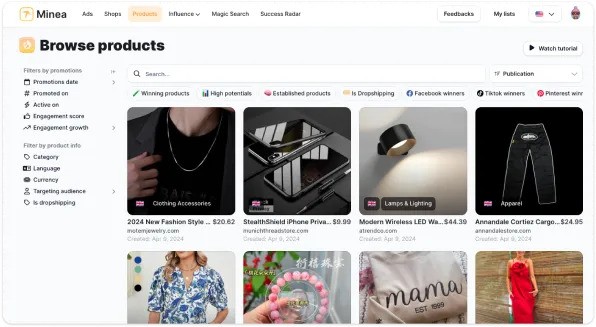
Use Minea to shortlist products with momentum and stable pricing. In the current dataset, products like a posture corrector belt with a trend score of 92 and an LED face mask with a trend score of 88 show strong demand signals.
Check the offer reality. Minea’s snapshot indicates an average product price around $29.99, which anchors your margin math when you build bundles.
Sanity-check fulfillment. Supplier countries in the dataset include China, Turkey, and Vietnam. That matters for shipping time expectations and customer support load.
Move to AdSpy for Meta creative research. Search the product category and the top three pain point hooks.
Translate research into a test plan. Write 3 hook variants, 2 proof variants, and 1 offer structure.
Launch the test in Meta Ads Manager, then come back to Minea to keep scanning for angle shifts and new competitors.
This is the practical case where Minea is not an abstract mention. It is the upstream source of product and angle selection, and AdSpy is the Meta validation layer.


If you are a dropshipper trying to launch your next Meta campaign without wasting your first $200 on weak creatives, AdSpy, a competitor ad spy tool, can feel like a shortcut. AdSpy claims a 197.7M+ searchable Facebook and Instagram ad database, but it also costs $149 per month and stays Meta-only.
Key takeaways: AdSpy is an ad intelligence tool focused on Facebook and Instagram, built for competitor analysis and creative research. Pricing is a flat $149 per month, and accounts have a 100k monthly ad viewer limit. It makes the most sense when you test many angles and need historical Meta ad patterns, not when you run one product and a small budget. If you need TikTok, Google, or YouTube coverage, AdSpy is the wrong tool by design.
What AdSpy does and what it does not do
AdSpy is an ad intelligence database for Facebook and Instagram ads. You use it to search and filter ads by keywords, engagement signals, landing page domains, and creative formats to reverse-engineer competitor angles. It does not manage your campaigns, and it does not show true conversion data like CPA or ROAS.
AdSpy sits in the research layer of digital marketing. It helps you answer one practical question: what creatives are other ecommerce sellers running right now, and what patterns keep showing up over time.
What AdSpy does well in practice:
Finds active and historical Meta ads fast through a large searchable archive.
Lets you filter ads to isolate a specific angle, offer type, or creative style.
Speeds up competitor analysis when you already know what you are looking for.
Where AdSpy is often misunderstood:
It is not a performance dashboard. You are not getting verified results like profit per purchase.
It is not a media buying autopilot. You still build and run tests in Meta Ads Manager.
It is not cross-platform. If your strategy depends on TikTok creatives, AdSpy coverage stops at Meta.
Top 10 Best Facebook Ads of the Day
Every day, new e-commerce businesses launch highly profitable products thanks to effective ads. Take inspiration from them and be the next one 👇
AdSpy database size and coverage in 2026
AdSpy’s core value is breadth and history on Meta. It is positioned as a Facebook and Instagram ad archive with 197.7M+ ads in its searchable database, and that depth helps you spot recurring hooks and offer structures that keep getting recycled by winning stores.
The database scale matters when you do structured creative research. You can pull a list of ads around a product category, then narrow to the exact promise you want to test. For dropshipping, that is usually a pain point hook, a visual demo pattern, and an offer framing.
The coverage trade-off is simple:
If Meta is your main channel, AdSpy’s history is the point.
If you split spend across TikTok and Meta, a Meta-only tool will force blind spots.
Filters and search workflow for competitor analysis
AdSpy works best when you treat it like a query engine, not a feed. Start with one product keyword, then filter by ad type, language, and landing page patterns. Your goal is to isolate repeatable creative mechanics, not copy a single ad.
A practical workflow for a seller at the ad launch step looks like this:
Pick your product and the three angles you will test.
Search each angle as a separate query. Use plain language terms customers use.
Filter out noise by focusing on a few consistent constraints, such as language and ad type.
Save a short list of creatives, then extract what is actually repeatable.
What to extract from an ad so it becomes usable:
Hook type in the first 2 seconds.
Proof mechanism used on screen, such as a demo, a before and after, or social proof.
Offer structure, including bundles and guarantees.
Landing page layout pattern, since it often matches the ad promise.
This is where AdSpy behaves like an ad intelligence tool. The output is not a finished ad. The output is a hypothesis you can test.
Pricing, limits, and what $149 per month buys you
AdSpy has a single flat plan at $149 per month. The two practical constraints most sellers notice are the cost relative to early-stage budgets and the 100k monthly ad viewer limit, which can matter for heavy research workflows.
AdSpy’s pricing is simple to understand and hard to justify for casual use. For many dropshippers, $149 equals a meaningful slice of monthly testing spend.
AdSpy makes financial sense when:
You are running consistent Meta tests every week.
You are launching new products frequently.
You have a repeatable process where research directly improves creative quality.
AdSpy is usually a bad buy when:
You are learning Meta Ads basics and only need a few examples.
You run one store and you do not test new offers regularly.
You need multi-platform intelligence more than deep Meta history.
Interface and support realities
AdSpy is functional, but it is not known for a modern interface. Reviewers in 2026 report a dated experience and slow support, especially around billing and cancellation, which creates operational risk if you rely on it during tight launch windows.
For an ecommerce operator, support speed is not a cosmetic detail. If you cannot resolve billing access issues quickly, your research workflow breaks at the exact moment you need it.
How to reduce risk if you subscribe:
Treat the first week as an onboarding sprint. Build saved searches and export a research library you can reuse.
Keep documentation of subscription and billing actions in one place.
Make sure you understand what counts as an ad view in your workflow so you do not burn the 100k viewer limit unintentionally.
Minea
Reach $1,000 per day or get your money back
Is $20 a day enough for Facebook ads when you use AdSpy
A $20 per day Meta budget can work for disciplined testing, but it leaves little room for wasted creative iterations. AdSpy helps only if it improves your first-round creative quality and targeting hypotheses so you spend fewer days testing weak hooks.
At $20 per day, you are not buying massive data volume. You are buying learning cycles. The core tactic is to compress each test into a clear pass or fail decision.
A simple structure that fits low budgets:
Test 2 to 3 angles per product, not 10.
Keep the ad format consistent so you are isolating the hook and offer.
Run short tests with tight criteria, then kill losers fast.
AdSpy can support this by helping you avoid obviously saturated angles. It cannot create budget efficiency by itself. Budget efficiency comes from decisions in Meta Ads Manager.
Accuracy and ethics of ad intelligence tools
Ad intelligence tools like AdSpy are accurate for what they capture, which is the ad itself, its creative, and metadata signals. They are not accurate for what sellers actually care about, which is profit and conversion efficiency, since those metrics are not exposed publicly.
Competitor analysis has an ethical line. Watching the market is normal. Directly cloning a competitor’s creative crosses into brand risk and account risk.
A safe and effective way to use AdSpy:
Borrow mechanics, not identities. Copy the structure of a demo, not a brand’s exact script.
Use AdSpy to validate demand signals and angle frequency, not to steal.
Keep differentiation in your product page, offer, and fulfillment experience.
This is also where ad intelligence becomes a real digital marketing craft. The tool shows you patterns. You still have to build something that fits your store.
A dropshipping workflow that combines Minea and AdSpy
The fastest workflow is to use Minea to identify what is trending and which angles are gaining traction, then use AdSpy to validate how sellers package those angles on Meta. You finish by launching clean tests in Meta Ads Manager with fewer creative blind spots.
Here is a concrete weekly loop for a seller in the ad launch step:
Use Minea to shortlist products with momentum and stable pricing. In the current dataset, products like a posture corrector belt with a trend score of 92 and an LED face mask with a trend score of 88 show strong demand signals.
Check the offer reality. Minea’s snapshot indicates an average product price around $29.99, which anchors your margin math when you build bundles.
Sanity-check fulfillment. Supplier countries in the dataset include China, Turkey, and Vietnam. That matters for shipping time expectations and customer support load.
Move to AdSpy for Meta creative research. Search the product category and the top three pain point hooks.
Translate research into a test plan. Write 3 hook variants, 2 proof variants, and 1 offer structure.
Launch the test in Meta Ads Manager, then come back to Minea to keep scanning for angle shifts and new competitors.
This is the practical case where Minea is not an abstract mention. It is the upstream source of product and angle selection, and AdSpy is the Meta validation layer.
If you are a dropshipper trying to launch your next Meta campaign without wasting your first $200 on weak creatives, AdSpy, a competitor ad spy tool, can feel like a shortcut. AdSpy claims a 197.7M+ searchable Facebook and Instagram ad database, but it also costs $149 per month and stays Meta-only.
Key takeaways: AdSpy is an ad intelligence tool focused on Facebook and Instagram, built for competitor analysis and creative research. Pricing is a flat $149 per month, and accounts have a 100k monthly ad viewer limit. It makes the most sense when you test many angles and need historical Meta ad patterns, not when you run one product and a small budget. If you need TikTok, Google, or YouTube coverage, AdSpy is the wrong tool by design.
What AdSpy does and what it does not do
AdSpy is an ad intelligence database for Facebook and Instagram ads. You use it to search and filter ads by keywords, engagement signals, landing page domains, and creative formats to reverse-engineer competitor angles. It does not manage your campaigns, and it does not show true conversion data like CPA or ROAS.
AdSpy sits in the research layer of digital marketing. It helps you answer one practical question: what creatives are other ecommerce sellers running right now, and what patterns keep showing up over time.
What AdSpy does well in practice:
Finds active and historical Meta ads fast through a large searchable archive.
Lets you filter ads to isolate a specific angle, offer type, or creative style.
Speeds up competitor analysis when you already know what you are looking for.
Where AdSpy is often misunderstood:
It is not a performance dashboard. You are not getting verified results like profit per purchase.
It is not a media buying autopilot. You still build and run tests in Meta Ads Manager.
It is not cross-platform. If your strategy depends on TikTok creatives, AdSpy coverage stops at Meta.
Minea
Top 10 Best Facebook Ads of the Day
Every day, new e-commerce businesses launch highly profitable products thanks to effective ads. Take inspiration from them and be the next one 👇
AdSpy database size and coverage in 2026
AdSpy’s core value is breadth and history on Meta. It is positioned as a Facebook and Instagram ad archive with 197.7M+ ads in its searchable database, and that depth helps you spot recurring hooks and offer structures that keep getting recycled by winning stores.
The database scale matters when you do structured creative research. You can pull a list of ads around a product category, then narrow to the exact promise you want to test. For dropshipping, that is usually a pain point hook, a visual demo pattern, and an offer framing.
The coverage trade-off is simple:
If Meta is your main channel, AdSpy’s history is the point.
If you split spend across TikTok and Meta, a Meta-only tool will force blind spots.
Filters and search workflow for competitor analysis
AdSpy works best when you treat it like a query engine, not a feed. Start with one product keyword, then filter by ad type, language, and landing page patterns. Your goal is to isolate repeatable creative mechanics, not copy a single ad.
A practical workflow for a seller at the ad launch step looks like this:
Pick your product and the three angles you will test.
Search each angle as a separate query. Use plain language terms customers use.
Filter out noise by focusing on a few consistent constraints, such as language and ad type.
Save a short list of creatives, then extract what is actually repeatable.
What to extract from an ad so it becomes usable:
Hook type in the first 2 seconds.
Proof mechanism used on screen, such as a demo, a before and after, or social proof.
Offer structure, including bundles and guarantees.
Landing page layout pattern, since it often matches the ad promise.
This is where AdSpy behaves like an ad intelligence tool. The output is not a finished ad. The output is a hypothesis you can test.
Pricing, limits, and what $149 per month buys you
AdSpy has a single flat plan at $149 per month. The two practical constraints most sellers notice are the cost relative to early-stage budgets and the 100k monthly ad viewer limit, which can matter for heavy research workflows.
AdSpy’s pricing is simple to understand and hard to justify for casual use. For many dropshippers, $149 equals a meaningful slice of monthly testing spend.
AdSpy makes financial sense when:
You are running consistent Meta tests every week.
You are launching new products frequently.
You have a repeatable process where research directly improves creative quality.
AdSpy is usually a bad buy when:
You are learning Meta Ads basics and only need a few examples.
You run one store and you do not test new offers regularly.
You need multi-platform intelligence more than deep Meta history.
Interface and support realities
AdSpy is functional, but it is not known for a modern interface. Reviewers in 2026 report a dated experience and slow support, especially around billing and cancellation, which creates operational risk if you rely on it during tight launch windows.
For an ecommerce operator, support speed is not a cosmetic detail. If you cannot resolve billing access issues quickly, your research workflow breaks at the exact moment you need it.
How to reduce risk if you subscribe:
Treat the first week as an onboarding sprint. Build saved searches and export a research library you can reuse.
Keep documentation of subscription and billing actions in one place.
Make sure you understand what counts as an ad view in your workflow so you do not burn the 100k viewer limit unintentionally.
Minea
Reach $1,000 per day or get your money back
Is $20 a day enough for Facebook ads when you use AdSpy
A $20 per day Meta budget can work for disciplined testing, but it leaves little room for wasted creative iterations. AdSpy helps only if it improves your first-round creative quality and targeting hypotheses so you spend fewer days testing weak hooks.
At $20 per day, you are not buying massive data volume. You are buying learning cycles. The core tactic is to compress each test into a clear pass or fail decision.
A simple structure that fits low budgets:
Test 2 to 3 angles per product, not 10.
Keep the ad format consistent so you are isolating the hook and offer.
Run short tests with tight criteria, then kill losers fast.
AdSpy can support this by helping you avoid obviously saturated angles. It cannot create budget efficiency by itself. Budget efficiency comes from decisions in Meta Ads Manager.
Accuracy and ethics of ad intelligence tools
Ad intelligence tools like AdSpy are accurate for what they capture, which is the ad itself, its creative, and metadata signals. They are not accurate for what sellers actually care about, which is profit and conversion efficiency, since those metrics are not exposed publicly.
Competitor analysis has an ethical line. Watching the market is normal. Directly cloning a competitor’s creative crosses into brand risk and account risk.
A safe and effective way to use AdSpy:
Borrow mechanics, not identities. Copy the structure of a demo, not a brand’s exact script.
Use AdSpy to validate demand signals and angle frequency, not to steal.
Keep differentiation in your product page, offer, and fulfillment experience.
This is also where ad intelligence becomes a real digital marketing craft. The tool shows you patterns. You still have to build something that fits your store.
A dropshipping workflow that combines Minea and AdSpy
The fastest workflow is to use Minea to identify what is trending and which angles are gaining traction, then use AdSpy to validate how sellers package those angles on Meta. You finish by launching clean tests in Meta Ads Manager with fewer creative blind spots.
Here is a concrete weekly loop for a seller in the ad launch step:
Use Minea to shortlist products with momentum and stable pricing. In the current dataset, products like a posture corrector belt with a trend score of 92 and an LED face mask with a trend score of 88 show strong demand signals.
Check the offer reality. Minea’s snapshot indicates an average product price around $29.99, which anchors your margin math when you build bundles.
Sanity-check fulfillment. Supplier countries in the dataset include China, Turkey, and Vietnam. That matters for shipping time expectations and customer support load.
Move to AdSpy for Meta creative research. Search the product category and the top three pain point hooks.
Translate research into a test plan. Write 3 hook variants, 2 proof variants, and 1 offer structure.
Launch the test in Meta Ads Manager, then come back to Minea to keep scanning for angle shifts and new competitors.
This is the practical case where Minea is not an abstract mention. It is the upstream source of product and angle selection, and AdSpy is the Meta validation layer.
Who should buy AdSpy in 2026?

AdSpy is worth considering if you are an intermediate or advanced ecommerce advertiser who runs Meta every week and relies on social media ads to scale. It is not a beginner tool, and it is not a general ad research solution for multi-platform stacks.
AdSpy is a good fit for:
Dropshippers scaling on Facebook and Instagram who need constant creative inspiration grounded in real ads.
Agencies and media buyers who do competitor analysis across many clients and niches.
Sellers who frequently relaunch products and need historical context on what angles have already been exploited.
AdSpy is a poor fit for:
Sellers who mainly run TikTok or Google.
Budget-limited beginners who need education more than depth.
Teams that need modern collaboration workflows and fast support.
AdSpy alternatives if you need broader coverage
The best alternative to AdSpy depends on why you are leaving. If you need a free starting point, BigSpy is often used as an entry option for ad research. If you need multi-platform coverage, you should prioritize tools that cover TikTok and other channels, since AdSpy is Meta-only.
A practical way to pick an alternative without wasting another month:
Write down the channels you must cover, starting with TikTok if it drives your growth.
Decide whether you need deep history or just current creatives.
Decide whether you need landing page tracking, keyword search, or creator-style ad discovery.
AdSpy’s edge is depth on Meta. Alternatives win when you need breadth, cost flexibility, or a more modern UX.
Verdict
AdSpy is a strong Meta ad intelligence tool with a huge historical archive, but it is priced like a professional tool. If you are running consistent Facebook and Instagram tests, it can pay for itself by improving creative direction and cutting wasted iterations. If you are under-resourced or multi-platform, you should skip it and put the money into testing and production.
If you only test one approach this month, use AdSpy to extract three proven creative mechanics in your niche, then build original ads around those mechanics. Treat it as a research engine, not a copy machine.
FAQ
Is AdSpy worth the money
AdSpy can be worth it if you run Meta ads weekly and you use competitor analysis to shape your creative tests. At $149 per month, the value comes from reducing wasted ad spend and shortening your learning cycles. If you run occasional campaigns or you need TikTok data, the ROI is usually negative.
How much is AdSpy per month
AdSpy pricing is $149 per month on a flat plan. The cost is easy to forecast, but it is expensive for early-stage dropshipping budgets. You should evaluate it against your monthly testing spend and your ability to turn research into new creative iterations.
What does AdSpy do
AdSpy is an ad intelligence database for Facebook and Instagram. It lets you search and filter social media ads for competitor analysis, then extract patterns in hooks, offers, and landing pages. It does not provide true performance metrics like ROAS because those are not public.
What kind of ads can you find with AdSpy
You can find Facebook and Instagram ads across niches and regions, including video, image, and carousel formats. The practical use is to see how ecommerce sellers position products, structure offers, and build proof inside the creative. Use it to study mechanics, then produce original ads.
Does AdSpy offer a free trial
Many sellers look for a free trial to reduce risk, but AdSpy is primarily positioned as a paid subscription tool. Before subscribing, decide the exact research workflow you will run in week one so you can extract value quickly.
What is the best AdSpy tool
The best tool depends on your channel mix. If your entire growth engine is Facebook and Instagram, AdSpy’s database depth is the main advantage. If you need multi-platform ad intelligence across TikTok and other networks, a Meta-only tool will not fit your workflow.
Related Minea resources
If you are building a repeatable ad launch process, pair product research with competitor analysis and structured creative testing. Use Minea to shortlist products and angles, then use AdSpy to validate Meta creative patterns before you spend your first testing dollars.
Minea workflow overview: Find winning products and angles, then launch tests
How to structure a Meta creative test plan for ecommerce sellers
How to evaluate a product price point around the $29.99 range and protect margin
Disclosure
This article was written for ecommerce sellers evaluating ad intelligence tools for competitor analysis and creative research. This AdSpy review focuses on Meta ad research workflows used by dropshipping and ecommerce teams.
Similar articles

Facebook Ads Library for Dropshipping: How to Search, Filter, and Steal Better Angles (2026)
Competitor Spy Tools
Facebook Ads Library for Dropshipping: How to Search, Filter, and Steal Better Angles (2026)
Competitor Spy Tools
Facebook Ads Library for Dropshipping: How to Search, Filter, and Steal Better Angles (2026)
Competitor Spy Tools
Facebook Ads Library for Dropshipping: How to Search, Filter, and Steal Better Angles (2026)
Competitor Spy Tools




Our Free Adspys

Find winning products on our Tiktok adspy today!
Find winning products on our Facebook adspy today!
Find winning products on our Tiktok adspy today!
Find winning products on our Facebook adspy today!
Find winning products on our Tiktok adspy today!
Find winning products on our Facebook adspy today!
Find winning products on our Tiktok adspy today!
Find winning products on our Facebook adspy today!
1 winning product everyday.
Follow us!






Find out more
Read more
Minea © 2026
Find out more
Read more
Minea © 2026
Find out more
Read more
Minea © 2026
Find out more
Read more
Minea © 2026
Find out more
Read more
Minea © 2026
Find out more
Read more
Minea © 2026