
Explore our other topics
Contents
How to Find Competitors' Websites for Dropshipping Intelligence (2026)
You're running a dropshipping store and watching competitors move faster. They launch products you haven't seen, run ads you wish you'd thought of first, and somehow always know what's trending before you do. The gap isn't luck, it's competitive intelligence.
This guide shows you how to find every competitor in your niche, from zero to actionable intel, in under 30 minutes. You'll learn which tools find hidden competitors, how to analyze their traffic sources, and how to spot their winning products before the market gets saturated.
What You'll Achieve: A complete list of 10-15 direct competitors in your niche with traffic estimates; Insight into their best-performing products and ad creatives; Their supplier sources and pricing strategies; A competitor monitoring system you can replicate weekly; Time: 25-30 minutes for initial research; Cost: Free tools + optional $49/mo for Minea Premium; Skill level: Beginner to Intermediate
Before You Start: What You Need
You need three things: a defined niche (not "general store"), 20 minutes of focused time, and optionally a Minea account to analyze competitor ads. Free tools cover 80% of discovery; paid tools unlock ad intelligence.
Here's your checklist:
A clear niche focus: "fitness gadgets" beats "everything." Competitor research only works when you know who competes for your exact customer.
Browser with incognito mode: Avoid personalized search results that hide real SERP competitors.
Spreadsheet or note app: You'll capture 10-15 competitor URLs, traffic estimates, and product categories.
Minea account (optional): $49/mo Premium unlocks ad spy for competitor creatives. Free tier shows limited data.
Your own store URL: Some tools (Semrush Competitor Finder, SimilarWeb) work best when you input YOUR domain to find similar sites.
If you don't have a live store yet, use a competitor's domain you already know as the starting point.
What if we went even further?
Discover all our related articles and resources


Step 1: Identify Your Top 5 SERP Competitors

Start with Google organic results for your target products. The sites ranking for your keywords are already stealing your traffic. This 5-minute step costs nothing and reveals who Google sees as relevant in your space.
Time: 5 minutes
Cost: Free
Tool: Google Search (incognito mode)
Open an incognito browser window. Search for 3-5 product keywords you want to rank for. Examples:
"posture corrector back brace"
"portable blender for smoothies"
"LED face mask skincare"
Scroll past the ads. Look at positions 1-10 in organic results. Ignore Amazon, eBay, AliExpress, and marketplace aggregators, you're hunting single-brand Shopify dropshippers or DTC stores.
What to capture:
Domain name (e.g.,
example-posture.com)What they sell (general fitness or niche-specific)
Whether they're ranking with blog content, product pages, or landing pages
Repeat for all 3-5 keywords. You'll see overlap, some stores rank for multiple terms. That's your shortlist.
Common mistake: Searching only one keyword. Different product angles attract different competitors. "Best posture corrector" surfaces review sites; "buy posture corrector online" surfaces stores. Search both.
Step 2: Use a Free Competitor Finder Tool
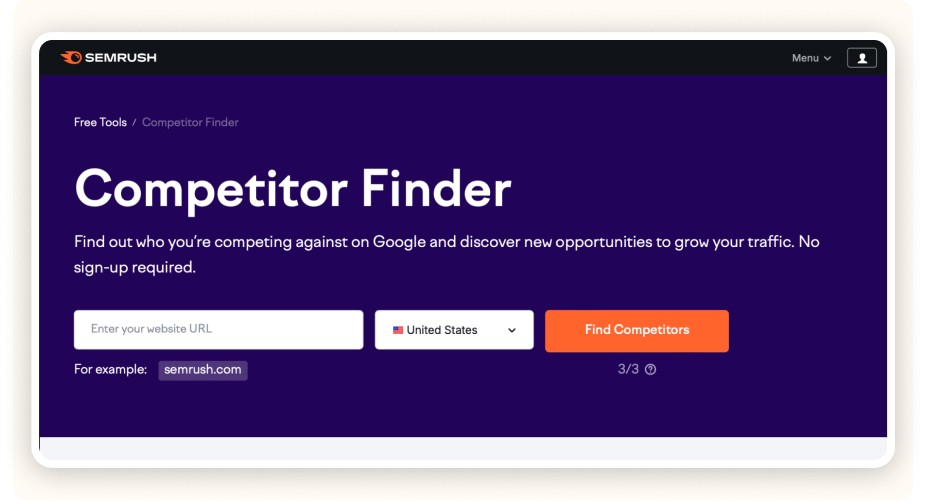
Free tools like Semrush's Competitor Finder or Competitors.app reveal sites you DIDN'T find in Google, stores ranking in other countries, running only paid ads, or targeting adjacent keywords. This step takes 8 minutes and often doubles your competitor list.
Time: 8 minutes
Cost: Free (limited results)
Tool: Semrush Competitor Finder or Competitors.app
Go to semrush.com/free-tools/competitor-finder/ or competitors.app/competitor-finder/. Enter one competitor domain from Step 1—or your own store URL if live.
The tool returns 5-15 similar sites based on:
Shared keyword rankings
Similar traffic patterns
Overlapping backlink profiles
Audience demographics
What to look for:
Traffic estimate (aim for competitors with 5K-100K monthly visits, big enough to validate demand, small enough to compete with)
Geographic focus (US, UK, EU stores operate differently)
Traffic sources (organic-heavy = SEO game; paid-heavy = they're spending on ads)
Export or copy the top 10 results into your spreadsheet.
Minea Insight: Before moving on, cross-check these domains in Minea's Ad Spy. Filter by "domain" and paste each competitor URL. Minea shows which ones are actively running Facebook or TikTok ads. If a competitor has 40+ active creatives, they're scaling, worth deeper analysis.
Common mistake: Assuming high-traffic sites are better competitors to study. A site doing 200K visits/month is either a media blog or an established brand, neither helps you model a new dropshipping store. Target 10K-50K monthly traffic for realistic playbooks.
Step 3: Analyze Competitor Traffic with SimilarWeb
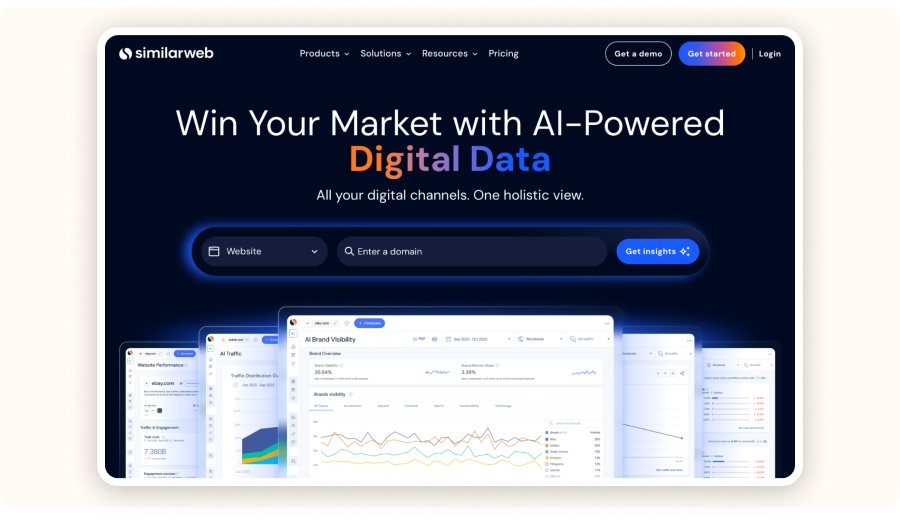
SimilarWeb reveals WHERE competitor traffic comes from, organic search, paid ads, social, email, or direct. This step (7 minutes) tells you which marketing channel to prioritize based on what's already working in your niche.
Time: 7 minutes
Cost: Free (basic data)
Tool: SimilarWeb
Visit similarweb.com. Enter each competitor domain from your list (start with the 3-5 highest-traffic sites to save time).
Navigate to the "Traffic Sources" tab. You'll see a breakdown:
Direct: Returning customers or brand searches
Organic Search: SEO-driven traffic
Paid Search: Google Ads
Social:Facebook, Instagram, TikTok, Pinterest referrals
Referrals: Backlinks from blogs, influencers, or review sites - Email: Newsletter clicks (often underreported)
What to extract:
If organic dominates (60%+), the competitor wins via SEO. Study their blog, product page titles, and URL structure.
If paid search is 30%+, they're bidding on keywords. Use SpyFu (Step 4) to steal their keyword list.
If social is 40%+, they're crushing influencers or paid social. Use Minea (Step 5) to see exact creatives.
Log the dominant traffic source for each competitor. Patterns emerge, if 8 out of 10 competitors rely on TikTok traffic, that's your channel signal.
Common mistake: Trusting SimilarWeb's absolute traffic numbers. The tool estimates; real numbers can vary ±30%. Use SimilarWeb for RATIOS (traffic source %) not totals.
What if we went even further?
Discover all our related articles and resources
Step 4: Uncover Competitor Keywords with SpyFu
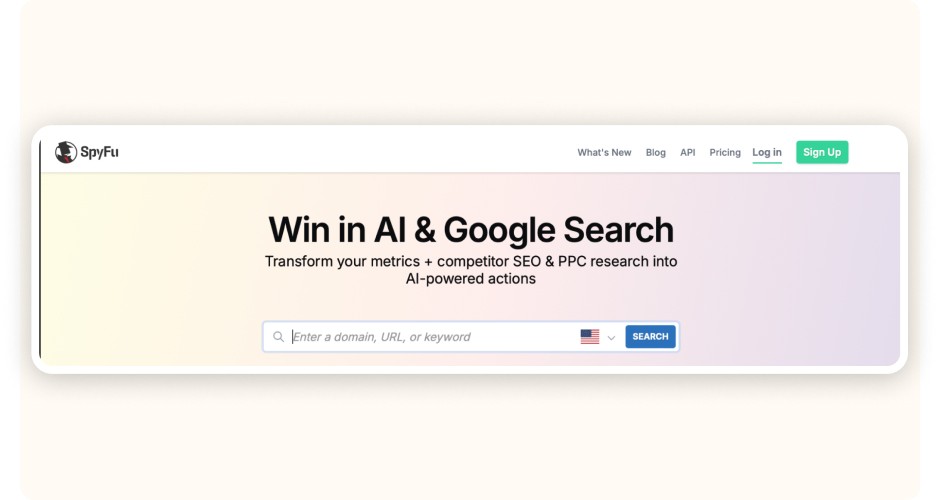
SpyFu reveals every keyword your competitors rank for organically AND every keyword they've ever bought in Google Ads. This 6-minute step costs nothing for basic results and exposes gaps, keywords they rank for that you don't.
Time: 6 minutes
Cost: Free (10 results per search) or $39/mo for full data
Tool: SpyFu
Go to spyfu.com. Enter a competitor domain. Click "SEO Research" for organic keywords or "PPC Research" for paid keywords.
Organic keywords tab:
Sort by "Ranking" to see their top 10 positions
Filter by search volume >500/month to ignore long-tail noise
Look for product keywords (e.g., "posture corrector for desk workers") vs. informational keywords ("how to fix posture")
PPC keywords tab:
Shows every Google Ads keyword they're bidding on
Displays ad copy they've tested (steal headline formulas)
Indicates how long they've been running each campaign
What to do: Download or note 10-15 high-volume keywords they rank for that YOU don't. Those are your content gaps. Also note 5-10 PPC keywords, if they're paying for clicks, conversion intent is validated.
Minea Insight: SpyFu shows Google keyword intent. Minea shows social proof. Combine them: if a competitor ranks for "portable blender" (SpyFu) AND runs 20 TikTok ads for portable blenders (Minea), you've found a validated product angle. Test it.
Common mistake: Copying their entire keyword list. Focus on keywords with 1K-10K monthly volume where they rank in positions 1-5. Competing for position 47 keywords wastes time.
Step 5: Spy on Competitor Ads with Minea
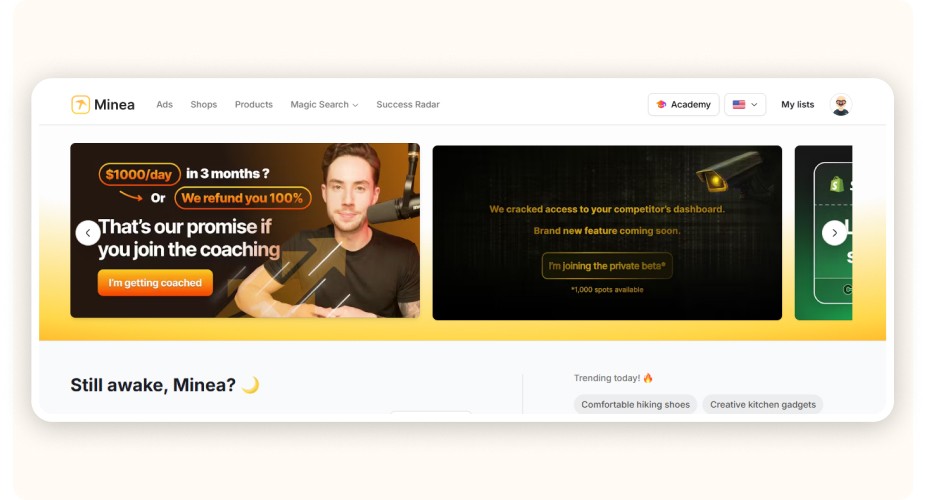
Minea's Ad Spy reveals every Facebook and TikTok ad your competitors are running, creatives, copy, engagement, and how long each ad has been live. This is the step dropshippers skip and regret. It takes 8 minutes and exposes exactly which products competitors are pushing hardest.
Time: 8 minutes
Cost: $49/mo Minea Premium (or free tier with 3 daily searches)
Tool: Minea Ad Spy
Log into Minea. Navigate to "Ad Spy." Instead of searching by keyword, use the domain filter. Paste a competitor's store URL.
Minea returns all active and recently paused ads from that domain across Facebook and TikTok.
What to analyze:
Metric | What it tells you | Action |
|---|---|---|
Creatives count | 50+ ads = aggressive scaling; 5-10 ads = testing phase | Prioritize competitors with 20-50 ads, proven but not saturated |
Engagement velocity | Likes/comments growing daily = winning creative | Save these ads. Study hook, offer, and CTA structure |
Ad lifespan | Running 30+ days = profitable (they wouldn't pay for a losing ad that long) | Test similar angles for your products |
Product focus | 80% of ads feature the same 2-3 products = hero products | Those products validated demand. Source similar items |
Click into individual ads. Minea shows:
Full video or image creative (download it for swipe file)
Ad copy and CTA - Landing page URL (visit it to see funnel and pricing
Engagement stats and comments (read comments for objections)
Real example: A competitor in the fitness niche runs 47 active TikTok ads. Minea shows 38 of them feature a posture corrector belt, all using UGC-style "I tried this for 30 days" hooks. Ad lifespan averages 22 days. Engagement velocity shows 150+ likes/day growth.
Translation: That posture corrector is their winner. The UGC angle works. You can test the same product category with a different hook or slight product variation (different color, bundle offer).
Common mistake: Saving every ad you see. Focus on ads running 15+ days with rising engagement. One-week ads are often tests that failed. Don't replicate failures.
Step 6: Map Competitor Suppliers and Pricing

Knowing WHAT competitors sell means nothing if you can't source it profitably. This final 5-minute step reveals their suppliers (AliExpress, CJ Dropshipping, or private agents) and pricing strategy. You'll know if you can compete on margin.
Time: 5 minutes
Cost: Free
Tool: Google Reverse Image Search + AliExpress
Pick 3-5 best-selling products you identified in Step 5 (via Minea ad frequency). Visit the competitor's product page. Right-click the product image. Select "Search image with Google."
Google returns visually similar listings. You'll see:
The same product on AliExpress (that's their supplier)
Variations on Amazon or eBay (ignore these)
Other dropshipping stores selling it (more competitors)
Open the AliExpress listing. Note:
Supplier price (often $8-$15 for gadgets)
Shipping time(15-30 days standard; 7-10 days with ePacket or AliExpress Standard)
Supplier rating (4.8+ stars with 500+ orders = reliable)
Now compare to competitor retail price. Standard dropshipping markup is 2.5-3x. If AliExpress shows $12 and competitor sells at $39.99, margin checks out. If competitor sells at $24.99, they're either using a cheaper agent or accepting thin margins for volume.
What to do: Log supplier cost, competitor retail price, and estimated margin for each product. If you can't match their pricing with 40%+ margin after ad spend, skip that product.
Minea Insight: Use Minea's "Shop Analysis" feature (Premium plan) to see competitor revenue estimates. If a store runs $2K/day in ad spend (visible via ad volume and lifespan), and Minea estimates $8K/day revenue, their margin math works. Model your pricing similarly.
Common mistake: Assuming competitors source from the first AliExpress result you find. Top dropshippers often use private agents (1688.com, CJ Dropshipping, Spocket) for better prices and faster shipping. If competitor pricing seems impossible, they're not using AliExpress, don't compete on price, compete on speed or branding.
What if we went even further?
Discover all our related articles and resources
Common Mistakes (and How to Fix Them)

Most dropshippers find competitors but analyze them wrong. These three mistakes waste hours and lead to bad product decisions. Each one has a 2-minute fix.
Studying competitors outside your traffic tier:
You find a store doing 500K visits/month and copy their strategy. Problem: they have brand equity, email lists, and influencer deals you don't. Their playbook won't work at your 2K visits/month stage.
How to fix? Filter for competitors with 5K-50K monthly visits (SimilarWeb). Their tactics scale to your level.
Ignoring ad lifespan in Minea:
You save 30 competitor ads without checking how long they've been running. Half are 3-day tests that failed.
How to fix? In Minea, filter ads by "First seen" and "Last seen." Only study ads running 15+ days. Anything shorter is unvalidated.
Assuming product success = product quality:
You see a competitor's product with 10K orders on AliExpress and assume it's a winner. Then you test it and get a 2% conversion rate. Why? The competitor isn't selling the product, they're selling the OFFER (bundle, scarcity, guarantee).
How to fix? When analyzing competitors, screenshot their product page structure, not just the product. Copy offers framing, urgency tactics, and guarantee language. Same product, better offer = better conversion.
Expected Results + Timeline
Competitive intelligence isn't one-and-done. Expect these milestones as you integrate this into your workflow.
Timeframe | What to Expect | Benchmark |
|---|---|---|
Day 1 | Complete first competitor audit for 10-15 sites | 2-3 hours total work |
Week 1 | Identify 3-5 product opportunities based on competitor ad frequency and margins | Test budget: $50-$100 per product |
Week 2-4 | Launch test ads using competitor-validated angles and offers | Expect 0.8-2% CTR if angle is proven |
Month 2 | Refine winning products; add 2-3 new competitors monthly to monitor | Conversion rate improves 15-30% using competitor offer structures |
Most dropshippers test 8-12 competitor-sourced products before finding a repeatable winner. Don't judge this process by your first product test, judge it after 10 tests with competitor-validated angles.
Verdict
Learning how to find competitors' websites isn't optional for serious dropshippers, it's the shortcut to validated products, proven ad angles, and pricing models that actually convert. Start with free tools like Google, Semrush's Competitor Finder, and SimilarWeb for traffic intelligence. Add Minea Premium if you want to see exact ad creatives and product focus. Run this audit monthly, not once. Competitors launch new winners constantly; your intel should stay current.
What next? pick your top 3 competitors from this research and build a tracking spreadsheet. Monitor their new products weekly using Minea's "New Ads" filter and Google Alerts for their domain. Competitive intelligence is a system, not a one-time project.
FAQ
How to find competitors of any website?
Use Semrush's Competitor Finder or Competitors.app. Enter the domain and the tool returns 10-20 sites with similar keyword rankings and traffic patterns. For deeper analysis, use SimilarWeb to see traffic sources and SpyFu for keyword overlaps. Minea adds social ad intelligence if the site runs Facebook or TikTok campaigns.
Can ChatGPT do a competitor analysis?
ChatGPT can't access live competitor data like traffic stats, active ads, or current keyword rankings. It generates analysis frameworks and suggests tools, but you still need SpyFu, SimilarWeb, or Minea to pull real data. Use ChatGPT to summarize findings or structure reports after you've gathered the raw intelligence.
How to find out a company's competitors?
Start with Google searches for their main product keywords to identify SERP competitors. Then use Semrush or SimilarWeb to find sites with overlapping audiences and traffic sources. For e-commerce stores, Minea's Ad Spy reveals competitors running similar product ads on social platforms. Cross-reference all three sources for a complete list.
What is the competitor find tool?
Competitor finder tools identify similar websites based on shared keywords, traffic patterns, or audience demographics. Semrush Competitor Finder and Competitors.app analyze SEO and organic data. SimilarWeb adds traffic source breakdowns. Minea focuses on paid social ad competitors. Use multiple tools, each catches competitors the others miss.
Disclosure:
This article is published by Minea, an ad spy and product research platform for dropshipping and e-commerce. Minea provides the Ad Spy, Shop Analysis, and Success Radar features referenced in this guide.
What if we went even further?
Discover all our related articles and resources