Minea vs Atria: Which Solution Should You Choose Based on Your Needs?
Comparative Market Analysis Tools
Author: Prince
Contents
When comparing Minea vs Atria, it’s important to understand one thing: they both operate in ads intelligence, but not for the same purpose.
Minea is built for product research, offer validation, and ecommerce monitoring. Its goal is to help you identify real opportunities fast. Atria, on the other hand, focuses more on creative workflow, ad exploitation, and AI-assisted asset production and organization.
So which one should you choose?
If your priority is finding and validating ecommerce products or offers, go with Minea.
If your goal is to industrialize your ad creation and organize your creative production using AI, Atria may be a better fit.
In short, Minea vs Atria comes down to your current bottleneck: opportunity discovery or creative execution.
Quick Verdict: Which One Should You Choose?
Minea or Atria?
Choose Minea if you need to figure out what to sell and validate it quickly. It’s the most useful tool when your priority is deciding what to test, product, offer, or angle, before spending money on ads.
Choose Atria if your main issue is creative production. If you want to organize your ads, develop new angles, generate more variations, and structure a real AI-powered creative workflow, it becomes a strong ally.
If you can only keep one tool for dropshipping, choose Minea. Why? Because in ecommerce performance, identifying a profitable opportunity always comes before scaling creative production.
That’s the core difference in Minea vs Atria: validation first, creation second.
Quick Comparison Between Minea and Atria
Here’s a clear snapshot to help you decide in the Minea vs Atria comparison:
Criteria | Minea | Atria |
|---|---|---|
Primary Goal | Find and validate ecommerce opportunities (product/offer/angle) | Structure and accelerate creative production (ads + AI) |
Most Profitable For | Beginners, solo ecommerce entrepreneurs, performance teams testing offers | Creative teams, agencies, brands with high content volume |
#1 Strength | Fast decision-making on what to test (upstream logic) | Creative workflow + AI to produce and iterate assets |
#2 Strength | Ecommerce-focused monitoring and performance analysis | Ad organization, inspiration tracking, industrialized creative process |
Main Weakness | Less adapted if your only need is creative ops | Less adapted if your #1 need is finding and validating a profitable offer |
Learning Curve | Fast if you follow a validation process | Fast for creative use, but can become dense (workflow, credits, team structure) |
Time-to-Value | Very fast to identify testable opportunities | Very fast to produce usable creative variations |
Typical Use Case | Find a product/offer to test this week | Produce 20 angle/hook variations for a validated offer |
Risk If Misused | Watching ads without a structured validation method | Producing too many creatives for a weak or unvalidated offer |
Quick Recommendation | If choosing 1 ecommerce performance tool: start with Minea | If your bottleneck is creative production and organization: choose Atria |
This table clarifies the strategic gap in Minea vs Atria: one helps you decide what to test, the other helps you scale how you present it.

Feature Comparison: Minea vs Atria
Opportunity Research and Discovery
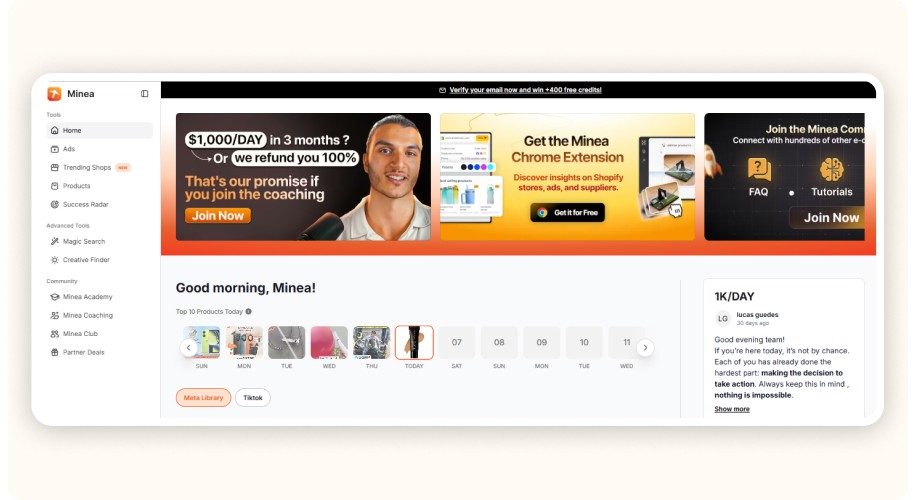
If you want to find a profitable opportunity, start by asking yourself: what do you need to test right now product, offer, or angle with strong enough signals to avoid random bets?
With Minea, you operate upstream. The goal is to reduce uncertainty and turn market signals into concrete actions. In the Minea vs Atria debate, this is where Minea clearly leads.
You mainly rely on:
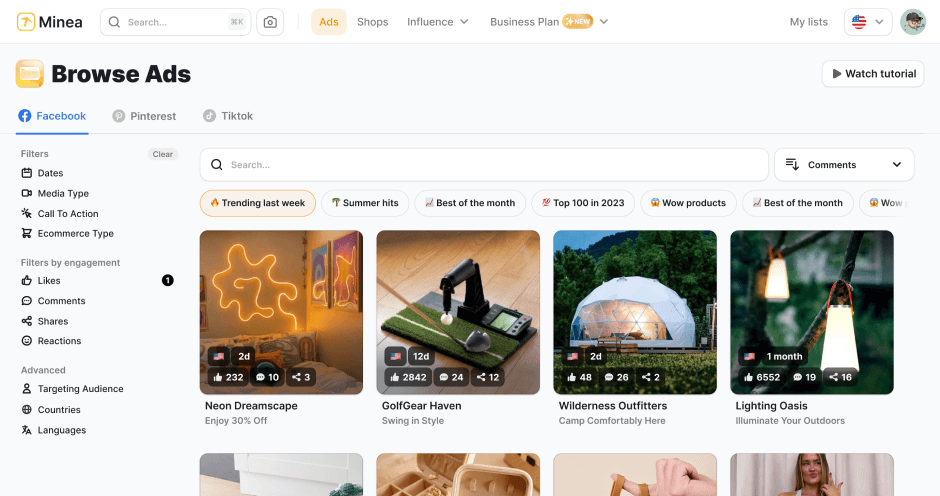
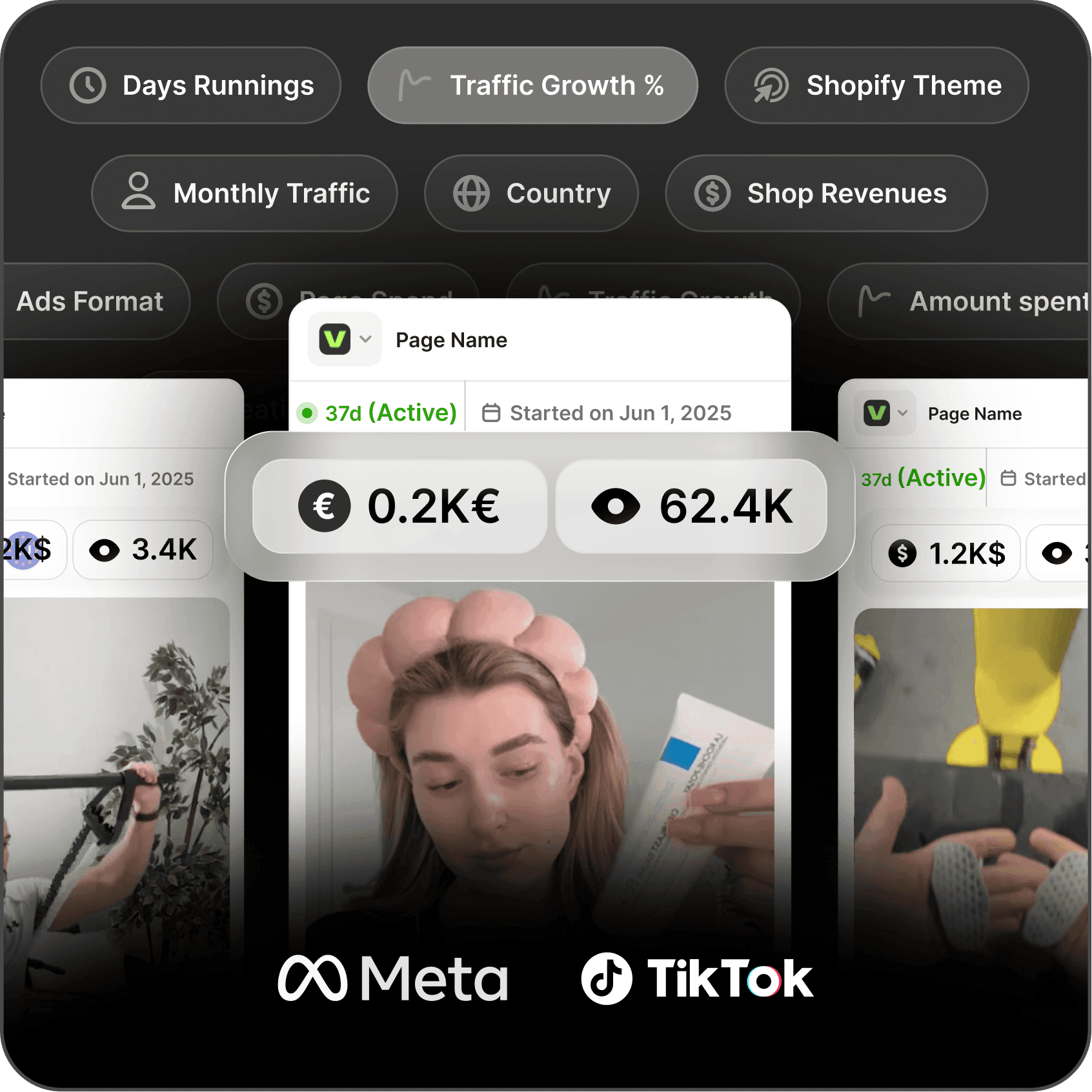
Ads Library (Meta/Facebook, TikTok, Pinterest) to identify performing ads, filter by country, date, format, store, or product type, then save and monitor creatives.
AI Magic Search to run product or angle research based on intent keywords and get relevant results without starting from scratch.
Success Radar (Business plan) to automatically detect trending products and monitor their evolution over time.
Trending Shops (Shopify) to analyze competitor stores (featured products, creatives, traffic sources) and understand why they convert.
AliExpress supplier search directly from product pages to accelerate sourcing validation.
Its biggest strength is discovery plus validation. You save time during selection and avoid spreading yourself too thin.
However, if your only need is a dedicated creative workspace to produce and organize dozens of assets, Minea is less adapted—even when compared in contexts like minea vs foreplay—though its Ads Library remains powerful for inspiration.
With Atria, the logic is more creative-first. In the Minea vs Atria comparison, Atria becomes relevant if you already have a validated offer and need to scale creative output:
Generate new angle ideas
Structure a creative workflow
Produce variations faster
Organize ads and AI-assisted iterations
The risk? If you lack a structured product validation method, you may stay stuck in inspiration mode, producing a lot of creatives for an average opportunity.
Ad Library / Ad Spy: Depth, Filters, and Practical Use
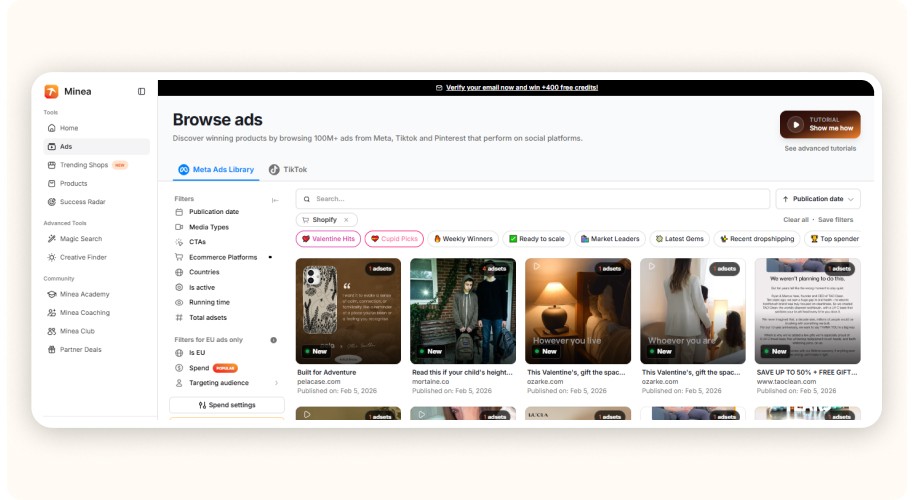
An ad library or ad spy tool isn’t just for scrolling through ads. It’s about identifying repeatable patterns: hooks, promises, offer structure, UGC style, video length, and format.
In the Minea vs Atria comparison, this is where their positioning starts to diverge.
With Minea, you operate in a performance-first environment. You mainly rely on:
Ads Library (Meta/Facebook, TikTok, Pinterest) to access thousands of ecommerce ads in one place
Advanced filters (publish date, platform, country, product type, store, format: video/image/carousel)
Unlimited favorites and watchlists to organize ads, products, and competitor stores
Ad performance tracking updates to see which creatives are accelerating or fading
Chrome extension to view ads and stores in live context and speed up your monitoring process
Minea’s strength lies in its exploitability. You’re not just collecting inspiration, you’re extracting testable angles from validated campaigns. In a Minea vs Atria analysis, Minea’s ad spy depth—much like the perspective highlighted in a guide on minea vs gethookd—is built around ecommerce performance, not just creative curation.
With Atria, the Ads Library / Ad Spy logic is more inspiration + organization oriented:
Largest ad library (Meta + TikTok access)
AI-driven search inside the ad database
Filter by themes to isolate specific creative styles or angles
Top-performing ads spotlight
Boards / multi-level boards to structure swipe files
Inactive ads saved forever
Chrome extension saving
Atria helps you structure creative inspiration efficiently. However, if your goal in the Minea vs Atria debate is identifying validated ecommerce opportunities, Minea offers deeper performance filtering and tracking logic.
Creative Analysis (Hooks, Scripts, Angles, Variations)
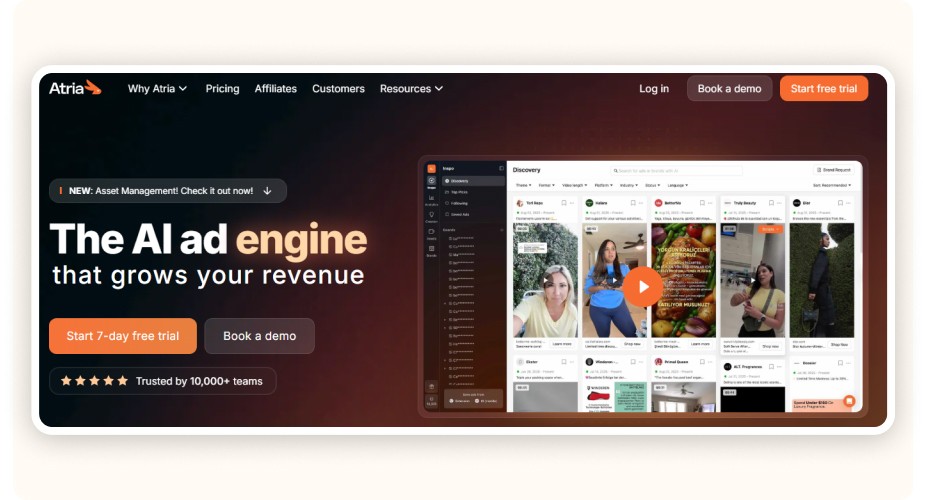
Moving from “I saw a good ad” to “I can produce my own version” is where creative execution matters.
In the Minea vs Atria comparison, Atria clearly leads on creative production tools.
With Atria, you can:
Create scripts in minutes by turning an angle into ready-to-shoot structures
Generate winning ad copy using AI (promise, proof, CTA) based on your brand brief
Use pre-made templates and Canva-ready templates
Create ads with AI to generate concepts and variations quickly
You can produce usable creative variations fast, without rebuilding everything from scratch at each iteration.
The limitation? Without a solid offer pipeline, you risk industrializing the wrong opportunity. You produce more creatives but for a weak or unvalidated offer. In that case, the issue isn’t creative production. It’s positioning, proof, or pricing.
With Minea, creative analysis supports product validation. In the Minea vs Atria debate, Minea uses creative insights to move from “performing ad” to “testable opportunity.”
You rely on:
Ads Library analysis to quickly break down what drives performance (hook, structure, format)
AI Creative Finder to generate variations from an existing visual or text
Watchlists to maintain a shortlist of replicable creatives
The tradeoff? Minea is less of a collaborative creative workspace if you manage high-volume asset production across teams.
AI: What Is It Actually Used For?

Both tools integrate AI, but the intent differs. AI accelerates analysis and production it does not replace your strategy: audience, offer, proof, pricing, and differentiation still matter.
In the Minea vs Atria comparison, Atria uses AI primarily to scale creative operations.
With Atria, AI helps you:
Use Radar (24/7 AI ad strategist) to detect patterns and suggest iterations
Extract insights with AI Insights
Run AI-driven search across the largest ad library
Use Customer review mining and URL analysis to generate angles
Perform Script extraction to replicate winning ad structures
This is powerful if your bottleneck is creative iteration and structured workflow.
With Minea, AI is decision-oriented. It shortens the path between a vague idea and a concrete test.
You mainly use:
AI Magic Search to search by intent (e.g., “pet products,” “back pain,” “viral home product”) and get relevant ads and product suggestions
Success Radar (Business) to automatically detect trending products and update selections every 8 hours
Top 10 winning products of the day (Business) based on engagement, virality score, format, and trend signals
The objective remains simple in the Minea vs Atria debate: help you answer three key questions fast:
What should I test?
With which angle?
Why might it work?
Without getting lost in endless concept production
Workflow & Collaboration

In the Minea vs Atria comparison, the workflow gap is obvious once you’re no longer working solo.
With Atria, the advantage is clear if you work as a team or if creative production is your main bottleneck. You want a repeatable process, one place to store assets, and fewer situations where everyone builds their own swipe file in isolation. This matters even more when you run high ad volume and you constantly iterate on creatives.
With Minea, the advantage shows up when you’re focused on ecommerce testing and execution. You want to move fast: test, measure, decide. If your setup is simple (solo operator or a small performance team), you’ll usually prefer a tool that supports decision-making and speed, especially when you need to identify trendy products with google trends rather than manage a full creative workspace.
For Ecommerce Sellers: Speed From “Insight → Test”

A good tool helps you reach an actionable decision fast: product, offer, angle, minimal creative, then measurement.
With Minea, you typically get a better “time-to-test.” You spot an opportunity, turn it into a simple hypothesis, and launch. The key benefit is reducing the friction between what you see and what you actually test. Minea fits better when your priority is to:
Decide what to test this week
Kill “false good ideas” quickly
Iterate on offer and angle based on real results
With Atria, the advantage is often a better “time-to-asset.” You move faster to produce hooks, scripts, variations, and keep your creative production organized. This is most useful when your offer is already validated and your performance depends on constant creative refresh. Atria fits better when your priority is to:
Ship lots of variations without losing structure
Feed a creative machine (advanced solo or team)
Speed up creative execution
Bottom line in Minea vs Atria: Minea accelerates decision and testing; Atria accelerates creative production.
Pricing: What Are These Tools Really Worth?

Pricing isn’t just “cheaper vs more expensive.” It’s the billing model.
In the Minea vs Atria comparison, Minea uses clear tiers built around ecommerce research and validation:
Starter: $49/month (10,000 credits)
Premium: $99/month (100,000 credits)
Business: $399/month (150,000 credits)
You’re mainly paying for research capacity (credits) plus feature access by tier.
Atria is more team/workflow-driven:
Core: $159/month (or $129/month billed annually), 5 seats included
Plus: higher pricing tiers (also available annually), with more capacity
$20/month per additional seat
Here, cost depends more on team size and usage, especially AI credits.
If you’re solo or a small ecommerce team, Minea is usually more predictable and cost-efficient. In discussions framed around dropscale vs minea : features, this often reinforces why Minea remains the more practical choice for lean operators. If you’re a creative team or agency that needs organization + AI, Atria can justify the spend.
Minea vs Atria pros and cons comparison
Pros and Cons of Minea
Pros | Cons |
|---|---|
More direct ecommerce discovery and validation thanks to: Ads Library (Meta/TikTok/Pinterest), AI Magic Search, Trending Shops (Shopify), and AliExpress Suppliers Finder. | Less of a true “creative workspace”: Minea includes AI Creative Finder, lists, and a Chrome extension, but it isn’t built around boards or team-based creative management. |
Faster decisions on what to test via Success Radar (Top 100 updated products) + Daily Top 10 Products (daily detection). | Less useful if your offer is already locked in and your main need is producing and organizing creative variations at scale. |
Structured monitoring with: favorites + unlimited tracking lists (products / ads / stores) + ad evolution tracking. | Risk of over-analysis without a clear method: if you don’t turn signals into test hypotheses, you may end up over-consuming data. |
Faster sourcing validation: direct access to AliExpress Suppliers Finder from product pages. | |
“In-context” monitoring: Chrome Extension to analyze stores and ads directly inside your browser. |
Pros and Cons of Atria
Pros | Cons |
|---|---|
AI-assisted creative production: generate/repurpose ads, extract scripts, analyze URLs and customer reviews to fuel concepts. | Risk of over-creation: the tool makes production easy, so if the offer isn’t validated, you may produce a lot on a weak foundation. |
Structured inspiration: AI search within a large ad library, theme filters, top-performing ads. | Less focused on upstream product/offer validation: more centered on creative workflow and ad exploitation than on deciding what to sell. |
Organization / creative ops: boards, asset hub, imports, collaboration (workspace logic). | Can be “too much” for a solo operator: if your only need is finding opportunities to test, the workflow/team layer may add unnecessary complexity. |
Team management: plans with seats, asset storage, ad account connections, brand tracking (“follow brands”) + AI insights. | AI quality depends on your brief: without clear input, outputs can become generic (a common risk with AI tools). |
Atria Chrome Extension: AI script analysis (competitor or own ads) + insights based on customer testimonials. | Requires a clear strategy: the tool executes and organizes, but it won’t fix a |
Use Cases: Which One Is Best for You?

Beginner / Solo Ecommerce: Prioritize Minea
Need to know what to sell and what to test fast? Minea is the better fit. It helps you spot product/offer opportunities and move into testing mode without getting stuck in endless creative production.
Your goal is simple: launch lean tests, measure, decide. Atria can wait. Until you have a validated offer, producing more creatives won’t fix the real problem.
Growing Ecommerce Business: Minea + Atria if Creative Is the Bottleneck
If you already test consistently and budgets are rising, Minea stays the foundation for feeding your pipeline (opportunities, angles, monitoring). Add Atria only if creative volume is holding you back and you need faster hook/script variation production with structure.
If creative isn’t the constraint, keep your stack simple.
Creative Agency / UGC Team / Creative Strategist: Prioritize Atria
If your job is delivering assets not picking the next product, Atria is the more logical choice. Organization, process, variations, and AI-assisted production are the core value.
Minea becomes relevant only if you also advise on market opportunities, angles, or competitor monitoring.
Established Brand: Atria to Scale Creative, Minea for Market Monitoring
If your products already sell, creative refresh becomes the main lever: new angles, new variations, constant testing. Atria comes first. Minea still helps in parallel for trend monitoring and spotting angles or offer opportunities before others.



Conclusion
If you’re an ecommerce seller or dropshipper and your top priority is finding what to test (product/offer/angle), choose Minea. If you’re an agency or creative team and your priority is scaling ad production and organization with AI, choose Atria.
In the Minea vs Atria debate, Minea remains the most logical core tool for adspy dropshipping and ecommerce performance because it sits upstream, where profitability is decided. Creative comes after.
FAQ
What is the main difference between Minea and Atria?
The core difference in Minea vs Atria is focus. Minea helps you find and validate winning ecommerce products and offers. Atria focuses on creative production, helping teams generate, organize, and scale ad assets using AI.
Is Minea better for dropshipping beginners?
Yes. If you’re a beginner in ecommerce or dropshipping, Minea is usually the better starting point. It helps you identify what to test before spending money on ads, which is critical for profitability.
When should I choose Atria over Minea?
Choose Atria if your product and offer are already validated and your main bottleneck is creative production. It’s ideal for agencies, creative strategists, and brands producing large volumes of ads.
Can I use both Minea and Atria together?
Yes. Many growing ecommerce businesses use Minea for product research and validation, then Atria to scale creative output once an offer proves profitable.
Similar articles