Minea vs Foreplay: Which Tool Should You Choose for Your E-commerce in 2026?
Comparative Market Analysis Tools
Author: Elysa
Contents
Choosing between Minea vs Foreplay? Good news: these two marketing analysis tools don’t do the same job, so the right choice is often simpler than it looks.
Minea helps you decide what to sell and what to push. It supports:
market reading
product discovery
e-commerce ad analysis
store analysis
demand signals
Foreplay, on the other hand, focuses on organizing, analyzing, and systemizing your ad creation. It’s built for ad saving (Meta/TikTok/LinkedIn), boards, collaboration, competitor tracking (Spyder), and creative analytics (Lens).
When choosing between Minea vs Foreplay, don’t ask which tool has more features. Ask where you’re stuck: is it the product/market, or creative execution and ad production?
Minea vs Foreplay: What You Need to Remember
Two tools, two jobs. Minea helps you decide what to test (product, offer, angles). Foreplay helps you execute, organize, and scale creatively.
Minea: The Best Tool to Decide What to Sell
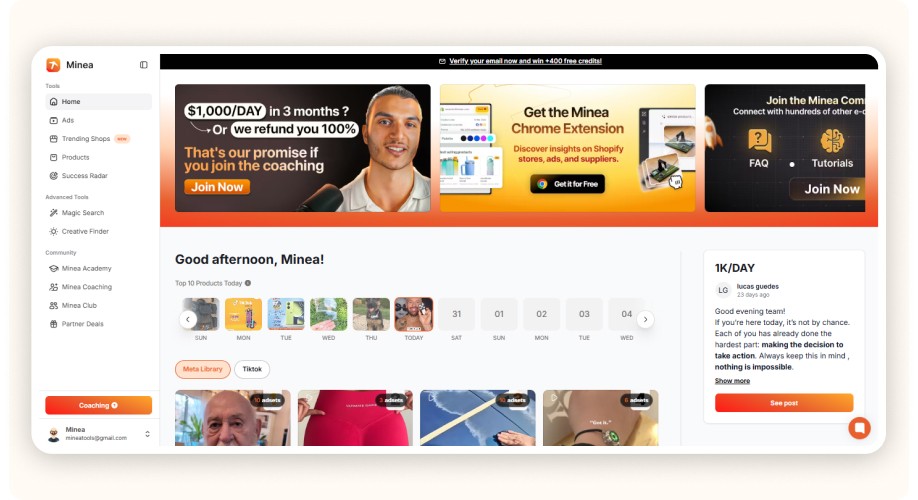
If you’re constantly asking “what should I sell?”, “which angle?”, or “what price?”, Minea is your tool. Designed to read the market, it helps you:
spot rising products
understand why they sell
see who’s already pushing them
With Minea, you analyze e-commerce ads and connect them to real business logic: offer, positioning, pricing, and competition.
For example, before burning your testing budget, you can validate a product by checking signals like ad volume, repetition, ad longevity, and engagement. Then you analyze the stores behind those ads, pricing, bundles, arguments, and page structure. This way, you test with a higher chance of success and avoid “one-night winners” that die within 48 hours.
Foreplay: The Ideal Tool to Systemize Creative and Scale Your Tests
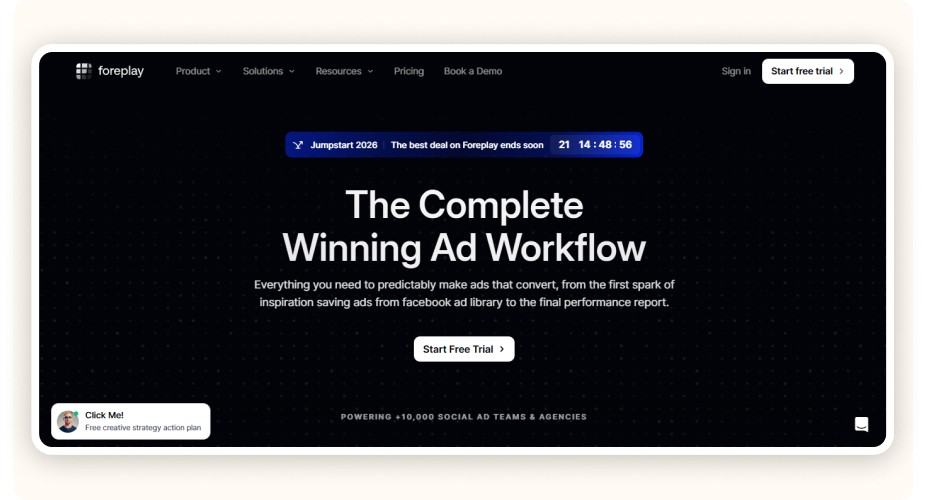
Your products are validated, but you lack creativity, structure, or testing rhythm? That’s where Foreplay becomes an accelerator. Here, the goal isn’t to find the “right product,” but to build a repeatable system:
collect winning ads
organize ideas
track competitors
produce faster
If you’re testing 30 variations per week, Foreplay structures your swipe file with boards. It also lets you track competitors using Spyder and align teams with Lens (creative reporting). You quickly see what actually works, hooks, formats, promises, and proof.
In short, Minea helps you make market decisions. Foreplay helps you structure creative and capitalize on your tests. If you’re asking what is Foreplay, the Foreplay meaning here is clear: it’s a creative system for paid ads, not a product research engine.
Comparison Table: Minea vs Foreplay
Criteria | Minea | Foreplay |
|---|---|---|
Positioning | Market-driven e-commerce platform → product → ads → stores → execution | Creative-focused platform: save → organize → track → analyze → brief |
Main goal | Decide what to sell and how (product, offer, angle, pricing) | Industrialize creative production and capitalize on tests |
Product research engine | Very strong: “winning products” logic + market signals | Limited: indirect discovery via ads, no dedicated product engine |
AdSpy / Ads Library | E-commerce-oriented: ads analyzed with product/store context (Meta/TikTok/Pinterest depending on plan) | Excellent for collecting and organizing ads from Meta/TikTok/LinkedIn |
Business context (ad → product → offer) | Strong: connects ads to bundles, pricing, and positioning | Medium: creative-first focus (hook, format, concept) |
Store / shop analysis | Very useful: “store-first” view (best sellers, pricing, offer structure) | Secondary: “campaign-first” view, no full shop analysis |
Competitor analysis | Solid via market and e-commerce actors | Very strong with always-on competitor tracking (Spyder) |
Swipe file / inspiration organization | Decent: ad saving and sorting, decision-oriented | Excellent: boards, tags, collaboration, team library |
Team collaboration | Basic to good, depending on usage | Built for teams: sharing, processes, test organization |
Creative analytics / reporting | Limited (not the core focus) | Very strong with Lens: pattern analysis and creative reporting |
Creative production / briefs | Directional: helps define what to produce | Execution-driven: turns inspiration into briefs and testable variations |
E-commerce execution | Strong: Shopify import, sourcing/ops logic (workflow-dependent) | Out of scope: not built for sourcing or store operations |
Onboarding / routine | Market & decision routine (shortlist → analyze → test) | Creative iteration routine (save → boards → tracking → insights → briefs) |
Best for | Finding/validating products, building offers, reading markets | Scaling creative, organizing tests, tracking competitors |
Less suitable if… | You mainly want creative analytics and collaboration | You want a full end-to-end product research tool |

Product Research: Which Tool Is Best for Finding Winning Products?
Finding winning products isn’t just about “seeing ads that are running.” It’s about being able to launch a testable product with a coherent offer (price, bundle, promise) backed by a market signal that lasts. That’s the real difference in the Minea vs Foreplay debate.
Minea: The Strongest Option to Find Winning Products
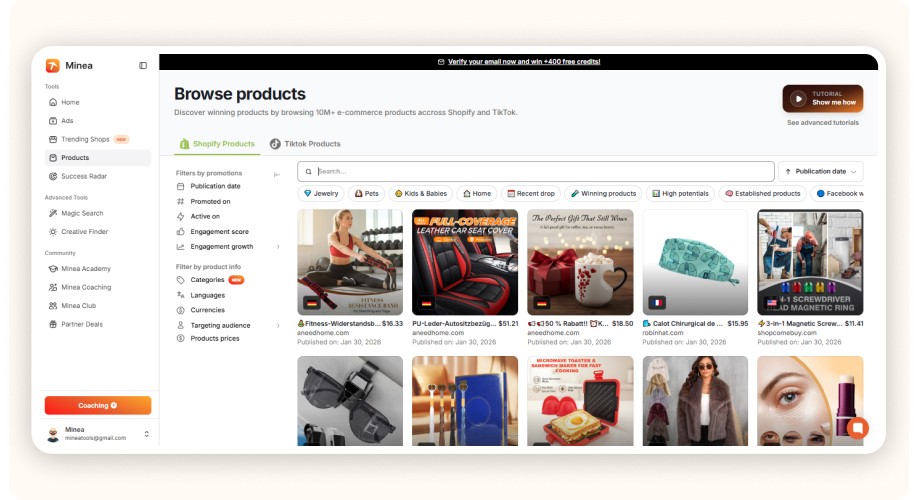
Minea is built to detect winning products. You get structured signals, including the Success Radar, which highlights a Top 100 of the best-performing products, updated every 8 hours. Most importantly, Minea follows a true e-commerce logic that connects ad → product → store → offer.
With Minea, you can quickly:
spot a product that’s gaining traction,
check if the signal repeats (multiple stores, multiple advertisers),
analyze pages that already sell (price, bundles, promises, proof),
speed up execution with Shopify import.
If your goal is to consistently compare outcomes and pick products that are actually testable, Minea—as highlighted in comparisons like minea vs gethookd—is the more reliable choice.
Foreplay: Great for Inspiration, Less for Product Discovery
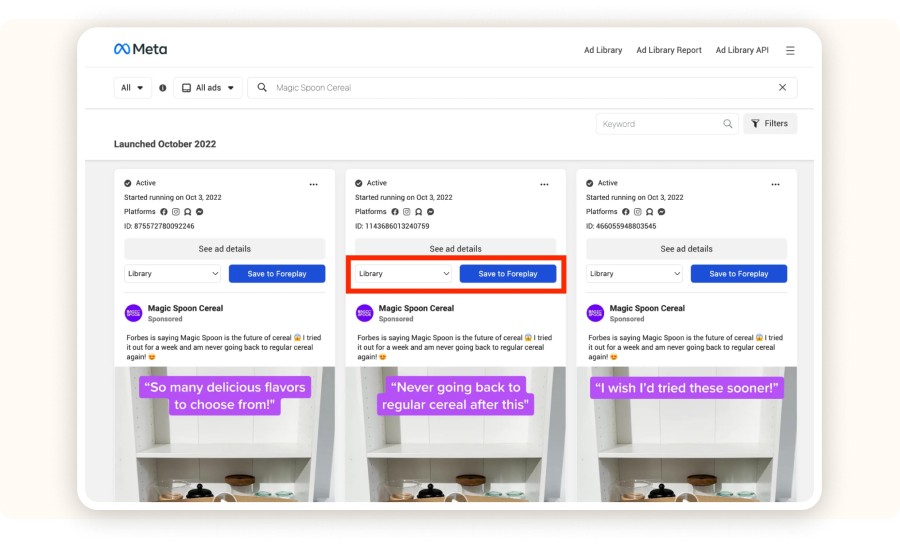
Foreplay helps you spot products through ads, but that’s not its core job. Its real strength is saving, organizing, tracking, and analyzing creatives. In short, it’s a system to industrialize inspiration and creative production.
With Foreplay, you can:
save 50 ads from a niche into a board,
tag hooks, formats, and promises,
extract 10 angles to produce and test.
But don’t confuse a “cool ad” with a “profitable product.” A creative can perform even if the product is average, or if the offer is weak. If you’re asking what is Foreplay, the Foreplay meaning here is clear: it’s a creative operating system, not a market validation engine.
The simplest workflow is to use Foreplay for angles and hooks, then validate the product with a market read (signal repetition, duration, offer consistency). For that, Minea remains more effective. It is especially useful when you need to identify trendy products with google trends before deciding which ideas are worth turning into creatives. So if your priority is launching testable products, Minea wins, while Foreplay is the perfect complement to turn ideas into creatives, fast and at scale.
AdSpy / Ads Library: “Seeing Ads” vs “Using Them”
The goal isn’t to collect ads. The goal is to ship an ad with a clear plan: what to copy, what to adapt, and what to test first, this is where Minea vs Foreplay differs.
Minea: An E-commerce AdSpy With Context (Ad → Product → Store)
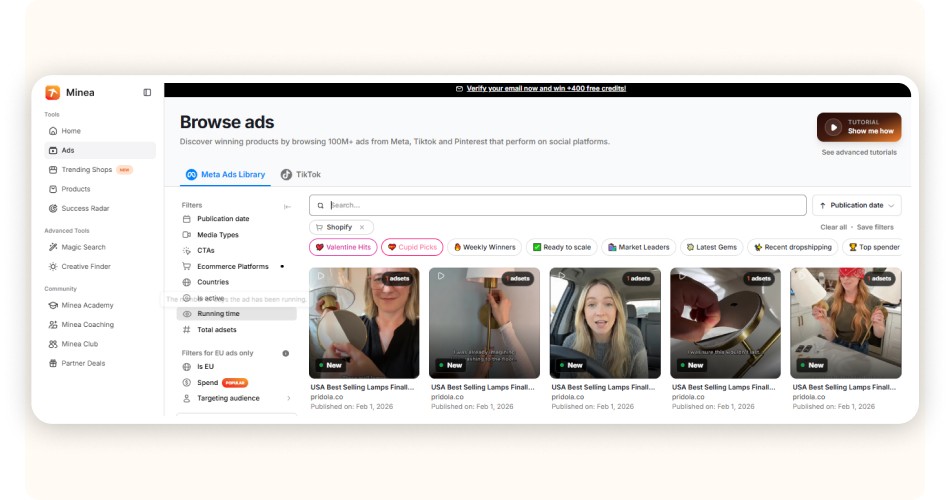
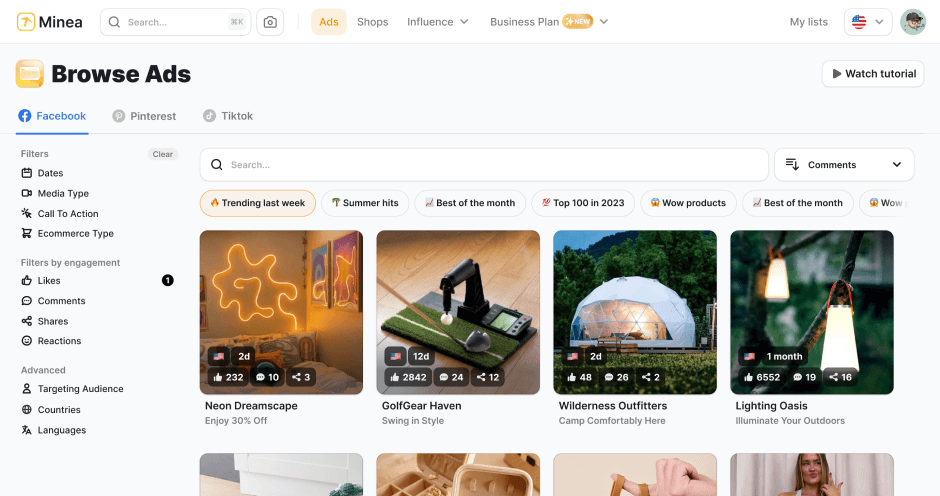
With Minea, the Ads Library isn’t just a video gallery. Its value lies in the e-commerce and dropshipping context. You filter ads and trace back what really matters: which product is being pushed, by whom, and within which store setup.
In terms of coverage, Minea highlights Meta starting with the Starter plan, then adds TikTok and Pinterest as you upgrade. This matters less as a simple feature checklist, as in adplexity, and more as a way to understand the mechanism behind a winning ad—its angle, promise, offer, and page.
To keep it actionable, only save ads you can summarize clearly in one line each:
the product,
the hook (exact opening line),
the offer (price/bundle/guarantee),
the proof (UGC, reviews, demo, before/after),
the landing type (product page, advertorial, quiz, collection).
If you can’t fill these five lines, you won’t know what to produce or test.
Foreplay: The Best “Save + Organize + Exploit” Approach
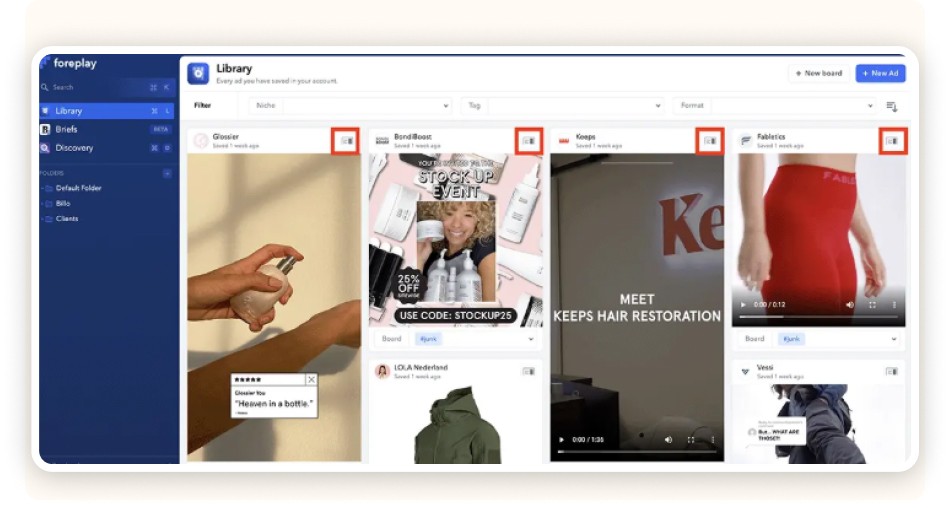
Foreplay is designed to collect and organize ads (via extension) and turn them into an operating system. You save ads from Meta/TikTok/LinkedIn libraries, organize them into boards, tag them, share them, and feed your tests without starting from scratch.
To use Foreplay effectively, structure your boards:
one board per persona,
one board per format (UGC demo, before/after, comparison),
one board per objection (“too expensive,” “doesn’t work,” “don’t trust it”).
Avoid copying the visual style (editing, music, colors) without copying the real lever. What makes an ad perform is usually hook + proof + offer, not the look.
Before producing a variation, write down the exact hook, the proof used, and the CTA + offer. That’s how you turn an Ads Library into a real testing machine, and where a comparison like minea vs atria helps frame Minea vs Foreplay as a complementary workflow rather than a competition.
Competitive Analysis: Stores (Minea) vs Campaigns (Foreplay)
Spying on competitors isn’t just about watching ads. You can either start from stores to understand the offer (price, bundles, page structure), or from campaigns to see what brands are testing and iterating. Both approaches generate different insights, and that’s where Minea vs Foreplay clearly diverges.
Minea: A “Store-First” View (Offer, Page, Pricing)
With Minea, competitor analysis starts from stores. The goal is to understand what actually sells and how it’s sold, not just which ads are running. Minea exposes the full offer logic:
hero products and how they’re positioned
pricing strategy (entry price, tiers, promotions)
bundles and upsells
page structure (promise, proof, objections, CTA)
These insights help you build a relevant offer, not just clone a product.
That said, never analyze a store without understanding its “why now.” A shop can take off because of timing: seasonality, a TikTok trend, a viral creative, or a strong short-term angle. If you copy the page without understanding the timing, you usually arrive too late.
The most effective method is to create a short profile for each store, including:
the offer (price + bundle)
the angle (core promise)
the proof (UGC, reviews, demos, before/after)
the friction points (delivery, trust, unanswered objections)
This is where Minea vs Foreplay really shows its strength on the strategy side.
Foreplay: A “Campaign-First” View + Always-On Tracking (Spyder)
With Foreplay, competitor analysis happens through ad campaigns. The goal is to see what brands are testing, iterating, and keeping live.
Thanks to Spyder, you can track competitors continuously and save their ads, even after they disappear from ad libraries. This lets you spot strong signals:
new tests launched every week
hooks that keep coming back (often a sign of scaling)
dominant formats (UGC demos, before/after, comparisons, social proof)
Never steal aggressive DTC hooks without the proof to back them up. Some brands can promise more because they have assets you don’t: UGC volume, reviews, press mentions, or strong product proof. Instead, adapt the hook to your own assets.
No UGC or social proof? Lower the promise and reinforce the demo. This execution mindset is central to the Foreplay meaning as a creative system.
Creative Analytics & Reporting: Clear Advantage for Foreplay

Foreplay pulls ahead if you want to measure creative performance properly, not just store ads. With Lens, ads become actionable data through reporting, segmentation, and sharing (including white-label options depending on usage). Foreplay also stands out with pricing that doesn’t scale based on ad spend, your costs don’t automatically increase just because you spend more on ads.
Lens answers the real question: what makes an ad win?
For example, you can compare three concepts over the same period, UGC demo, before/after, comparison, and identify which one performs best. Then you set a clear direction for the next cycle: “Push this format, with this hook, and this proof.”
This is exactly why, in the Minea vs Foreplay debate, Foreplay dominates on creative analytics.
E-commerce & Dropshipping Execution: A Major Advantage for Minea
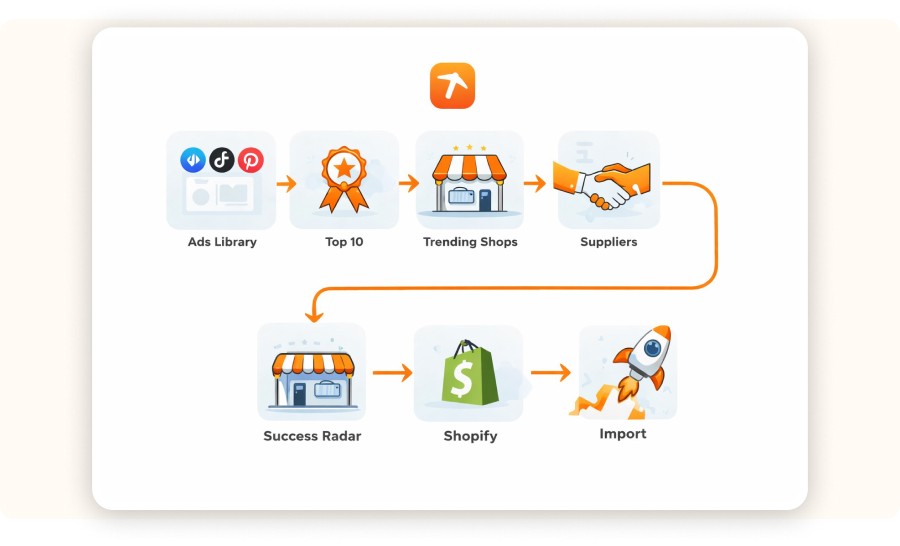
Minea doesn’t stop at ideas. Beyond finding winning products, it helps you execute without breaking your workflow.
Once you spot a product via the Ads Library (Meta/TikTok/Pinterest depending on plan), the Top 10, or the Success Radar (Top 100 updated every 8 hours), you can move straight into execution:
analyze Trending Shops (Shopify stores) to understand the winning offer
use Find Suppliers to trace the product back to a supplier (AliExpress)
import directly into Shopify (one click) to speed up testing
The real advantage is speed and consistency. You validate the context, reuse a solid base, and focus your time on what actually moves the needle: the offer and the page. In dropshipping, this speed matters because profitability windows are often short. Executing cleanly and faster gives you the edge, which is also why Minea stands out among the best product sourcing tools for sellers comparing Minea vs Foreplay.
Pricing Logic: “E-commerce Credits” vs “Creative Workflow & Accounts”
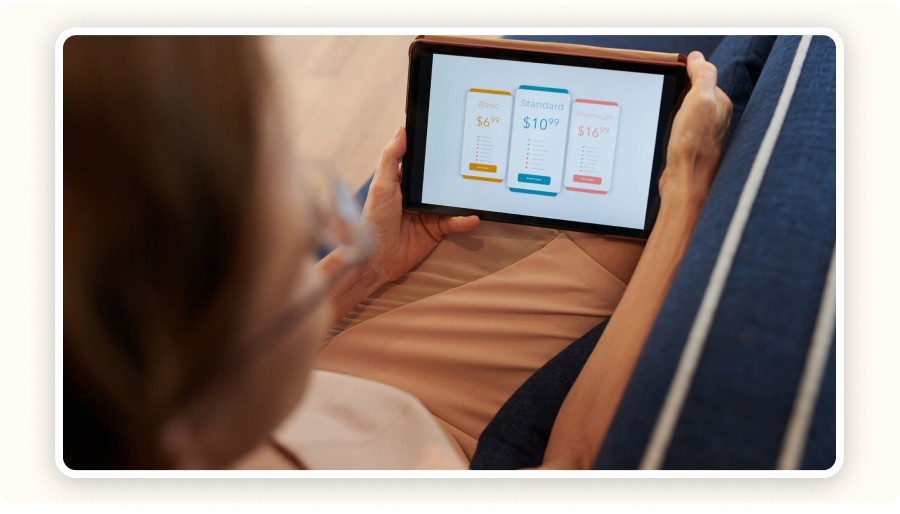
Minea and Foreplay don’t follow the same pricing logic. The cheapest option on paper isn’t always the best deal.
Minea is priced like an e-commerce data tool. You pay for a plan and credits to research products, analyze ads and stores, and make better decisions.
Starter: $49/month → 10,000 credits
Premium: $99/month → 100,000 credits
Business: $399/month → 150,000 credits + Success Radar (Top 100, updated every 8 hours)
Trial: 200 credits + up to 30% off on annual plans
The value is strong if your priority is avoiding bad tests. One poorly chosen product or misunderstood offer can cost more than the subscription.
Foreplay is priced as a creative workflow + team tool. You pay for a plan, users, and ad accounts to scale production and capitalize on what works.
Basic: $59/month (1 user included, +$20/user)
Workflow: $175/month (up to 5 users, Spyder + Lens, 1 ad account)
Agency: $459/month (up to 10 users, Spyder + Lens, 10 ad accounts)
Annual pricing: Basic $49/month, Workflow $149/month, Agency $389/month
Lens: +$50 per additional ad account
Foreplay offers excellent value if you produce creatives at scale, work in teams, and want reusable learnings (boards, tracking, analytics). If you produce little, you’re mainly paying for process.
UX & Onboarding: “Market Routine” vs “Creative Routine”
With Minea, you operate like an operator: market → product → ads → stores → action. This is efficient if your goal is fast decision-making, what to test, with which angle, and on what offer. The tool naturally pushes you from analysis to shortlist to testing.
The main trap with Minea is staying stuck in research mode. If you don’t make a decision by the end of a session, you haven’t moved forward.
With Foreplay, the UX is designed for creative and media buying teams. You’re not deciding what to sell, but building a system: save → boards → competitor tracking → analytics → briefs. If you produce many variations and want to scale learnings while keeping the team aligned, this workflow feels natural.
This difference defines the Foreplay meaning in practice, and why Minea vs Foreplay depends on your bottleneck.
Using Minea and Foreplay Together: Is It Possible?
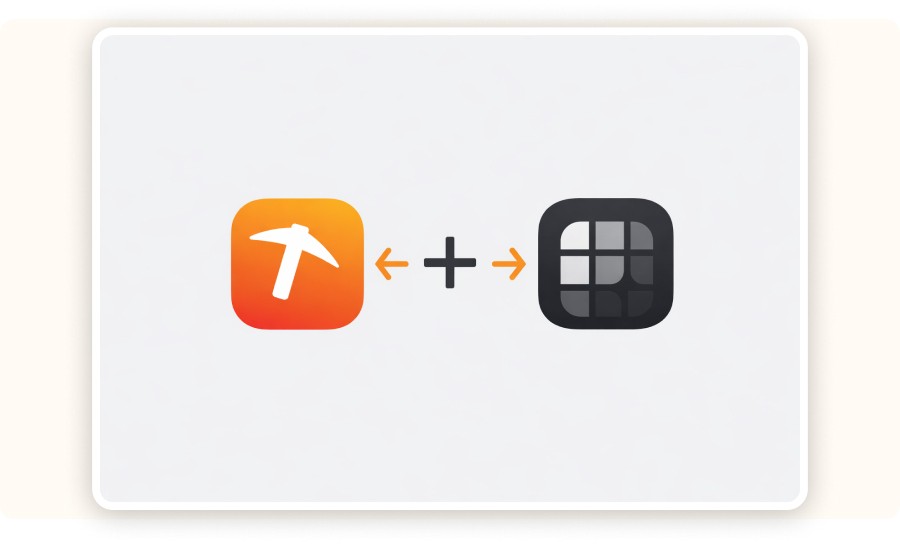
Yes! and it’s a very clean combination if you want a full process. Think strategy → execution.
Minea helps you frame the decision. You identify a credible product, validate the signal, understand the winning offer (price, bundle, promise), and walk away with a clear shortlist: what to test, which angle, which offer.
Foreplay then takes over as the creative engine. You organize examples, track competitors, identify repeating patterns, and turn them into briefs and launch-ready variations.
For example, Minea helps you identify three strong angles on a product (pain, proof, objection). In Foreplay, you turn each angle into five hooks, 15 creatives ready to test. Meanwhile, you monitor competitor iterations and archive what works (hook, format, promise) to reuse in the next cycle instead of starting from scratch.
This is where Minea vs Foreplay becomes a powerful combo rather than a choice.


Final Verdict: Which Tool Should You Choose in 2026?

Choose based on your bottleneck.
You still need to secure product and market fit? You want to find a winner, understand the offer that sells, and move fast with a full e-commerce logic? You want a data → decision flow and tools like Success Radar (Top 100 updated every 8 hours)? Choose Minea.
Your products are already validated and your problem is creative production? Choose Foreplay. It helps you organize a swipe file, track competitors continuously (Spyder), and measure what actually works with analytics (Lens).
If you’re scaling, use both. Minea decides what to push. Foreplay industrializes execution
FAQ
What is the difference between Minea and Foreplay?
Minea focuses on market analysis and product research to help e-commerce brands decide what to sell and how to position offers. Foreplay is a creative workflow tool designed to organize ads, track competitors, and scale creative production.
What is Foreplay and how does it work for e-commerce?
Foreplay is an ad organization and creative analytics tool. Its purpose is to save, structure, and analyze ads from platforms like Meta and TikTok, helping teams turn inspiration into repeatable creative systems.
What is the meaning of Foreplay in marketing tools?
In e-commerce marketing, the Foreplay meaning refers to a creative operating system, not its common dictionary definition. It helps brands manage ad inspiration, competitor tracking, and creative insights at scale.
Which tool is better for finding winning products?
Minea is better for finding winning products because it connects ads, products, stores, and offers using market signals and data. Foreplay is better suited for creative inspiration after products are already validated.
Similar articles