Explore our other topics
Contents
TikTok Dropshipping for Ecommerce: How It Works, What It Pays, and What Actually Scales in 2026
If you run an ecommerce store and you keep seeing competitors sell on TikTok, TikTok dropshipping is the model they’re using to test products fast without buying inventory upfront. It can work, but it rewards tight fulfillment and UGC-style videos that sell the result in seconds.
In short: TikTok dropshipping is selling products through TikTok content and TikTok Shop (or a store linked from TikTok) while a supplier fulfills each order for you. You win by pairing scroll-stopping demos with reliable shipping, then scaling the few products that convert.
What TikTok dropshipping is
TikTok dropshipping is an ecommerce model where you create TikTok content to generate demand, then sell through TikTok Shop or a connected store while a supplier ships each order to your customer. You focus on marketing, product positioning, and customer support rather than holding inventory.
TikTok dropshipping is not “selling random stuff on TikTok.” It’s dropshipping adapted to a feed where buyers purchase after a short demo makes the product feel obvious.
Two common setups dominate:
TikTok Shop first: You list products inside TikTok Shop. Customers buy in-app.
Storefront first: TikTok is the traffic engine. The sale happens on your Shopify store.
The main difference versus classic dropshipping is operational. TikTok Shop pushes stricter account health and fulfillment discipline. That pressure is also the opportunity, because most sellers fail on operations, not content.
How TikTok dropshipping works: the mechanics
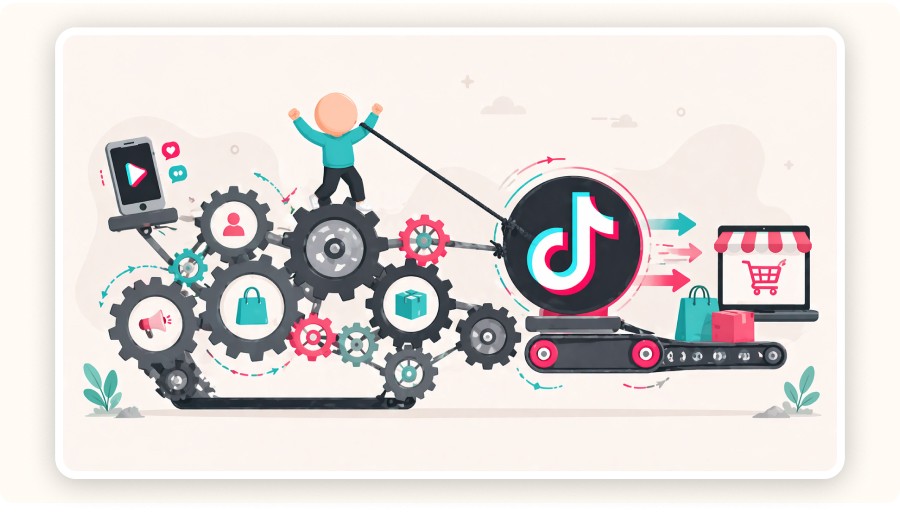
The mechanics are straightforward: you pick a product that demonstrates well, publish short-form videos to create demand, sell through TikTok Shop or your store, then route the order to a supplier who fulfills it. Your profit is the sale price minus product cost, shipping, platform fees, refunds, and ad spend.
A clean dropshipping loop:
Pick a product: It must show “visual proof” in 5–15 seconds.
Create an offer: One promise per video.
Produce variations: Different hooks, angles, and demos.
List the product: TikTok Shop listing or Shopify product page.
Route orders: Send orders to the supplier.
Track delivery: Valid tracking and consistent updates.
Handle support: Questions, refunds, review management.
Scale winners: Increase volume only after delivery stays stable.
Example margin math for an impulse product price point:
Sale price: $29.99
Supplier product cost: $12.00
Shipping/handling: $4.00
Gross margin before ads and refunds: $13.99
That margin can support scale only if product quality and delivery match the video’s promise.
TikTok Shop dropshipping vs Shopify dropshipping vs affiliate
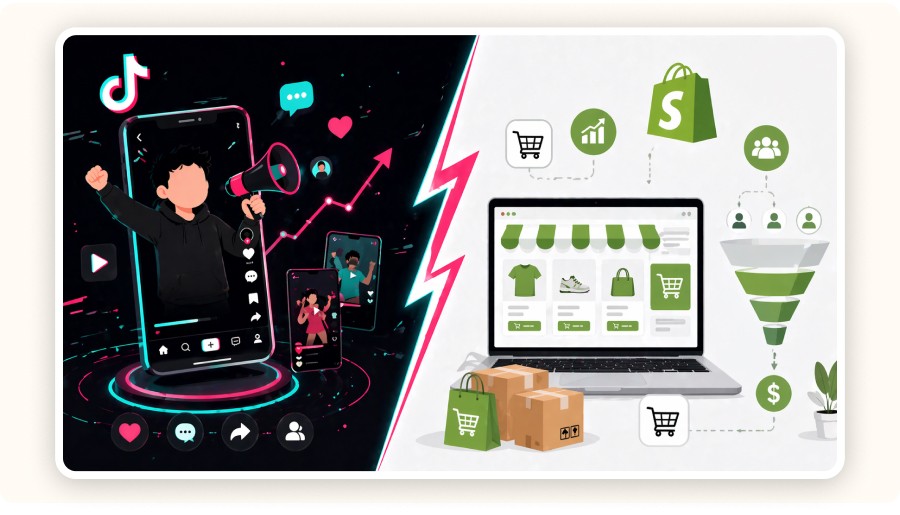
TikTok Shop dropshipping sells inside TikTok with stricter fulfillment expectations, Shopify dropshipping sells on your own store with more control, and TikTok affiliates earn commissions by promoting someone else’s product. The best choice depends on how much control you need over checkout, branding, and customer experience.
Model | Where the sale happens | Who owns customer experience | What you earn | What you control |
|---|---|---|---|---|
TikTok Shop dropshipping | In TikTok | Shared with TikTok | Margin per order | Listing, content, supplier choice |
Shopify dropshipping marketed on TikTok | On Shopify | You | Margin per order | Checkout, upsells, brand, support |
TikTok affiliate marketing | In TikTok | Brand owns it | Commission per order | Content only |
Practical decision rule for ecommerce sellers:
Choose TikTok Shop when you want in-app conversion and can meet strict shipping standards.
Choose Shopify when you want higher LTV, bundles, and brand control.
Choose an affiliate when you want to learn TikTok creative without supplier risk.
Legal requirements for TikTok dropshipping in the US

In the US, selling through TikTok Shop typically requires identity verification and business or tax documentation, and you still need standard ecommerce compliance such as accurate product claims, clear policies, and proper tax handling. Treat it like a real business from day one.
A solid baseline for Legal Requirements and account compliance:
Verification: Expect identity verification and tax documentation during setup.
Truthful claims: Your content claims must match the product.
Clear policies: Shipping, returns, and support must match reality.
Category compliance: Be careful with cosmetics, electronics, kids products, supplements, and health claims.
When compliance breaks, it usually looks like rising refunds and disputes. That damage is hard to reverse.
Fulfillment expectations: why speed is the real moat
TikTok dropshipping scales when fulfillment is predictable. TikTok Shop favors sellers who confirm orders fast, upload valid tracking, and deliver on time. If your supply chain can’t keep up, content performance won’t save the business.
TikTok is content-driven, but delivery sets the ceiling. If your supplier cannot ship reliably, the business becomes refunds, disputes, and account risk.
Three operational rules that keep ecommerce stable:
Pick suppliers for reliability first. Content is easy to iterate. Fulfillment is not.
Avoid high expectation-gap products. If the video implies premium quality and the product feels cheap, refunds spike.
Choose products that survive delays. Fragile items and complicated setup items create support load.
This brief’s supplier regions include China, Turkey, and Vietnam. Your best choice is the one that consistently uploads tracking and hits predictable delivery windows.
Is TikTok dropshipping profitable: the economics that matter
TikTok dropshipping profitability depends on conversion rate, contribution margin per order, and cost to acquire a buyer. You can scale when contribution margin stays positive after refunds and when fulfillment holds steady under volume.
Profitability gets misread because TikTok can spike fast. A product can look profitable on day 3 and collapse on day 30.
Use this lens for every dropshipping product:
Contribution margin: sale price minus product cost, shipping, fees, refunds.
Acquisition cost: ad spend per purchase, or the cost of producing content if you scale organically.
Cash flow: payout timing versus supplier payment timing.
Two common failure modes for dropshippers:
Refund drift: quality and delivery issues surface after the first wave.
Creative fatigue: the seller has no system to generate new angles.
Your edge is not finding one winning product. Your edge is finding winners consistently.
What TikTok pays: creator payouts vs ecommerce revenue
TikTok pays creators through its monetization programs, but TikTok dropshipping income comes mainly from ecommerce profit, not from TikTok view payouts. Treat “views paychecks” as a bonus, not a business model.
Creator monetization and ecommerce monetization are different. If you run a store, your KPI is profitable orders, not views.
A claim like “TikTok pays $600 for 1M views” is not a planning number for an ecommerce business because payouts depend on program rules, eligibility, region, and platform changes.
A cleaner model:
Views are distributed.
Orders are the business.
Profitability is the scoreboard.
The products that actually work for TikTok dropshipping
The best TikTok dropshipping products demo visually in seconds, create an immediate before-and-after, and sit in an impulse-friendly price range while leaving room for margin and refunds.
A product filter for ecommerce testing:
Clear scroll-stop moment in the first 2 seconds
Simple use case with minimal setup
Low support burden and low breakage risk
Minea’s product signals included in this brief highlight product types that keep showing up in short-form creative tests:
Posture corrector belt (trend score 92)
LED face mask (trend score 88)
Portable blender (trend score 85)
Smart ring fitness tracker (trend score 81)
Heated eyelash curler (trend score 78)
These products share a pattern: they’re easy to demonstrate on TikTok, and they fit impulse purchase behavior.
Marketing on TikTok: the creative system that scales
TikTok dropshipping scales through volume testing: you test multiple hooks and demos per product, then scale the few creatives that drive profitable orders. A repeatable creative pipeline beats a single viral hit.
A simple creative system for dropshipping stores:
5 hooks per product: the first sentence and the first visual.
2 demo styles: hands-only and talking-head.
One variable per iteration: hook, demo, offer, call to action.
A tight ecommerce workflow that reduces guesswork:
Use Minea to identify what angles and creatives are already working in your niche.
Script 10 videos around those angles and match the scroll-stop moment.
Launch on TikTok and kill weak angles quickly.
This is how experienced sellers avoid random testing. They start from proven demand, then improve execution.
Ethical and long-term considerations
TikTok dropshipping can be run ethically, but only if product quality and transparency match the promise in the content. The fastest way to lose your store is to create a gap between what the video implies and what the customer receives.
A more durable path:
Order samples early and confirm quality
Keep claims accurate and demos honest
If a product wins, improve shipping, packaging, and support to turn it into a brand asset
Long-term brand building usually beats short-term arbitrage in ecommerce because it reduces refund risk and increases repeat purchase.
Summary table: the TikTok dropshipping reality check
Use this table to decide if TikTok dropshipping fits your current ecommerce setup.
Decision factor | Baseline | What works | What breaks |
|---|---|---|---|
Price point | $29.99 average in this brief | Impulse-friendly with margin | High price and high return risk |
Creative workload | High volume | 10–20 variations per product | One-off viral hope |
Fulfillment dependency | Very high | Reliable tracking and support | Unpredictable shipping |
Scaling constraint | Account health | Low refunds and clear claims | Disputes and policy violations |
Long-term upside | Medium to high | Winner becomes a brand | Constant low-quality churn |
How to get started this week
Start with one product, one supplier plan, and a tight creative test loop. Your first goal is a repeatable process that produces clean delivery and consistent conversion.
A minimum viable path for a dropshipper:
Pick one product that demos clearly and fits an impulse price range.
Order samples and validate quality.
Set up a TikTok Shop listing or a Shopify product page that matches the video promise.
Produce 10 short videos using 5 hooks and 2 demo styles.
Track refunds and delivery performance before you scale volume.
FAQ
Can you do dropshipping on TikTok
Yes. You can run dropshipping through TikTok by selling via TikTok Shop or by sending TikTok traffic to your ecommerce store. TikTok Shop is stricter on fulfillment and tracking, while Shopify gives more checkout and post-purchase control.
Is TikTok dropshipping profitable
It can be profitable when the contribution margin stays positive after refunds and your creative system produces winners consistently. It usually fails with weak product quality, unreliable shipping, or dependence on one viral creative.
What are the best products to dropship on TikTok
Products that show a clear transformation in seconds and feel like impulse buys tend to work best. In this brief’s set, posture corrector belts, LED face masks, and portable blenders fit that pattern because they demo clearly in short-form video.
What are the legal requirements for dropshipping on TikTok
In the US, expect identity verification and tax documentation during setup, especially for TikTok Shop. You also need accurate product claims, clear shipping and return policies, and category-specific compliance for regulated products.
How do I set up a TikTok dropshipping store
Choose TikTok Shop for in-app checkout or Shopify for full control, then create a listing or product page that matches your video promise. Confirm supplier shipping and tracking reliability, and test multiple creatives before scaling volume.
Does TikTok pay $600 for 1m views
Some creators earn payouts through TikTok monetization programs, but it is not a stable planning number for a dropshipping business. TikTok dropshipping income mainly comes from ecommerce profit per order, not from view payouts.
Can I make $10,000 per month dropshipping
Yes, but it usually requires a product with stable demand, a creative pipeline that produces multiple winners, and fulfillment that holds under volume. The faster route is to scale one winner, then improve operations and creative iteration instead of constantly chasing new trends.
Bottom line
TikTok dropshipping is a real ecommerce model in 2026. It rewards sellers who can produce UGC-style creative at volume and back it up with fulfillment that stays clean under pressure. Treat it like a system: product selection, creative testing, and operational discipline.
If you want a faster starting point, use Minea to spot product demand and working angles before you invest in content production.
Related resources on Minea
Winning products: how to validate demand before testing ads
TikTok ad testing checklist for dropshipping stores
Supplier vetting for faster shipping and fewer refunds