Finding winning products for Facebook Ads relies on 5 criteria, the free Meta Ad Library method, and a 72-hour test structure that kills losers fast.
Minea analyzes the top-performing Facebook ads on the market in real time to identify winning products before your competitors do.

Finding winning products for Facebook Ads relies on 5 criteria, the free Meta Ad Library method, and a 72-hour test structure that kills losers fast.
Minea analyzes the top-performing Facebook ads on the market in real time to identify winning products before your competitors do.
Finding winning products for Facebook Ads relies on 5 criteria, the free Meta Ad Library method, and a 72-hour test structure that kills losers fast.
Minea analyzes the top-performing Facebook ads on the market in real time to identify winning products before your competitors do.
Finding winning products for Facebook Ads relies on 5 criteria, the free Meta Ad Library method, and a 72-hour test structure that kills losers fast.
Minea analyzes the top-performing Facebook ads on the market in real time to identify winning products before your competitors do.
Finding winning products for Facebook Ads relies on 5 criteria, the free Meta Ad Library method, and a 72-hour test structure that kills losers fast.
Minea analyzes the top-performing Facebook ads on the market in real time to identify winning products before your competitors do.
Finding winning products for Facebook Ads relies on 5 criteria, the free Meta Ad Library method, and a 72-hour test structure that kills losers fast.
Minea analyzes the top-performing Facebook ads on the market in real time to identify winning products before your competitors do.
Contents
How to Find Winning Products for Facebook Ads in 2026: A 5-Step Framework That Eliminates Losers Before You Spend a Dollar
Most people trying to find winning products for Facebook Ads are asking the wrong question. They want to know which product will make them money. The more useful question is which products definitively cannot — and how to spot the small subset that still has room for a newcomer to be profitable.
This guide walks through the framework I use to find winning dropshipping products: five non-negotiable criteria, one free discovery method, one paid method that earns its cost at volume, and a testing structure that tells you within about 72 hours whether a product deserves more budget or a swift shutdown.
Every figure below comes from my own campaigns and the walkthroughs I publish on my channel. Those videos are in French, and I link the specific one at each claim, so you can check any number against the account it came from. I would rather show you the spend than ask you to take my word for it.
TL;DR — How to Find Winning Products for Facebook Ads
A winning Facebook Ads product must have a wow effect — without it, no perceived value, no margin, no profit.
Target a €25–€60 (≈$27–$65) selling price with a minimum €20 margin after product cost.
The Meta Ad Library is free and shows real active ads — start there before paying for any tool.
Spy-tool filters that work: last 30 days, image or video, Shopify, 200–7,000 likes.
Test one campaign per product with 5–10 adsets at €10/day using ABO for comparable results.
Kill an ad when its cost per acquisition exceeds your gross margin — the rule is that simple.
Why Most "Winning Product" Advice Fails
Scroll through any dropshipping forum and you will find lists of "winning products for 2026" written as if picking the right item guarantees the result. It does not. The advice fails on three points that most competitors gloss over.
First, no criteria set guarantees a winner. I make this distinction in How to Succeed in Dropshipping in 2026: I can tell you whether a product CAN work or definitively CANNOT — never whether it WILL. The job of product research is elimination. What remains after you cut the certain losers is the pool of potentially interesting products.
Second, product characteristics and timing are separate dimensions. A posture corrector or a blackhead vacuum meets every criterion on paper. As I say in How to Find a Product to Sell on Shopify in 2026, these should not be launched now — especially by beginners — because they are saturated. A winning product at the wrong moment is a losing campaign.
Third, saturation is misunderstood. I cover this in How to Tell if a PRODUCT Is SATURATED: a saturated product is not necessarily one that stopped working for everyone. Established sellers with tight supply chains, custom creatives, and mature pixels can still print money on items that would ruin a beginner. Saturation is relative to who is running the ads.
The 5 Non-Negotiable Criteria of a Winning Product
Before you touch the Ad Library, internalize the five criteria that turn browsing into elimination. Miss any one of them and the product is out — not "worth testing anyway", out. This is the shape of what most people search for when they look up winning dropshipping products, but the criteria matter more than any list.
1. The Wow Effect
The wow effect is the root condition — everything downstream depends on it. I lay out the chain in The BEST WAY to FIND WINNING PRODUCTS in 2025: no wow effect → no perceived value → no room for a €20 margin → no way to sell above €25 → no profitability on Facebook Ads. My counter-example is cutlery. It is impossible to sell cutlery on Facebook Ads dropshipping because nothing about a fork produces the moment of surprise that stops a thumb on a feed.
The wow effect can come from an unexpected mechanism, a striking visual result, or a clever solution to a specific pain. What it cannot be is generic.
2. The €25–€60 Price Band with €20+ Margin
In How to Find a Product to Sell on Shopify in 2026, I land on a clear range: sell between €25 and €60 (≈$27–$65) on Facebook, with €20–€50 (≈$22–$54) preferred on TikTok. The floor on margin is €20 after product cost. €30 is better. €40 is better still.
The band works from both ends. The floor exists because anything cheaper cannot absorb ad costs and still leave a profit. The ceiling reflects where the products in this model typically sit — items costing €17–18 from a supplier can carry a €60 price when the perceived value genuinely supports it.
3. Real Margin Is Not Naive Margin
This is where new dropshippers lose their businesses. I walk through the arithmetic in A Complete Guide to Dropshipping in 2026: a €5 product sold at €25 is not €20 of profit. After company taxes, VAT, platform fees, ad spend, and customer service, the margin shrinks fast. Real net margins on a healthy dropshipping business land at 20–25% — not the 80% a spreadsheet suggests.
Plan for the real number. A product that only pencils at the naive number will bleed you on the true one.
4. Content Availability
You cannot sell what you cannot show. In The BEST WAY to FIND WINNING PRODUCTS in 2025, I count content availability as a selection criterion in its own right: before launching, verify there are enough images and videos in circulation to build the store and produce ads. If nothing exists yet, do not launch — pick a different product or wait until the content pool grows.
5. The Competition Sweet Spot
The competitive landscape carries its own signal. In the same video, I describe the sweet spot: dozens of recent entrants on a product is a bad sign — you are late. Nobody at all on the product is also a bad sign — either the demand does not exist or someone already tried and failed. You want the in-between: a handful of active sellers, some with durability, some with fresh entries.
Minea
Top 100 best-performing products this month
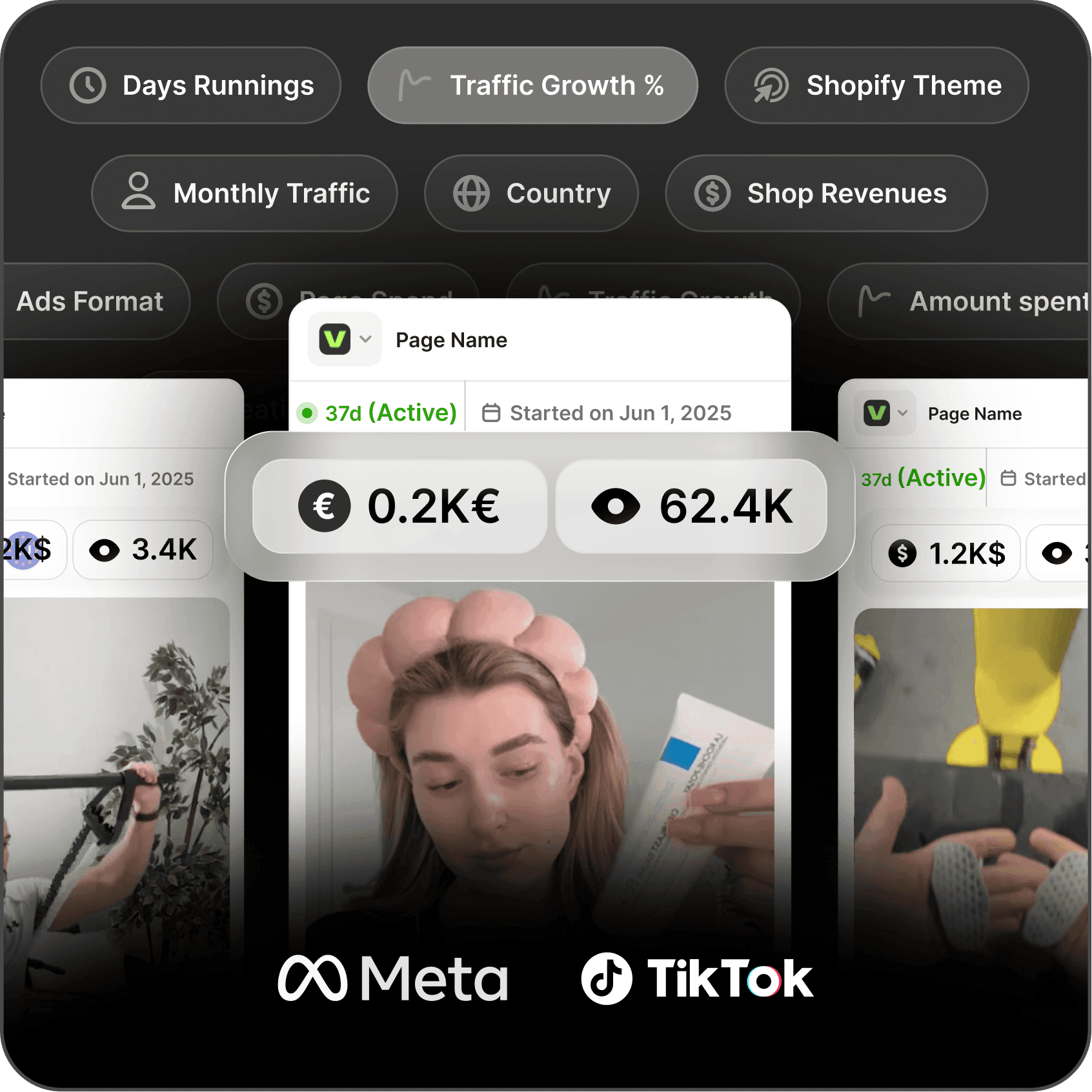
Detected in real time by our AI from market signals: real sales, advertising statistics, and performance
Method 1 — How to Use the Facebook Ad Library to Find Winning Products (Free)
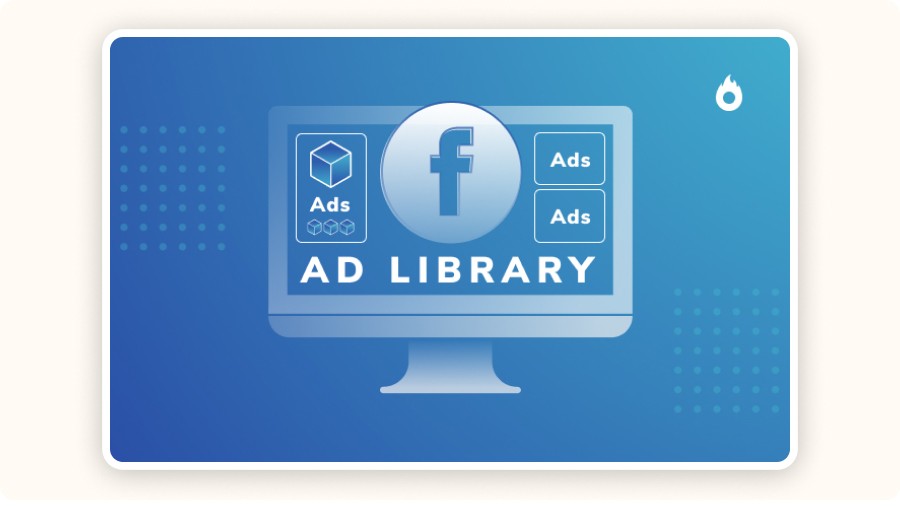
The best free product research tool in the market is Meta's own. In Comprehensive Dropshipping Course for Beginners, I walk through the Facebook Ads Library as the free method I recommend beginners start with. You need to be logged into a Facebook account to use it, and it lives at facebook.com/ads/library.
Here is the working sequence.
Open the Meta Ad Library and switch the filter to "All ads".
Set the country filter to the market you plan to test — do not leave it on "All".
Search a product keyword. Start broad ("posture corrector"), then narrow to the specific angle you suspect ("posture corrector for desk workers").
Filter down to active ads only. Inactive ads are historical noise.
Click into each ad and check the start date. Ads running for six months or longer with continued spend are the durable signal you want.
Click through to the advertiser's page and read their other ads. A single winning creative is interesting; a store running the same product across multiple creative variations for months is proof of an economic engine.
Click the ad's destination link and study the landing page. Product page structure, offer stack, upsells, and trust elements all tell you what is actually converting.
What to look for: durability (long-running ads), variety (multiple creatives for the same product), and specificity (angles that target a defined persona rather than "everyone who wants X").
What kills the product: everyone who entered recently is already inactive. If the six most recent advertisers on a keyword all stopped within 30 days, the market punished them for a reason.
Method 2 — Ad Spy Tools: When They Earn Their Cost
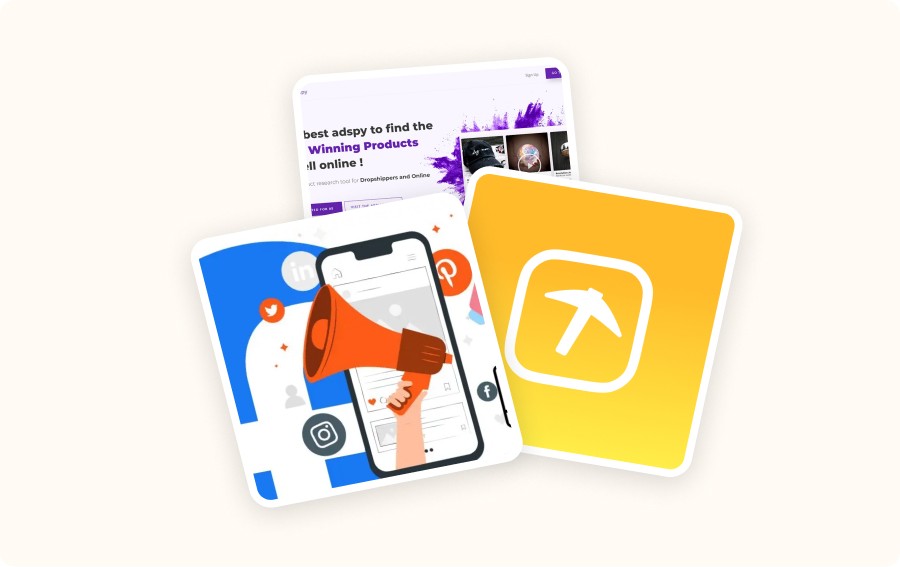
An ad spy tool does what the free library cannot: filter by engagement, verify AliExpress availability, expose store-level revenue signals, and pull across TikTok, Pinterest, and Meta at once. You do not need one to start. You need one when you are evaluating multiple products a week and the manual method has become your bottleneck.
The Filter Recipe
In 10 MINUTES to Find a Product That Sells for Over €10,000 a Day on Shopify, I lay out my filter recipe for a Facebook ad spy workflow. Applied in order:
Ads created in the last 30 days — genuinely new campaigns.
Ad format: image or video — exclude carousels, which skew toward brand accounts.
Landing page: redirects to a Shopify store — confirms an e-commerce operator.
"Is dropshipping" AI filter — checks the product image against AliExpress availability.
Likes between 200 and 7,000 — 200+ proves the ad is gaining traction; above 7,000 is where I stop looking, because at 10,000 or 170,000 likes the market is oversaturated for a newcomer.
Vary your filter combinations across sessions. Running the same recipe every day surfaces the same products every day.
The Store-Level Signal
In Create FREE UGC CONTENT using AI, I found a product — turmeric cotton pads for deep skin cleaning, available on AliExpress — through a Shop Tracker function that let me track a specific store and see how much daily revenue it was generating. Store-level revenue tracking is a signal the free library simply does not expose.
Cross-Platform Reach
In Comprehensive Dropshipping Course for Beginners, I make the point that just because you plan to run Meta Ads does not mean you should skip the TikTok and Pinterest tabs. A TikTok ad spy view can occasionally surface products already proven on one platform but not yet running on Facebook — an opening for you, though I would call it rare rather than routine.
One case worth noting: in DROPSHIPPING: €1,000,000 in 5 Months—Adam's Crazy Story, my student Adam generated $600,000 in a single month (December) on one product targeting the USA — and, as he describes in that interview, later added related products and upsells. When I asked how he found the product, he answered: Minea.
How to Spy on Your Competitors' Facebook Ads
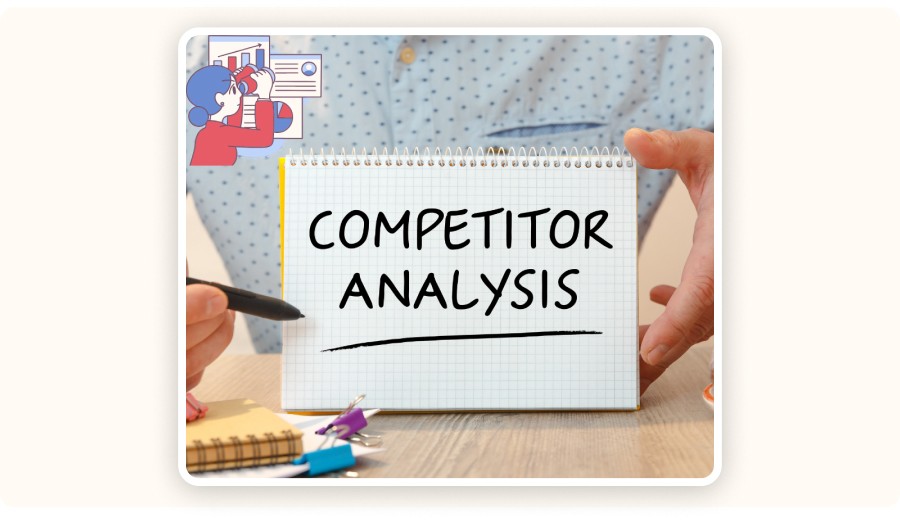
Studying competitor Facebook ads is a different exercise from product research: it asks what one specific store is doing that you could do better.
The Meta Ad Library lets you pull every active ad from any advertiser page. Once you have a competitor identified — from your product research or from someone you already know is in your niche — read their entire active ad set. The creatives they keep running for months are the ones paying for themselves. The creatives that appeared once and disappeared were tests that failed.
In The Ultimate Strategy for Building a €1 Million E-Commerce Business by 2026, I frame the goal precisely: study the marketing differences between each competitor to find an angle that has been used little or not at all. If every competitor is running the same angle, that angle is saturated even if the product is not. The gap you are looking for is a proven product with an unused angle.
Product Validation: Reviving "Saturated" Products With a New Angle
This is where competitor guides stop and the real work begins. In How I'll Make €1,000 a Day with E-Commerce in 2026, I walk through two cases that reframe the saturation question entirely. Understanding it often separates a first launch that lands on genuinely profitable Facebook products from years of cycling through "new" ideas that were saturated long before you found them.
Loop earplugs are, by any conventional read, near-saturated. Yet I relaunched them profitably by targeting motorcycle riders who wanted to cut wind and engine noise on long rides. A precise persona and an angle nobody had run before turned a "dead" product into a working campaign.
The abdominal slimming belt is a stronger example. One of my students exceeded €1,000/day on it more than three years ago. That belt still runs today under a new angle targeting mothers who are struggling to regain a flat stomach after childbirth. Same product. Different audience. Different problem framing. Profitable again.
The principle: a new marketing angle lets you be profitable on a saturated product because you reach a new audience the incumbents are not addressing.
This connects to what I call the "star" moment in How to Find a Product to Sell on Shopify in 2026. Every product moves along a curve: a fad, a wave, a trail, then saturation as more sellers arrive and fewer buyers remain. You want to catch a product in the "star" range — proven enough that you know the demand is real, not yet crowded enough that a beginner cannot break in. A new angle on a mature product effectively resets its curve for the audience you have just discovered.
How to Validate a Winning Product With a Facebook Ads Test
Finding a candidate is not the same as validating it. This is the step beginners skip, and it is why most product research effort is wasted.
In Comprehensive Dropshipping Course for Beginners, I frame the workflow as three steps: criteria, research, analysis. Finding someone with 1,800 likes in two weeks does not mean you blindly launch — that number is a signal that the product is worth analyzing, not a signal that it is worth spending. Beginners get to step two and swipe their card. The analysis step is where the real decisions get made.
The Test Structure
In Comprehensive Facebook Ads Course: My Strategies Explained, I lay out the structure: one campaign per product. Inside it, 5–10 adsets depending on budget. €10/day (≈$11/day) per adset. Roughly 3 days on average to know whether the product is profitable and what needs to change.
I run ABO (adset budget optimization) rather than CBO for the test phase specifically because it guarantees every adset gets the same budget. When results come in, you are comparing like with like — no adset can starve another out of the picture.
Test by Creative vs Test by Interest
In Comprehensive TikTok Ads Training, I distinguish two test shapes based on what you have available. More than three creatives ready to run means you test by creative: same targeting across every adset, different creative in each one. Very few creatives means you test by interest: same creative in every adset, different audience interest in each one. The rule underneath both: change one variable per adset so you can attribute the result cleanly.
The CPA Kill Rule
Cost per acquisition is the primary metric. In Comprehensive Dropshipping Course for Beginners, I give the worked example plainly: sell at €30, product costs €10, gross margin is €20. A CPA below €20 means the adset is profitable. If your CPA on a sale is €15, you keep €5. At €21, you lose €1 per sale. The rule is that mechanical — no story, no "let it run a bit longer to see", no exceptions for creatives you personally like.
Testing Creatives: Free vs. Paid Content
In DROPSHIPPING : TESTING AT 0€ VS 3000€, I ran the same product two ways: once with content I found free on the internet, once with over €3,000 of custom-produced content. The free-content version outperformed the €3,000 version — a result that surprised me. My practice is to test competitor content, own-made content, and modified content, rather than building every ad from scratch. The takeaway is not that expensive content is bad; it is that content that already resonates on the internet often resonates in ad units too.
Scaling the Winners
Once ABO identifies the profitable creatives, you scale. In Comprehensive Facebook Ads Training, I open a new CBO campaign with the best 2–5 creatives from the test. It is also possible to be profitable and to scale on a single profitable creative — one of my students reached three figures a day with exactly one profitable creative while every other creative in the account lost money.
For a reference point on what a profitable day at real volume looks like: in Comprehensive Dropshipping Course for Beginners, I show a day where I spent $2,779 and generated $9,421, with many sales untracked by the pixel so the true revenue exceeded €11,000 (≈$11,900). Of roughly 15–20 active adsets, only 2 were unprofitable. That is what the discipline compounds into — not on day one, but eventually.
Sourcing Your Winner: AliExpress vs a Sourcing Agent
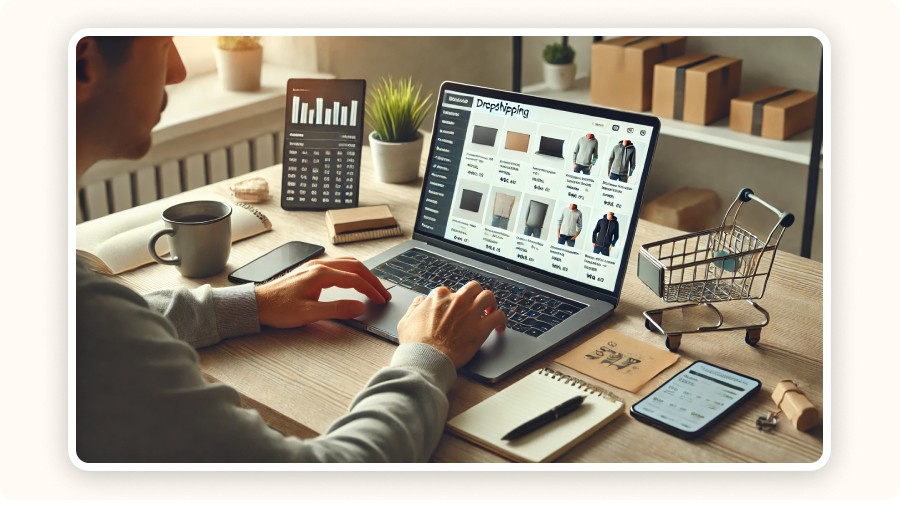
Once a product is validated, sourcing becomes the next lever. To find dropshipping products most beginners start on AliExpress via Dsers — cheap, fast to set up, no minimum orders. In HOW TO FIND DROPSHIPPING SUPPLIERS, I recommend moving to a sourcing agent in China at volume: faster shipping routes, quality control, custom packaging, and a real relationship where disputes get resolved rather than the AliExpress refund lottery. One caveat: for very cheap products (€2–3 range), an agent's shipping routes can cost more than AliExpress's near-free shipping, which erases the advantage.
Frequently Asked Questions
How do you find winning products on Facebook?
Use the Meta Ad Library to find ads that have been active for six months or longer with multiple creative variations from the same advertiser, then verify the product against the five criteria: wow effect, €25–€60 price band, €20+ margin after all real costs, sufficient content available online, and a competition sweet spot that is neither empty nor crowded.
Is $20 a day good for Facebook ads?
For product testing, my structure calls for €10/day (≈$11/day) per adset with 5–10 adsets running in parallel per product — so by that arithmetic a full test runs roughly €50–€100/day. A $20/day total budget is too thin to produce a readable result across several adsets, though it can cover a single adset on an already-validated creative.
How do you use the Facebook Ad Library to find winning ads?
Search a product keyword, filter to active ads in your target country, click into each ad to check its start date, then visit the advertiser's page to see their full active ad set. Long-running ads with multiple creative variations from the same store are the strongest durability signal you can get for free.
What is the best way to find winning products?
Start with the free Meta Ad Library to learn what "winning" looks like in your niche, apply the five-criteria filter to eliminate losers, then graduate to a paid spy tool when you are testing multiple products a week and manual research has become your bottleneck. The elimination mindset matters more than the tool.
How do you find winning products for Facebook ads for free?
The Meta Ad Library at facebook.com/ads/library is the primary free method. Log into a Facebook account, search product keywords, filter to active ads in your target country, and study advertisers running the same product across multiple creatives for six months or longer — that is the free proxy for genuine profitability.
What is the best ad spy tool for Facebook ads?
Look for multi-platform coverage (Meta, TikTok, Pinterest), recency and landing-page filters, engagement thresholds you can set, AliExpress availability verification, and store-level revenue signals. Minea covers those capabilities; alternatives exist and the right choice depends on your workflow. There is no single "best" — there is what matches how you research.
Conclusion — Your Next Steps
Product research is elimination work. You are not looking for the guaranteed winner — that person does not exist. You are looking for the small set of products that pass every one of the five criteria and that you can approach with an angle nobody else is running.
This week, do one concrete thing: open the Meta Ad Library, pick a niche you understand, and run the free method end-to-end on five products. Apply the five criteria to each. Eliminate the four that fail. If the fifth survives, you have your test candidate — and you will have a real baseline for whether your research method is the bottleneck, or your patience is.
How to Find Winning Products for Facebook Ads in 2026: A 5-Step Framework That Eliminates Losers Before You Spend a Dollar
Most people trying to find winning products for Facebook Ads are asking the wrong question. They want to know which product will make them money. The more useful question is which products definitively cannot — and how to spot the small subset that still has room for a newcomer to be profitable.
This guide walks through the framework I use to find winning dropshipping products: five non-negotiable criteria, one free discovery method, one paid method that earns its cost at volume, and a testing structure that tells you within about 72 hours whether a product deserves more budget or a swift shutdown.
Every figure below comes from my own campaigns and the walkthroughs I publish on my channel. Those videos are in French, and I link the specific one at each claim, so you can check any number against the account it came from. I would rather show you the spend than ask you to take my word for it.
TL;DR — How to Find Winning Products for Facebook Ads
A winning Facebook Ads product must have a wow effect — without it, no perceived value, no margin, no profit.
Target a €25–€60 (≈$27–$65) selling price with a minimum €20 margin after product cost.
The Meta Ad Library is free and shows real active ads — start there before paying for any tool.
Spy-tool filters that work: last 30 days, image or video, Shopify, 200–7,000 likes.
Test one campaign per product with 5–10 adsets at €10/day using ABO for comparable results.
Kill an ad when its cost per acquisition exceeds your gross margin — the rule is that simple.
Why Most "Winning Product" Advice Fails
Scroll through any dropshipping forum and you will find lists of "winning products for 2026" written as if picking the right item guarantees the result. It does not. The advice fails on three points that most competitors gloss over.
First, no criteria set guarantees a winner. I make this distinction in How to Succeed in Dropshipping in 2026: I can tell you whether a product CAN work or definitively CANNOT — never whether it WILL. The job of product research is elimination. What remains after you cut the certain losers is the pool of potentially interesting products.
Second, product characteristics and timing are separate dimensions. A posture corrector or a blackhead vacuum meets every criterion on paper. As I say in How to Find a Product to Sell on Shopify in 2026, these should not be launched now — especially by beginners — because they are saturated. A winning product at the wrong moment is a losing campaign.
Third, saturation is misunderstood. I cover this in How to Tell if a PRODUCT Is SATURATED: a saturated product is not necessarily one that stopped working for everyone. Established sellers with tight supply chains, custom creatives, and mature pixels can still print money on items that would ruin a beginner. Saturation is relative to who is running the ads.
The 5 Non-Negotiable Criteria of a Winning Product
Before you touch the Ad Library, internalize the five criteria that turn browsing into elimination. Miss any one of them and the product is out — not "worth testing anyway", out. This is the shape of what most people search for when they look up winning dropshipping products, but the criteria matter more than any list.
1. The Wow Effect
The wow effect is the root condition — everything downstream depends on it. I lay out the chain in The BEST WAY to FIND WINNING PRODUCTS in 2025: no wow effect → no perceived value → no room for a €20 margin → no way to sell above €25 → no profitability on Facebook Ads. My counter-example is cutlery. It is impossible to sell cutlery on Facebook Ads dropshipping because nothing about a fork produces the moment of surprise that stops a thumb on a feed.
The wow effect can come from an unexpected mechanism, a striking visual result, or a clever solution to a specific pain. What it cannot be is generic.
2. The €25–€60 Price Band with €20+ Margin
In How to Find a Product to Sell on Shopify in 2026, I land on a clear range: sell between €25 and €60 (≈$27–$65) on Facebook, with €20–€50 (≈$22–$54) preferred on TikTok. The floor on margin is €20 after product cost. €30 is better. €40 is better still.
The band works from both ends. The floor exists because anything cheaper cannot absorb ad costs and still leave a profit. The ceiling reflects where the products in this model typically sit — items costing €17–18 from a supplier can carry a €60 price when the perceived value genuinely supports it.
3. Real Margin Is Not Naive Margin
This is where new dropshippers lose their businesses. I walk through the arithmetic in A Complete Guide to Dropshipping in 2026: a €5 product sold at €25 is not €20 of profit. After company taxes, VAT, platform fees, ad spend, and customer service, the margin shrinks fast. Real net margins on a healthy dropshipping business land at 20–25% — not the 80% a spreadsheet suggests.
Plan for the real number. A product that only pencils at the naive number will bleed you on the true one.
4. Content Availability
You cannot sell what you cannot show. In The BEST WAY to FIND WINNING PRODUCTS in 2025, I count content availability as a selection criterion in its own right: before launching, verify there are enough images and videos in circulation to build the store and produce ads. If nothing exists yet, do not launch — pick a different product or wait until the content pool grows.
5. The Competition Sweet Spot
The competitive landscape carries its own signal. In the same video, I describe the sweet spot: dozens of recent entrants on a product is a bad sign — you are late. Nobody at all on the product is also a bad sign — either the demand does not exist or someone already tried and failed. You want the in-between: a handful of active sellers, some with durability, some with fresh entries.
Minea
Top 100 best-performing products this month
Detected in real time by our AI from market signals: real sales, advertising statistics, and performance
Method 1 — How to Use the Facebook Ad Library to Find Winning Products (Free)
The best free product research tool in the market is Meta's own. In Comprehensive Dropshipping Course for Beginners, I walk through the Facebook Ads Library as the free method I recommend beginners start with. You need to be logged into a Facebook account to use it, and it lives at facebook.com/ads/library.
Here is the working sequence.
Open the Meta Ad Library and switch the filter to "All ads".
Set the country filter to the market you plan to test — do not leave it on "All".
Search a product keyword. Start broad ("posture corrector"), then narrow to the specific angle you suspect ("posture corrector for desk workers").
Filter down to active ads only. Inactive ads are historical noise.
Click into each ad and check the start date. Ads running for six months or longer with continued spend are the durable signal you want.
Click through to the advertiser's page and read their other ads. A single winning creative is interesting; a store running the same product across multiple creative variations for months is proof of an economic engine.
Click the ad's destination link and study the landing page. Product page structure, offer stack, upsells, and trust elements all tell you what is actually converting.
What to look for: durability (long-running ads), variety (multiple creatives for the same product), and specificity (angles that target a defined persona rather than "everyone who wants X").
What kills the product: everyone who entered recently is already inactive. If the six most recent advertisers on a keyword all stopped within 30 days, the market punished them for a reason.
Method 2 — Ad Spy Tools: When They Earn Their Cost
An ad spy tool does what the free library cannot: filter by engagement, verify AliExpress availability, expose store-level revenue signals, and pull across TikTok, Pinterest, and Meta at once. You do not need one to start. You need one when you are evaluating multiple products a week and the manual method has become your bottleneck.
The Filter Recipe
In 10 MINUTES to Find a Product That Sells for Over €10,000 a Day on Shopify, I lay out my filter recipe for a Facebook ad spy workflow. Applied in order:
Ads created in the last 30 days — genuinely new campaigns.
Ad format: image or video — exclude carousels, which skew toward brand accounts.
Landing page: redirects to a Shopify store — confirms an e-commerce operator.
"Is dropshipping" AI filter — checks the product image against AliExpress availability.
Likes between 200 and 7,000 — 200+ proves the ad is gaining traction; above 7,000 is where I stop looking, because at 10,000 or 170,000 likes the market is oversaturated for a newcomer.
Vary your filter combinations across sessions. Running the same recipe every day surfaces the same products every day.
The Store-Level Signal
In Create FREE UGC CONTENT using AI, I found a product — turmeric cotton pads for deep skin cleaning, available on AliExpress — through a Shop Tracker function that let me track a specific store and see how much daily revenue it was generating. Store-level revenue tracking is a signal the free library simply does not expose.
Cross-Platform Reach
In Comprehensive Dropshipping Course for Beginners, I make the point that just because you plan to run Meta Ads does not mean you should skip the TikTok and Pinterest tabs. A TikTok ad spy view can occasionally surface products already proven on one platform but not yet running on Facebook — an opening for you, though I would call it rare rather than routine.
One case worth noting: in DROPSHIPPING: €1,000,000 in 5 Months—Adam's Crazy Story, my student Adam generated $600,000 in a single month (December) on one product targeting the USA — and, as he describes in that interview, later added related products and upsells. When I asked how he found the product, he answered: Minea.
How to Spy on Your Competitors' Facebook Ads
Studying competitor Facebook ads is a different exercise from product research: it asks what one specific store is doing that you could do better.
The Meta Ad Library lets you pull every active ad from any advertiser page. Once you have a competitor identified — from your product research or from someone you already know is in your niche — read their entire active ad set. The creatives they keep running for months are the ones paying for themselves. The creatives that appeared once and disappeared were tests that failed.
In The Ultimate Strategy for Building a €1 Million E-Commerce Business by 2026, I frame the goal precisely: study the marketing differences between each competitor to find an angle that has been used little or not at all. If every competitor is running the same angle, that angle is saturated even if the product is not. The gap you are looking for is a proven product with an unused angle.
Product Validation: Reviving "Saturated" Products With a New Angle
This is where competitor guides stop and the real work begins. In How I'll Make €1,000 a Day with E-Commerce in 2026, I walk through two cases that reframe the saturation question entirely. Understanding it often separates a first launch that lands on genuinely profitable Facebook products from years of cycling through "new" ideas that were saturated long before you found them.
Loop earplugs are, by any conventional read, near-saturated. Yet I relaunched them profitably by targeting motorcycle riders who wanted to cut wind and engine noise on long rides. A precise persona and an angle nobody had run before turned a "dead" product into a working campaign.
The abdominal slimming belt is a stronger example. One of my students exceeded €1,000/day on it more than three years ago. That belt still runs today under a new angle targeting mothers who are struggling to regain a flat stomach after childbirth. Same product. Different audience. Different problem framing. Profitable again.
The principle: a new marketing angle lets you be profitable on a saturated product because you reach a new audience the incumbents are not addressing.
This connects to what I call the "star" moment in How to Find a Product to Sell on Shopify in 2026. Every product moves along a curve: a fad, a wave, a trail, then saturation as more sellers arrive and fewer buyers remain. You want to catch a product in the "star" range — proven enough that you know the demand is real, not yet crowded enough that a beginner cannot break in. A new angle on a mature product effectively resets its curve for the audience you have just discovered.
How to Validate a Winning Product With a Facebook Ads Test
Finding a candidate is not the same as validating it. This is the step beginners skip, and it is why most product research effort is wasted.
In Comprehensive Dropshipping Course for Beginners, I frame the workflow as three steps: criteria, research, analysis. Finding someone with 1,800 likes in two weeks does not mean you blindly launch — that number is a signal that the product is worth analyzing, not a signal that it is worth spending. Beginners get to step two and swipe their card. The analysis step is where the real decisions get made.
The Test Structure
In Comprehensive Facebook Ads Course: My Strategies Explained, I lay out the structure: one campaign per product. Inside it, 5–10 adsets depending on budget. €10/day (≈$11/day) per adset. Roughly 3 days on average to know whether the product is profitable and what needs to change.
I run ABO (adset budget optimization) rather than CBO for the test phase specifically because it guarantees every adset gets the same budget. When results come in, you are comparing like with like — no adset can starve another out of the picture.
Test by Creative vs Test by Interest
In Comprehensive TikTok Ads Training, I distinguish two test shapes based on what you have available. More than three creatives ready to run means you test by creative: same targeting across every adset, different creative in each one. Very few creatives means you test by interest: same creative in every adset, different audience interest in each one. The rule underneath both: change one variable per adset so you can attribute the result cleanly.
The CPA Kill Rule
Cost per acquisition is the primary metric. In Comprehensive Dropshipping Course for Beginners, I give the worked example plainly: sell at €30, product costs €10, gross margin is €20. A CPA below €20 means the adset is profitable. If your CPA on a sale is €15, you keep €5. At €21, you lose €1 per sale. The rule is that mechanical — no story, no "let it run a bit longer to see", no exceptions for creatives you personally like.
Testing Creatives: Free vs. Paid Content
In DROPSHIPPING : TESTING AT 0€ VS 3000€, I ran the same product two ways: once with content I found free on the internet, once with over €3,000 of custom-produced content. The free-content version outperformed the €3,000 version — a result that surprised me. My practice is to test competitor content, own-made content, and modified content, rather than building every ad from scratch. The takeaway is not that expensive content is bad; it is that content that already resonates on the internet often resonates in ad units too.
Scaling the Winners
Once ABO identifies the profitable creatives, you scale. In Comprehensive Facebook Ads Training, I open a new CBO campaign with the best 2–5 creatives from the test. It is also possible to be profitable and to scale on a single profitable creative — one of my students reached three figures a day with exactly one profitable creative while every other creative in the account lost money.
For a reference point on what a profitable day at real volume looks like: in Comprehensive Dropshipping Course for Beginners, I show a day where I spent $2,779 and generated $9,421, with many sales untracked by the pixel so the true revenue exceeded €11,000 (≈$11,900). Of roughly 15–20 active adsets, only 2 were unprofitable. That is what the discipline compounds into — not on day one, but eventually.
Sourcing Your Winner: AliExpress vs a Sourcing Agent
Once a product is validated, sourcing becomes the next lever. To find dropshipping products most beginners start on AliExpress via Dsers — cheap, fast to set up, no minimum orders. In HOW TO FIND DROPSHIPPING SUPPLIERS, I recommend moving to a sourcing agent in China at volume: faster shipping routes, quality control, custom packaging, and a real relationship where disputes get resolved rather than the AliExpress refund lottery. One caveat: for very cheap products (€2–3 range), an agent's shipping routes can cost more than AliExpress's near-free shipping, which erases the advantage.
Frequently Asked Questions
How do you find winning products on Facebook?
Use the Meta Ad Library to find ads that have been active for six months or longer with multiple creative variations from the same advertiser, then verify the product against the five criteria: wow effect, €25–€60 price band, €20+ margin after all real costs, sufficient content available online, and a competition sweet spot that is neither empty nor crowded.
Is $20 a day good for Facebook ads?
For product testing, my structure calls for €10/day (≈$11/day) per adset with 5–10 adsets running in parallel per product — so by that arithmetic a full test runs roughly €50–€100/day. A $20/day total budget is too thin to produce a readable result across several adsets, though it can cover a single adset on an already-validated creative.
How do you use the Facebook Ad Library to find winning ads?
Search a product keyword, filter to active ads in your target country, click into each ad to check its start date, then visit the advertiser's page to see their full active ad set. Long-running ads with multiple creative variations from the same store are the strongest durability signal you can get for free.
What is the best way to find winning products?
Start with the free Meta Ad Library to learn what "winning" looks like in your niche, apply the five-criteria filter to eliminate losers, then graduate to a paid spy tool when you are testing multiple products a week and manual research has become your bottleneck. The elimination mindset matters more than the tool.
How do you find winning products for Facebook ads for free?
The Meta Ad Library at facebook.com/ads/library is the primary free method. Log into a Facebook account, search product keywords, filter to active ads in your target country, and study advertisers running the same product across multiple creatives for six months or longer — that is the free proxy for genuine profitability.
What is the best ad spy tool for Facebook ads?
Look for multi-platform coverage (Meta, TikTok, Pinterest), recency and landing-page filters, engagement thresholds you can set, AliExpress availability verification, and store-level revenue signals. Minea covers those capabilities; alternatives exist and the right choice depends on your workflow. There is no single "best" — there is what matches how you research.
Conclusion — Your Next Steps
Product research is elimination work. You are not looking for the guaranteed winner — that person does not exist. You are looking for the small set of products that pass every one of the five criteria and that you can approach with an angle nobody else is running.
This week, do one concrete thing: open the Meta Ad Library, pick a niche you understand, and run the free method end-to-end on five products. Apply the five criteria to each. Eliminate the four that fail. If the fifth survives, you have your test candidate — and you will have a real baseline for whether your research method is the bottleneck, or your patience is.
How to Find Winning Products for Facebook Ads in 2026: A 5-Step Framework That Eliminates Losers Before You Spend a Dollar
Most people trying to find winning products for Facebook Ads are asking the wrong question. They want to know which product will make them money. The more useful question is which products definitively cannot — and how to spot the small subset that still has room for a newcomer to be profitable.
This guide walks through the framework I use to find winning dropshipping products: five non-negotiable criteria, one free discovery method, one paid method that earns its cost at volume, and a testing structure that tells you within about 72 hours whether a product deserves more budget or a swift shutdown.
Every figure below comes from my own campaigns and the walkthroughs I publish on my channel. Those videos are in French, and I link the specific one at each claim, so you can check any number against the account it came from. I would rather show you the spend than ask you to take my word for it.
TL;DR — How to Find Winning Products for Facebook Ads
A winning Facebook Ads product must have a wow effect — without it, no perceived value, no margin, no profit.
Target a €25–€60 (≈$27–$65) selling price with a minimum €20 margin after product cost.
The Meta Ad Library is free and shows real active ads — start there before paying for any tool.
Spy-tool filters that work: last 30 days, image or video, Shopify, 200–7,000 likes.
Test one campaign per product with 5–10 adsets at €10/day using ABO for comparable results.
Kill an ad when its cost per acquisition exceeds your gross margin — the rule is that simple.
Why Most "Winning Product" Advice Fails
Scroll through any dropshipping forum and you will find lists of "winning products for 2026" written as if picking the right item guarantees the result. It does not. The advice fails on three points that most competitors gloss over.
First, no criteria set guarantees a winner. I make this distinction in How to Succeed in Dropshipping in 2026: I can tell you whether a product CAN work or definitively CANNOT — never whether it WILL. The job of product research is elimination. What remains after you cut the certain losers is the pool of potentially interesting products.
Second, product characteristics and timing are separate dimensions. A posture corrector or a blackhead vacuum meets every criterion on paper. As I say in How to Find a Product to Sell on Shopify in 2026, these should not be launched now — especially by beginners — because they are saturated. A winning product at the wrong moment is a losing campaign.
Third, saturation is misunderstood. I cover this in How to Tell if a PRODUCT Is SATURATED: a saturated product is not necessarily one that stopped working for everyone. Established sellers with tight supply chains, custom creatives, and mature pixels can still print money on items that would ruin a beginner. Saturation is relative to who is running the ads.
The 5 Non-Negotiable Criteria of a Winning Product
Before you touch the Ad Library, internalize the five criteria that turn browsing into elimination. Miss any one of them and the product is out — not "worth testing anyway", out. This is the shape of what most people search for when they look up winning dropshipping products, but the criteria matter more than any list.
1. The Wow Effect
The wow effect is the root condition — everything downstream depends on it. I lay out the chain in The BEST WAY to FIND WINNING PRODUCTS in 2025: no wow effect → no perceived value → no room for a €20 margin → no way to sell above €25 → no profitability on Facebook Ads. My counter-example is cutlery. It is impossible to sell cutlery on Facebook Ads dropshipping because nothing about a fork produces the moment of surprise that stops a thumb on a feed.
The wow effect can come from an unexpected mechanism, a striking visual result, or a clever solution to a specific pain. What it cannot be is generic.
2. The €25–€60 Price Band with €20+ Margin
In How to Find a Product to Sell on Shopify in 2026, I land on a clear range: sell between €25 and €60 (≈$27–$65) on Facebook, with €20–€50 (≈$22–$54) preferred on TikTok. The floor on margin is €20 after product cost. €30 is better. €40 is better still.
The band works from both ends. The floor exists because anything cheaper cannot absorb ad costs and still leave a profit. The ceiling reflects where the products in this model typically sit — items costing €17–18 from a supplier can carry a €60 price when the perceived value genuinely supports it.
3. Real Margin Is Not Naive Margin
This is where new dropshippers lose their businesses. I walk through the arithmetic in A Complete Guide to Dropshipping in 2026: a €5 product sold at €25 is not €20 of profit. After company taxes, VAT, platform fees, ad spend, and customer service, the margin shrinks fast. Real net margins on a healthy dropshipping business land at 20–25% — not the 80% a spreadsheet suggests.
Plan for the real number. A product that only pencils at the naive number will bleed you on the true one.
4. Content Availability
You cannot sell what you cannot show. In The BEST WAY to FIND WINNING PRODUCTS in 2025, I count content availability as a selection criterion in its own right: before launching, verify there are enough images and videos in circulation to build the store and produce ads. If nothing exists yet, do not launch — pick a different product or wait until the content pool grows.
5. The Competition Sweet Spot
The competitive landscape carries its own signal. In the same video, I describe the sweet spot: dozens of recent entrants on a product is a bad sign — you are late. Nobody at all on the product is also a bad sign — either the demand does not exist or someone already tried and failed. You want the in-between: a handful of active sellers, some with durability, some with fresh entries.
Minea
Top 100 best-performing products this month
Detected in real time by our AI from market signals: real sales, advertising statistics, and performance
Method 1 — How to Use the Facebook Ad Library to Find Winning Products (Free)
The best free product research tool in the market is Meta's own. In Comprehensive Dropshipping Course for Beginners, I walk through the Facebook Ads Library as the free method I recommend beginners start with. You need to be logged into a Facebook account to use it, and it lives at facebook.com/ads/library.
Here is the working sequence.
Open the Meta Ad Library and switch the filter to "All ads".
Set the country filter to the market you plan to test — do not leave it on "All".
Search a product keyword. Start broad ("posture corrector"), then narrow to the specific angle you suspect ("posture corrector for desk workers").
Filter down to active ads only. Inactive ads are historical noise.
Click into each ad and check the start date. Ads running for six months or longer with continued spend are the durable signal you want.
Click through to the advertiser's page and read their other ads. A single winning creative is interesting; a store running the same product across multiple creative variations for months is proof of an economic engine.
Click the ad's destination link and study the landing page. Product page structure, offer stack, upsells, and trust elements all tell you what is actually converting.
What to look for: durability (long-running ads), variety (multiple creatives for the same product), and specificity (angles that target a defined persona rather than "everyone who wants X").
What kills the product: everyone who entered recently is already inactive. If the six most recent advertisers on a keyword all stopped within 30 days, the market punished them for a reason.
Method 2 — Ad Spy Tools: When They Earn Their Cost
An ad spy tool does what the free library cannot: filter by engagement, verify AliExpress availability, expose store-level revenue signals, and pull across TikTok, Pinterest, and Meta at once. You do not need one to start. You need one when you are evaluating multiple products a week and the manual method has become your bottleneck.
The Filter Recipe
In 10 MINUTES to Find a Product That Sells for Over €10,000 a Day on Shopify, I lay out my filter recipe for a Facebook ad spy workflow. Applied in order:
Ads created in the last 30 days — genuinely new campaigns.
Ad format: image or video — exclude carousels, which skew toward brand accounts.
Landing page: redirects to a Shopify store — confirms an e-commerce operator.
"Is dropshipping" AI filter — checks the product image against AliExpress availability.
Likes between 200 and 7,000 — 200+ proves the ad is gaining traction; above 7,000 is where I stop looking, because at 10,000 or 170,000 likes the market is oversaturated for a newcomer.
Vary your filter combinations across sessions. Running the same recipe every day surfaces the same products every day.
The Store-Level Signal
In Create FREE UGC CONTENT using AI, I found a product — turmeric cotton pads for deep skin cleaning, available on AliExpress — through a Shop Tracker function that let me track a specific store and see how much daily revenue it was generating. Store-level revenue tracking is a signal the free library simply does not expose.
Cross-Platform Reach
In Comprehensive Dropshipping Course for Beginners, I make the point that just because you plan to run Meta Ads does not mean you should skip the TikTok and Pinterest tabs. A TikTok ad spy view can occasionally surface products already proven on one platform but not yet running on Facebook — an opening for you, though I would call it rare rather than routine.
One case worth noting: in DROPSHIPPING: €1,000,000 in 5 Months—Adam's Crazy Story, my student Adam generated $600,000 in a single month (December) on one product targeting the USA — and, as he describes in that interview, later added related products and upsells. When I asked how he found the product, he answered: Minea.
How to Spy on Your Competitors' Facebook Ads
Studying competitor Facebook ads is a different exercise from product research: it asks what one specific store is doing that you could do better.
The Meta Ad Library lets you pull every active ad from any advertiser page. Once you have a competitor identified — from your product research or from someone you already know is in your niche — read their entire active ad set. The creatives they keep running for months are the ones paying for themselves. The creatives that appeared once and disappeared were tests that failed.
In The Ultimate Strategy for Building a €1 Million E-Commerce Business by 2026, I frame the goal precisely: study the marketing differences between each competitor to find an angle that has been used little or not at all. If every competitor is running the same angle, that angle is saturated even if the product is not. The gap you are looking for is a proven product with an unused angle.
Product Validation: Reviving "Saturated" Products With a New Angle
This is where competitor guides stop and the real work begins. In How I'll Make €1,000 a Day with E-Commerce in 2026, I walk through two cases that reframe the saturation question entirely. Understanding it often separates a first launch that lands on genuinely profitable Facebook products from years of cycling through "new" ideas that were saturated long before you found them.
Loop earplugs are, by any conventional read, near-saturated. Yet I relaunched them profitably by targeting motorcycle riders who wanted to cut wind and engine noise on long rides. A precise persona and an angle nobody had run before turned a "dead" product into a working campaign.
The abdominal slimming belt is a stronger example. One of my students exceeded €1,000/day on it more than three years ago. That belt still runs today under a new angle targeting mothers who are struggling to regain a flat stomach after childbirth. Same product. Different audience. Different problem framing. Profitable again.
The principle: a new marketing angle lets you be profitable on a saturated product because you reach a new audience the incumbents are not addressing.
This connects to what I call the "star" moment in How to Find a Product to Sell on Shopify in 2026. Every product moves along a curve: a fad, a wave, a trail, then saturation as more sellers arrive and fewer buyers remain. You want to catch a product in the "star" range — proven enough that you know the demand is real, not yet crowded enough that a beginner cannot break in. A new angle on a mature product effectively resets its curve for the audience you have just discovered.
How to Validate a Winning Product With a Facebook Ads Test
Finding a candidate is not the same as validating it. This is the step beginners skip, and it is why most product research effort is wasted.
In Comprehensive Dropshipping Course for Beginners, I frame the workflow as three steps: criteria, research, analysis. Finding someone with 1,800 likes in two weeks does not mean you blindly launch — that number is a signal that the product is worth analyzing, not a signal that it is worth spending. Beginners get to step two and swipe their card. The analysis step is where the real decisions get made.
The Test Structure
In Comprehensive Facebook Ads Course: My Strategies Explained, I lay out the structure: one campaign per product. Inside it, 5–10 adsets depending on budget. €10/day (≈$11/day) per adset. Roughly 3 days on average to know whether the product is profitable and what needs to change.
I run ABO (adset budget optimization) rather than CBO for the test phase specifically because it guarantees every adset gets the same budget. When results come in, you are comparing like with like — no adset can starve another out of the picture.
Test by Creative vs Test by Interest
In Comprehensive TikTok Ads Training, I distinguish two test shapes based on what you have available. More than three creatives ready to run means you test by creative: same targeting across every adset, different creative in each one. Very few creatives means you test by interest: same creative in every adset, different audience interest in each one. The rule underneath both: change one variable per adset so you can attribute the result cleanly.
The CPA Kill Rule
Cost per acquisition is the primary metric. In Comprehensive Dropshipping Course for Beginners, I give the worked example plainly: sell at €30, product costs €10, gross margin is €20. A CPA below €20 means the adset is profitable. If your CPA on a sale is €15, you keep €5. At €21, you lose €1 per sale. The rule is that mechanical — no story, no "let it run a bit longer to see", no exceptions for creatives you personally like.
Testing Creatives: Free vs. Paid Content
In DROPSHIPPING : TESTING AT 0€ VS 3000€, I ran the same product two ways: once with content I found free on the internet, once with over €3,000 of custom-produced content. The free-content version outperformed the €3,000 version — a result that surprised me. My practice is to test competitor content, own-made content, and modified content, rather than building every ad from scratch. The takeaway is not that expensive content is bad; it is that content that already resonates on the internet often resonates in ad units too.
Scaling the Winners
Once ABO identifies the profitable creatives, you scale. In Comprehensive Facebook Ads Training, I open a new CBO campaign with the best 2–5 creatives from the test. It is also possible to be profitable and to scale on a single profitable creative — one of my students reached three figures a day with exactly one profitable creative while every other creative in the account lost money.
For a reference point on what a profitable day at real volume looks like: in Comprehensive Dropshipping Course for Beginners, I show a day where I spent $2,779 and generated $9,421, with many sales untracked by the pixel so the true revenue exceeded €11,000 (≈$11,900). Of roughly 15–20 active adsets, only 2 were unprofitable. That is what the discipline compounds into — not on day one, but eventually.
Sourcing Your Winner: AliExpress vs a Sourcing Agent
Once a product is validated, sourcing becomes the next lever. To find dropshipping products most beginners start on AliExpress via Dsers — cheap, fast to set up, no minimum orders. In HOW TO FIND DROPSHIPPING SUPPLIERS, I recommend moving to a sourcing agent in China at volume: faster shipping routes, quality control, custom packaging, and a real relationship where disputes get resolved rather than the AliExpress refund lottery. One caveat: for very cheap products (€2–3 range), an agent's shipping routes can cost more than AliExpress's near-free shipping, which erases the advantage.
Frequently Asked Questions
How do you find winning products on Facebook?
Use the Meta Ad Library to find ads that have been active for six months or longer with multiple creative variations from the same advertiser, then verify the product against the five criteria: wow effect, €25–€60 price band, €20+ margin after all real costs, sufficient content available online, and a competition sweet spot that is neither empty nor crowded.
Is $20 a day good for Facebook ads?
For product testing, my structure calls for €10/day (≈$11/day) per adset with 5–10 adsets running in parallel per product — so by that arithmetic a full test runs roughly €50–€100/day. A $20/day total budget is too thin to produce a readable result across several adsets, though it can cover a single adset on an already-validated creative.
How do you use the Facebook Ad Library to find winning ads?
Search a product keyword, filter to active ads in your target country, click into each ad to check its start date, then visit the advertiser's page to see their full active ad set. Long-running ads with multiple creative variations from the same store are the strongest durability signal you can get for free.
What is the best way to find winning products?
Start with the free Meta Ad Library to learn what "winning" looks like in your niche, apply the five-criteria filter to eliminate losers, then graduate to a paid spy tool when you are testing multiple products a week and manual research has become your bottleneck. The elimination mindset matters more than the tool.
How do you find winning products for Facebook ads for free?
The Meta Ad Library at facebook.com/ads/library is the primary free method. Log into a Facebook account, search product keywords, filter to active ads in your target country, and study advertisers running the same product across multiple creatives for six months or longer — that is the free proxy for genuine profitability.
What is the best ad spy tool for Facebook ads?
Look for multi-platform coverage (Meta, TikTok, Pinterest), recency and landing-page filters, engagement thresholds you can set, AliExpress availability verification, and store-level revenue signals. Minea covers those capabilities; alternatives exist and the right choice depends on your workflow. There is no single "best" — there is what matches how you research.
Conclusion — Your Next Steps
Product research is elimination work. You are not looking for the guaranteed winner — that person does not exist. You are looking for the small set of products that pass every one of the five criteria and that you can approach with an angle nobody else is running.
This week, do one concrete thing: open the Meta Ad Library, pick a niche you understand, and run the free method end-to-end on five products. Apply the five criteria to each. Eliminate the four that fail. If the fifth survives, you have your test candidate — and you will have a real baseline for whether your research method is the bottleneck, or your patience is.


Our Free Adspys

Find winning products on our Tiktok adspy today!
Find winning products on our Facebook adspy today!
Find winning products on our Tiktok adspy today!
Find winning products on our Facebook adspy today!
Find winning products on our Tiktok adspy today!
Find winning products on our Facebook adspy today!
Find winning products on our Tiktok adspy today!
Find winning products on our Facebook adspy today!
1 winning product everyday.
Follow us!





Find out more
Read more
Minea © 2026
Find out more
Read more
Minea © 2026
Find out more
Read more
Minea © 2026
Find out more
Read more
Minea © 2026
Find out more
Read more
Minea © 2026
Find out more
Read more
Minea © 2026