
Christmas Dropshipping in 2026: What to Sell, and When to Stop
Best niche products dropshipping
Author:
Contents
Christmas is the only period of the year where the deadline matters more than the product. A good product that arrives on 27 December is a refund, and a mediocre product that arrives on 20 December is a sale.
That single fact should drive every decision you make this quarter. This guide covers the calendar first, then the categories that still work, then the margin arithmetic, in that order, because getting the order wrong is how people lose money in Q4.
TL;DR, Christmas dropshipping in 2026
Work backwards from the shipping cut-off, not forwards from the product.
Stop taking orders you cannot deliver before 24 December, a late gift is a guaranteed refund and a chargeback risk.
European or domestic warehouses matter more in Q4 than in any other period. Long shipping from Asia stops being viable around mid-November.
Advertising costs rise sharply in Q4. A product with €20 margin in October may have €8 in December.
Gift-intent products beat self-purchase products: something bought *for* someone else has different criteria.
Start in September or October. A store launched in December is launched for next year.


First: the calendar decides everything
Before choosing a single product, fix three dates.
Your supplier's dispatch time. Not the marketing promise, the real one. Ask, and add days for Q4 volume.
Your carrier's delivery window. Domestic and EU carriers publish Christmas cut-offs; note them for your market.
Your own order cut-off. This is the date you stop accepting orders for Christmas delivery. Work backwards from 24 December, subtract carrier time, subtract dispatch time, then subtract a buffer for the delays that always happen in December.
That last date is the one that protects you. Publish it visibly on the product page and in checkout. Sellers who skip this step spend January processing refunds.
Practical consequence: if you are sourcing from Asia with 15–25 day shipping, your order cut-off lands around late November. After that, only products in a European or domestic warehouse can be sold as Christmas gifts.
Categories that hold up
Rather than a list of specific products, which ages within weeks and which nobody can verify, here are the categories whose economics work in Q4, and why.
Gift-intent products. A gift is chosen with different criteria than a self-purchase: presentation matters, the price band is tighter, and the buyer often knows less about the category. Products that photograph well and explain themselves in three seconds do disproportionately well.
Products with an obvious recipient. "For someone who cooks", "for a cat owner", "for someone who is always cold". A clear recipient makes the ad write itself and the targeting obvious.
Decoration and ambience. Seasonal by definition, bought early, and the buyer is not comparing prices across ten stores.
Practical products with a visible demonstration. The wow effect that works all year works harder at Christmas, because the buyer is scrolling for ideas rather than searching for a specific item.
What to avoid in Q4 specifically: anything with sizing (returns), anything fragile (December logistics), anything electronic requiring a warranty conversation, and anything whose only supplier ships from Asia after mid-November.
The general criteria still apply, the full set is in the product research checklist and in how to find winning products for Facebook Ads.
The Q4 margin problem nobody plans for
Advertising costs rise in Q4. Every retailer with a budget is bidding against you, on the same platforms, for the same attention. That pressure peaks between Black Friday and mid-December.
This changes the arithmetic on products you have already validated.

A product showing €20 of gross margin in October can be underwater in December, not because anything about the product changed, but because the cost of acquiring the customer did.
Real net margin in dropshipping already runs closer to 20–25% than the 80% a naive calculation suggests, I work through the full calculation in my breakdown of how dropshipping actually works. In Q4, assume that number gets worse before it gets better.
What to do about it: price with more headroom than usual. If your normal rule is three times product cost, Q4 is where that becomes a floor rather than a target.
The stop rule still applies, more strictly
The temptation in Q4 is to keep a losing campaign running because "it is Christmas and volume will come". It does not work that way.
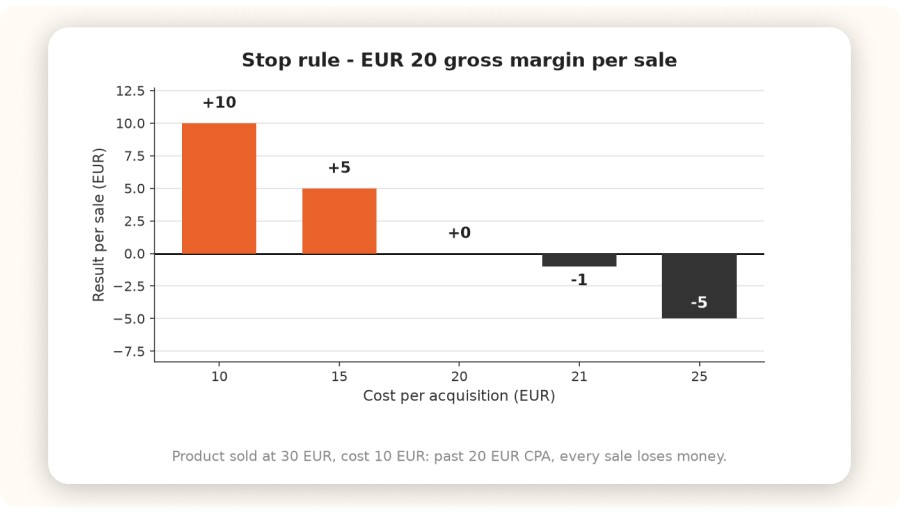
Once cost per acquisition exceeds gross margin, every additional sale loses money, in December exactly as in June. The difference is that in December you lose it faster, because you are spending more per click.
The testing structure does not change: one campaign per product, 5–10 adsets, three days to decide, cost per acquisition as the stop rule. Full detail in my Facebook Ads walkthrough.
Sourcing for Q4
The supplier decision matters more this quarter than any other.
For a beginner, the standard route remains a marketplace, accepting that the cut-off arrives in November.
At volume, a sourcing agent changes the economics: faster shipping routes, quality control before dispatch, and a real interlocutor when December goes wrong, covered in my video on dropshipping suppliers and compared in best dropshipping suppliers.
The Q4-specific criterion: does this supplier have stock in a warehouse near your customers? That single question decides whether you can sell past the end of November.
Finding what is already selling
You do not have to guess what works this season. Products being advertised persistently right now are being paid for repeatedly, which is the closest public evidence available.
The free route is the Meta Ad Library and the TikTok Creative Center, method in how to check competitor ads.
What matters in Q4 is timing the observation: an advertiser who started a Christmas campaign in September and is still running it in October has validated something. One who started last week has validated nothing yet.
A realistic timeline
September–October. Research, source, test. This is where the work happens. Products validated now are the ones you scale in November.
Early November. Scale what works. Confirm supplier stock and dispatch times in writing.
Mid to late November. Last window for long shipping. Set and publish your order cut-off.
December. Sell only what you can deliver. Push local-warehouse products. Resist the urge to launch anything new.
After your cut-off. Switch messaging to post-Christmas: self-purchase, January use, gift cards if you have them.
Minea
Top 100 best-performing products this month
Detected in real time by our AI from market signals: real sales, advertising statistics, and performance

FAQ
When should I start Christmas dropshipping?
September or October for research and testing, so you scale in November with products you have already validated. A store launched in December is realistically launched for the following year, there is no time left to test, and Q4 advertising costs punish untested products.
What is the shipping cut-off for Christmas dropshipping?
Work backwards from 24 December: subtract your carrier's delivery window, your supplier's real dispatch time, and a buffer for December delays. With 15–25 day shipping from Asia, that typically lands in late November. After that date, only stock in a local or European warehouse can be sold as a Christmas gift.
Are Christmas products still profitable in 2026?
Yes, but with less margin than the rest of the year. Advertising costs rise in Q4 because every retailer is bidding for the same attention. Price with more headroom than usual and treat three times product cost as a floor rather than a target.
What Christmas products sell best?
Rather than specific items, which change every season, the categories that hold up are gift-intent products with an obvious recipient, seasonal decoration, and practical products with a visible demonstration. Avoid anything with sizing, fragility, or a supplier who only ships from Asia.
Can I still dropship for Christmas if I start in November?
Only with products stocked in a local or European warehouse, and only if you publish an honest order cut-off. Selling a gift you cannot deliver before 24 December produces refunds, chargebacks and reviews that outlast the season.
Christmas is the only period of the year where the deadline matters more than the product. A good product that arrives on 27 December is a refund, and a mediocre product that arrives on 20 December is a sale.
That single fact should drive every decision you make this quarter. This guide covers the calendar first, then the categories that still work, then the margin arithmetic, in that order, because getting the order wrong is how people lose money in Q4.
TL;DR, Christmas dropshipping in 2026
Work backwards from the shipping cut-off, not forwards from the product.
Stop taking orders you cannot deliver before 24 December, a late gift is a guaranteed refund and a chargeback risk.
European or domestic warehouses matter more in Q4 than in any other period. Long shipping from Asia stops being viable around mid-November.
Advertising costs rise sharply in Q4. A product with €20 margin in October may have €8 in December.
Gift-intent products beat self-purchase products: something bought *for* someone else has different criteria.
Start in September or October. A store launched in December is launched for next year.
First: the calendar decides everything
Before choosing a single product, fix three dates.
Your supplier's dispatch time. Not the marketing promise, the real one. Ask, and add days for Q4 volume.
Your carrier's delivery window. Domestic and EU carriers publish Christmas cut-offs; note them for your market.
Your own order cut-off. This is the date you stop accepting orders for Christmas delivery. Work backwards from 24 December, subtract carrier time, subtract dispatch time, then subtract a buffer for the delays that always happen in December.
That last date is the one that protects you. Publish it visibly on the product page and in checkout. Sellers who skip this step spend January processing refunds.
Practical consequence: if you are sourcing from Asia with 15–25 day shipping, your order cut-off lands around late November. After that, only products in a European or domestic warehouse can be sold as Christmas gifts.
Categories that hold up
Rather than a list of specific products, which ages within weeks and which nobody can verify, here are the categories whose economics work in Q4, and why.
Gift-intent products. A gift is chosen with different criteria than a self-purchase: presentation matters, the price band is tighter, and the buyer often knows less about the category. Products that photograph well and explain themselves in three seconds do disproportionately well.
Products with an obvious recipient. "For someone who cooks", "for a cat owner", "for someone who is always cold". A clear recipient makes the ad write itself and the targeting obvious.
Decoration and ambience. Seasonal by definition, bought early, and the buyer is not comparing prices across ten stores.
Practical products with a visible demonstration. The wow effect that works all year works harder at Christmas, because the buyer is scrolling for ideas rather than searching for a specific item.
What to avoid in Q4 specifically: anything with sizing (returns), anything fragile (December logistics), anything electronic requiring a warranty conversation, and anything whose only supplier ships from Asia after mid-November.
The general criteria still apply, the full set is in the product research checklist and in how to find winning products for Facebook Ads.
The Q4 margin problem nobody plans for
Advertising costs rise in Q4. Every retailer with a budget is bidding against you, on the same platforms, for the same attention. That pressure peaks between Black Friday and mid-December.
This changes the arithmetic on products you have already validated.
A product showing €20 of gross margin in October can be underwater in December, not because anything about the product changed, but because the cost of acquiring the customer did.
Real net margin in dropshipping already runs closer to 20–25% than the 80% a naive calculation suggests, I work through the full calculation in my breakdown of how dropshipping actually works. In Q4, assume that number gets worse before it gets better.
What to do about it: price with more headroom than usual. If your normal rule is three times product cost, Q4 is where that becomes a floor rather than a target.
The stop rule still applies, more strictly
The temptation in Q4 is to keep a losing campaign running because "it is Christmas and volume will come". It does not work that way.
Once cost per acquisition exceeds gross margin, every additional sale loses money, in December exactly as in June. The difference is that in December you lose it faster, because you are spending more per click.
The testing structure does not change: one campaign per product, 5–10 adsets, three days to decide, cost per acquisition as the stop rule. Full detail in my Facebook Ads walkthrough.
Sourcing for Q4
The supplier decision matters more this quarter than any other.
For a beginner, the standard route remains a marketplace, accepting that the cut-off arrives in November.
At volume, a sourcing agent changes the economics: faster shipping routes, quality control before dispatch, and a real interlocutor when December goes wrong, covered in my video on dropshipping suppliers and compared in best dropshipping suppliers.
The Q4-specific criterion: does this supplier have stock in a warehouse near your customers? That single question decides whether you can sell past the end of November.
Finding what is already selling
You do not have to guess what works this season. Products being advertised persistently right now are being paid for repeatedly, which is the closest public evidence available.
The free route is the Meta Ad Library and the TikTok Creative Center, method in how to check competitor ads.
What matters in Q4 is timing the observation: an advertiser who started a Christmas campaign in September and is still running it in October has validated something. One who started last week has validated nothing yet.
A realistic timeline
September–October. Research, source, test. This is where the work happens. Products validated now are the ones you scale in November.
Early November. Scale what works. Confirm supplier stock and dispatch times in writing.
Mid to late November. Last window for long shipping. Set and publish your order cut-off.
December. Sell only what you can deliver. Push local-warehouse products. Resist the urge to launch anything new.
After your cut-off. Switch messaging to post-Christmas: self-purchase, January use, gift cards if you have them.
Minea
Top 100 best-performing products this month
Detected in real time by our AI from market signals: real sales, advertising statistics, and performance
FAQ
When should I start Christmas dropshipping?
September or October for research and testing, so you scale in November with products you have already validated. A store launched in December is realistically launched for the following year, there is no time left to test, and Q4 advertising costs punish untested products.
What is the shipping cut-off for Christmas dropshipping?
Work backwards from 24 December: subtract your carrier's delivery window, your supplier's real dispatch time, and a buffer for December delays. With 15–25 day shipping from Asia, that typically lands in late November. After that date, only stock in a local or European warehouse can be sold as a Christmas gift.
Are Christmas products still profitable in 2026?
Yes, but with less margin than the rest of the year. Advertising costs rise in Q4 because every retailer is bidding for the same attention. Price with more headroom than usual and treat three times product cost as a floor rather than a target.
What Christmas products sell best?
Rather than specific items, which change every season, the categories that hold up are gift-intent products with an obvious recipient, seasonal decoration, and practical products with a visible demonstration. Avoid anything with sizing, fragility, or a supplier who only ships from Asia.
Can I still dropship for Christmas if I start in November?
Only with products stocked in a local or European warehouse, and only if you publish an honest order cut-off. Selling a gift you cannot deliver before 24 December produces refunds, chargebacks and reviews that outlast the season.
Similar articles


How to dropship tech products for ecommerce profit: a 7-step playbook for 2026
Best niche products dropshipping
How to dropship tech products for ecommerce profit: a 7-step playbook for 2026
Best niche products dropshipping
How to dropship tech products for ecommerce profit: a 7-step playbook for 2026
Best niche products dropshipping
How to dropship tech products for ecommerce profit: a 7-step playbook for 2026
Best niche products dropshipping




Our Free Adspys

Find winning products on our Tiktok adspy today!
Find winning products on our Facebook adspy today!
Find winning products on our Tiktok adspy today!
Find winning products on our Facebook adspy today!
Find winning products on our Tiktok adspy today!
Find winning products on our Facebook adspy today!
Find winning products on our Tiktok adspy today!
Find winning products on our Facebook adspy today!
1 winning product everyday.
Follow us!






Find out more
Read more
Minea © 2026
Find out more
Read more
Minea © 2026
Find out more
Read more
Minea © 2026
Find out more
Read more
Minea © 2026
Find out more
Read more
Minea © 2026
Find out more
Read more
Minea © 2026