How to Use Minea Shop Spy Tool to Find Winning Dropshipping Products in 20 Minutes (2026)
Find Competitors Websites
Author: Baptiste
Contents
You spend hours scrolling through product databases, wondering which items actually sell. Meanwhile, successful dropshippers already cracked the code: they spy on stores that are already winning and reverse-engineer their strategy.
This guide shows you how to use Minea's Shop Spy tool to go from competitor discovery to product validation in 20 minutes. You'll identify profitable stores, extract their product catalog, analyze their ad strategy, and validate demand, all before ordering your first sample. Total time: 20 minutes per store analysis. Cost: $49/mo Minea Starter plan.
What You'll Achieve:
Identify 3-5 active dropshipping stores in your target niche
Extract their top-selling products with pricing and supplier data
Analyze their ad creatives and positioning angles
Validate product demand with real revenue estimates
Time: 20 minutes per store analysis
Cost: $49/mo (Minea Starter)
Skill level: Beginner to intermediate
Before You Start: What You Need
Minea Shop Spy requires a Minea account (Starter or higher) and basic familiarity with Shopify store structures. You'll analyze competitor stores to extract actionable product intelligence.
Required tools:
Minea account ($49/mo Starter minimum), sign up at minea.com
Browser with ad blocker disabled (Shop Spy analyzes store tech stacks)
Notepad or spreadsheet to track findings
20-30 minutes of focused analysis time
Optional but recommended:
AliExpress or Alibaba account for supplier cross-reference
Shopify store (free trial works) for product import testing

Step 1: Find Active Dropshipping Stores in Your Niche
Minea's database tracks over 500,000 Shopify stores. Use filters to surface stores that are actively running ads, generating sales, and operating in your target market.
Time: 5 minutes
Cost: Free (included in Minea)
Tool: Minea Shop Spy
Open Minea and navigate to the Shop Spy tab in the main navigation. This is separate from AdSpy, Shop Spy focuses on store analysis, not individual ads.
Set your filters: 1. Country: United States (or your target market) 2. Store Status: Active (green indicator) 3. Ad Activity: Currently running ads (this proves they're spending money, which means they're profitable or testing) 4. Traffic Estimate: 10,000+ monthly visits minimum 5. Niche: Select your category (Beauty, Fitness, Home & Garden, etc.)
Click Search. You'll see 50-200 stores that match your criteria.
What to look for:
Stores with 5+ active ads in the last 30 days
Revenue estimates above $500/day
Recent ad creative uploads within the last 7 days
Common mistake: Filtering only by highest revenue. Those stores have established brands and can't be easily replicated. Target stores making $500-$3,000/day, profitable but still lean enough to reverse-engineer.
Step 2: Analyze Store Product Mix and Pricing Strategy
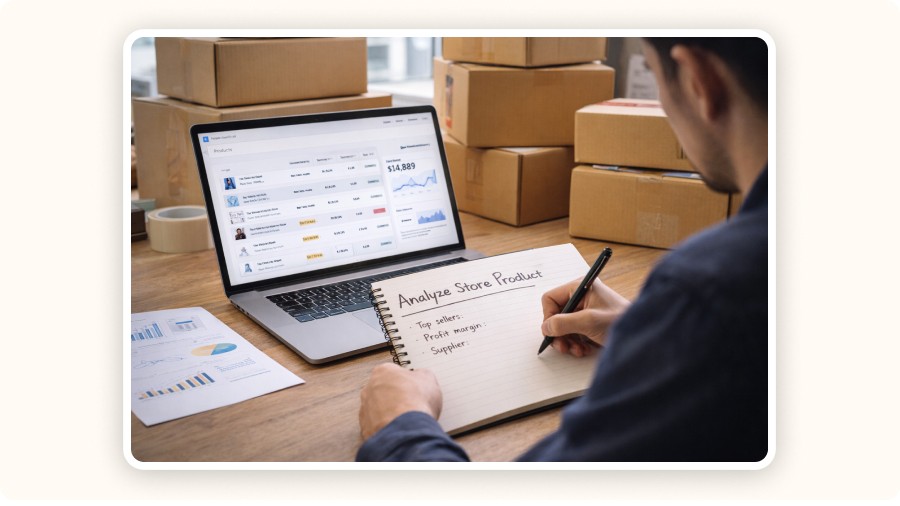
Shop Spy reveals the exact products a store sells, their pricing, and how long they've been featured. This tells you what's working NOW, not what worked six months ago.
Time: 5 minutes
Cost: Free
Tool: Minea Shop Spy store detail view
Click into a store from your search results. You'll land on the Store Overview page with four key tabs: Products, Ads, Tech Stack, and Performance.
Go to the Products tab. You'll see:
Product images and titles
Current price
Days listed on the store
Estimated monthly orders
Sort by "Estimated Orders" (highest first). The top 5-10 products are their winners.
What to analyze:
1. Price positioning: Are they selling at $29.99, $49.99, or $79.99? This reveals their margin strategy.
2. Product freshness: Items listed for 30+ days with high order estimates signal proven winners. Items listed under 7 days signal viral spikes that are riskier to replicate.
3. Product clusters: Multiple variations of the same item category signal category dominance, not one-hit wonder luck.
Minea Insight: Minea's Shop Spy currently tracks over 12 million products across active Shopify stores. Products with 10+ duplications (other stores selling the same item) signal either saturation or validated demand. Check the duplication count on each product card.
Common mistake: Copying the product with the MOST orders. That product often has the most ad spend behind it. Look for products with strong order volume but lower duplication counts under 15 stores. That's the sweet spot, validated but not saturated.
Step 3: Reverse-Engineer Their Ad Strategy
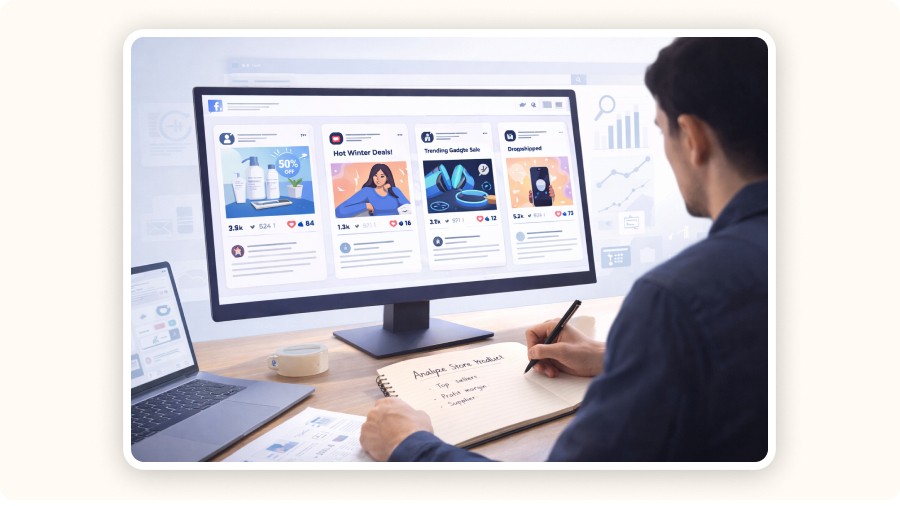
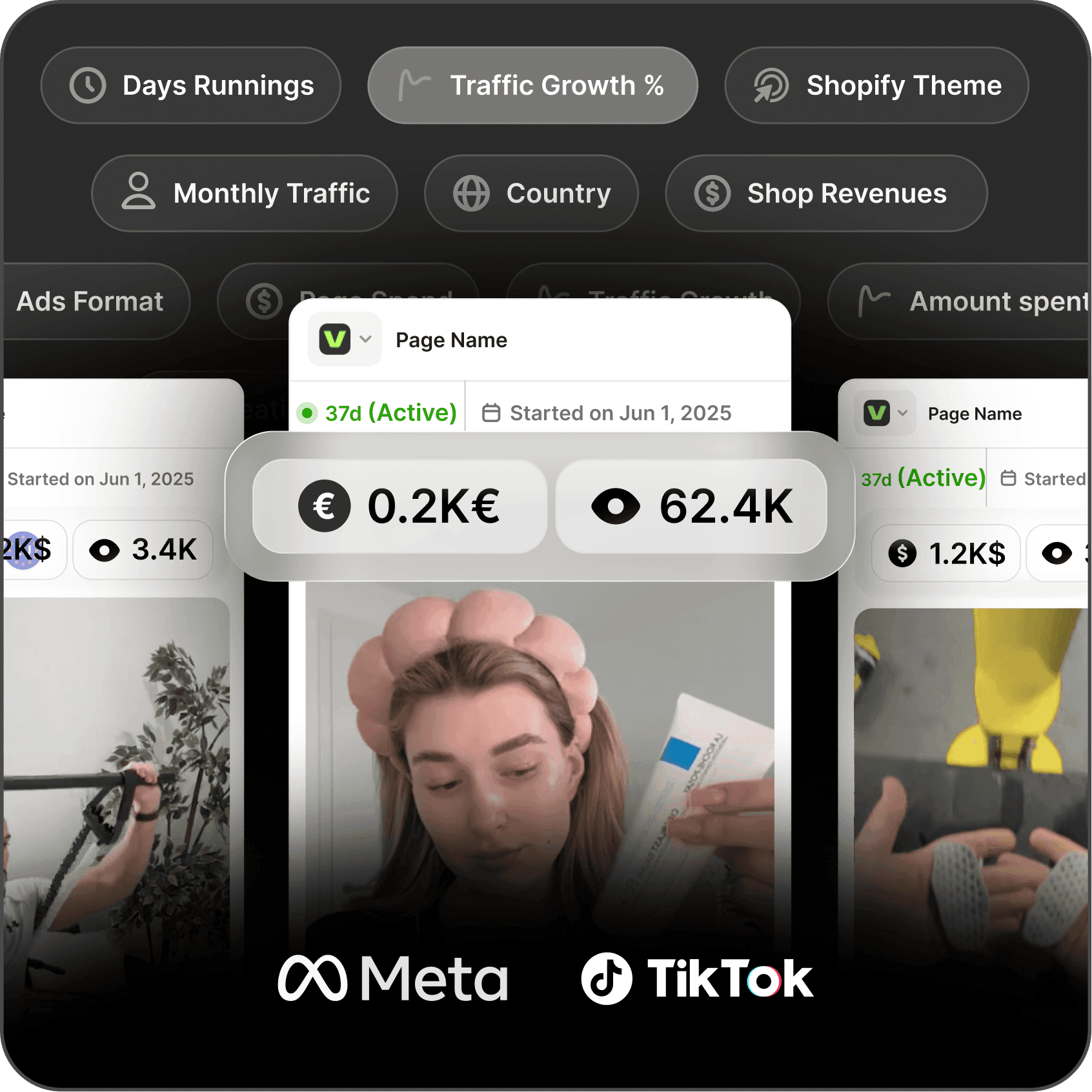
Knowing what they sell is half the intel. Knowing HOW they sell it, the angles, hooks, and creative formats, is the other half. Minea connects store products to their active ad campaigns.
Time: 5 minutes
Cost: Free
Tool: Minea Shop Spy + AdSpy integration
From the Store Overview page, click the Ads tab. You'll see all active and recent ads the store is running, organized by recency.
Filter by:
Platform: TikTok or Facebook (depending on where you plan to advertise)
Media Type: Video (video ads dominate e-commerce in 2026)
Date Range: Last 30 days
Click on an ad to see:
Full video or image creative
Ad copy (headline + body text)
CTA button text
Engagement metrics (likes, shares, comments)
Launch date and days running
What to extract: 1. Positioning angle: Are they selling a benefit ("fix your posture in 14 days"), a feeling ("feel confident in any outfit"), or urgency ("limited stock, selling out fast")? 2. Creative format: UGC-style testimonial? Product demo? Before/after? Founder story? 3. Ad longevity:Ads running for 60+ days = profitable. Ads running for 3-5 days = test phase (don't copy yet).
Reddit Reality Check: One seller on r/dropshipping reported: "I found a store doing $2K/day with ONE product. Their ads all used the same hook: 'Amazon sells this for $89, we found the supplier.' Copied the angle, different product, scaled to $800/day in 3 weeks."
Common mistake: Copying the ad creative pixel-for-pixel. Extract the STRUCTURE and ANGLE, then create your own version with original footage or sourced UGC.


Step 4: Validate Supplier and Margins
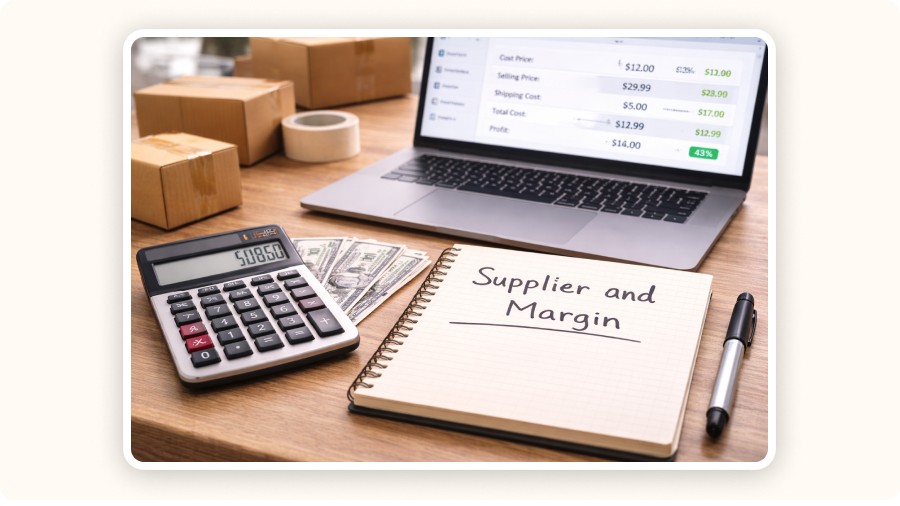
You've identified a winning product and the ad angle that sells it. Now validate you can source it profitably. Minea connects products to supplier platforms.
Time: 3 minutes
Cost: Free (research phase)
Tool: Minea product detail + AliExpress/CJ Dropshipping
Go back to the Products tab and click on a product you want to validate.
Minea shows:
Product title and image
Store's selling price
Estimated supplier cost (if Minea has AliExpress data linked)
Similar products on supplier platforms
If supplier data is pre-linked: Click through to see the AliExpress or CJ Dropshipping listing. Check:
Supplier price (should be 30-40% of retail for healthy margins)
Shipping time to your target country (15+ days = mention it in ad copy)
Supplier rating (4.5+ stars, 1,000+ orders minimum)
Order volume (500+ orders in last 30 days = reliable supply)
If no supplier link is shown: Copy the product image, open AliExpress, and use their image search feature. Find the same or similar product.
Margin calculation:
Store sells for: $49.99
Supplier cost: $12.50
Shipping: $3.50
Payment processing (3%): $1.50
Ad cost per sale (benchmark): $15-20
Net profit: $12-17 per sale
If your net profit is under $10/sale, skip this product. Low-margin products require massive volume to be worth it.
Common mistake: Ignoring shipping time. If the supplier ships from China with 20-day delivery, communicate that upfront in your store policy and ad disclaimers to avoid chargebacks.
Step 5: Cross-Check Demand with Minea AdSpy
A product might sell well on ONE store because that store has a strong brand or email list. Validate the product has MARKET demand, not just single-store demand.
Time: 2 minutes
Cost: Free
Tool: Minea AdSpy
Open a new tab and go to Minea's AdSpy tool. Search for the product you're validating.
Use these filters:
Keyword: Enter the product name or category (e.g., "posture corrector", "LED face mask")
Date: Last 60 days
Platform: All platforms (Facebook, TikTok, Pinterest)
Country: Your target market
What you're checking:
How many OTHER stores are advertising this product? (Minea shows duplicate count)
Are ads still active or did they die after 5 days? (Active = demand holds, dead = fad)
What's the engagement spread? (If 10 stores run ads but only 2 have strong engagement, the product is hard to sell)
Minea Insight: Products with 8-15 active advertisers signal validated demand without saturation. Under 5 advertisers = unproven or niche. Over 25 advertisers = saturated, margins compressed by competition.
Decision framework:
0-5 advertisers: High risk (unproven demand) but high reward (no competition). Good for experienced sellers willing to test.
8-15 advertisers: Sweet spot. Demand is validated, competition is manageable.
20+ advertisers: Saturated. Only enter if you have a unique angle or cost advantage.
Common Mistakes (and How to Fix Them)
Most beginners copy the PRODUCT but miss the SYSTEM. Successful stores combine product + angle + pricing + trust signals. Here's what to avoid.
Copying only the top-selling product: High-volume products often have high ad spend behind them. Instead, look for products ranked #3-7 by order volume — proven sellers with less competition and lower CPA.
Ignoring the tech stack: Check the Tech Stack tab to see what apps successful stores use. Common stack: Judge.me for reviews, Klaviyo for email, ReConvert for upsells. A bare-bones store will underperform even with identical ads.
Skipping ad longevity analysis: Ads running 90+ days signal profitability. Ads running under 7 days are tests. Don't replicate test-phase ads — validate engagement metrics first: CTR above 2%, engagement rate above 5%.
Using the exact same supplier: If 15 dropshippers source from one AliExpress supplier, one stock-out kills everyone's store. Search for 2-3 alternative suppliers to diversify risk.
Expected Results + Timeline
Minea Shop Spy is intelligence gathering, not a magic profit button. Here's a realistic timeline from research to revenue.
Timeframe | What to Expect | Benchmark |
|---|---|---|
Day 1-2 | Analyze 10-15 stores, shortlist 3-5 products | Time invested: 2-3 hours total |
Day 3-5 | Order samples from suppliers, test quality | Cost: $50-100 in samples + shipping |
Week 1 | Import winning product to Shopify, write copy | Store setup: 4-6 hours |
Week 2 | Launch test ads with angles extracted from Minea | Ad budget: $15-20 per angle, test 3 angles |
Week 3-4 | Scale winning ads, kill losing angles | Expect 20-50 orders if CTR >1.5% and CVR >2% |
Month 2 | Optimize store, add upsells, expand product line | Revenue target: $3K-10K depending on ad budget |
Realistic expectations: Most sellers test 8-12 products before finding a consistent winner. Minea Shop Spy compresses research time from weeks to hours, but execution still requires testing, iteration, and ad spend.
If your first product flops, don't blame the tool, review your supplier quality, ad creative execution, and pricing strategy. The intel is accurate; the execution variables are on you.
Verdict
Minea Shop Spy turns competitor research from guesswork into a systematic process. You're not hoping a product works, you're reverse-engineering stores that are ALREADY profitable and replicating their strategy with better execution. The 20-minute analysis framework in this guide eliminates months of blind product testing.
The key differentiator: Shop Spy connects products to ads to suppliers in one dashboard. You're not jumping between six tools to piece together intelligence. Start with stores making $500-$3K/day, extract their top 5 products, validate with AdSpy duplication data, and test the top 2. That's the playbook.
The Minea Shop Spy tool helps you identify winning dropshipping products by analyzing real stores, ad strategies, and supplier data. For a deeper breakdown of Minea's full feature set, see Minea's complete product research guide.
FAQ
What's the difference between Minea Shop Spy and AdSpy?
Shop Spy analyzes Shopify stores — their product catalog, revenue estimates, tech stack, and active ads. AdSpy analyzes individual ads across platforms without the store context. Use Shop Spy to find winning stores and extract their product strategy. Use AdSpy to validate demand across multiple advertisers. The two tools complement each other: Shop Spy for store intelligence, AdSpy for market-wide validation.
Can I use Shop Spy to find suppliers directly?
Minea links products to supplier platforms like AliExpress when data is available, but it's not a supplier directory. Use Shop Spy to identify which products successful stores are selling, then validate suppliers manually on AliExpress, CJ Dropshipping, or Alibaba. Cross-check supplier ratings, order volume, and shipping times before committing.
How accurate are Minea's revenue estimates?
Minea estimates revenue based on traffic data, conversion signals, and historical order patterns. Estimates are directional, not exact, think ±20-30% margin of error. A store showing $1,000/day might actually do $700-1,300/day. Use revenue estimates to filter for active, profitable stores, not as gospel for financial projections.
Do I need a Premium plan to access Shop Spy?
No. Minea's Starter plan ($49/mo) includes full Shop Spy access with store search, product analysis, and ad viewing. Premium and Business plans add features like Success Radar (product trend scoring), deeper historical data, and influencer tracking, but core Shop Spy functionality is available at the Starter tier.
What if the store I'm analyzing stops running ads?
That's useful intelligence. If a store stops advertising a product after 10-15 days, the product likely didn't hit ROAS targets. Don't replicate it. Focus on stores with ad campaigns running 30+ days continuously,, that signals profitability. Use Minea's date filters to surface only recently active ads.
Disclosure: This article is published by Minea, the leading ad spy and product research platform for e-commerce and dropshipping. All product recommendations are based on platform data and industry analysis. Minea is a paid tool; this guide demonstrates its Shop Spy functionality. We do not receive affiliate commissions from mentioned suppliers.
Similar articles