Minea vs Dropship.io (2026): Which Ad Spy Tool Fits Your Workflow?
Competitor Spy Tools
Author: Prince
Contents
Most comparisons of these two tools try to crown a winner. That framing is wrong, because Dropship.io and Minea answer different questions.
Dropship.io answers what is already selling. Minea answers what is being advertised right now. Those are different moments in a product's life, and the right tool depends on which moment a seller works in.
This comparison covers what each tool does, what each costs in 2026, and which signal fits which workflow.
One asymmetry, stated up front: the Minea side draws on years of documented usage by its founder, linked throughout so you can verify it. The Dropship.io side is built from public information, its own documentation, pricing and third-party reviews. That is an uneven evidence base, and worth knowing before weighing anything below.
TL;DR, Minea vs Dropship.io
Dropship.io is built around store and sales tracking: revenue estimates for Shopify stores, weekly best-seller lists, a sales tracker.
Minea is built around ad intelligence: ads across Facebook, TikTok, Pinterest and other placements, with the creative and its longevity attached.
Pricing (2026): Dropship.io runs $39 / $59 / $99 per month; Minea runs $49 / $99 / $199 per month. Both discount for longer commitments.
Use Dropship.io to validate a product that is already moving volume.
Use Minea to catch a product while the ad spend is still ramping.
The two overlap less than their marketing suggests, many sellers run both.
What Dropship.io actually does
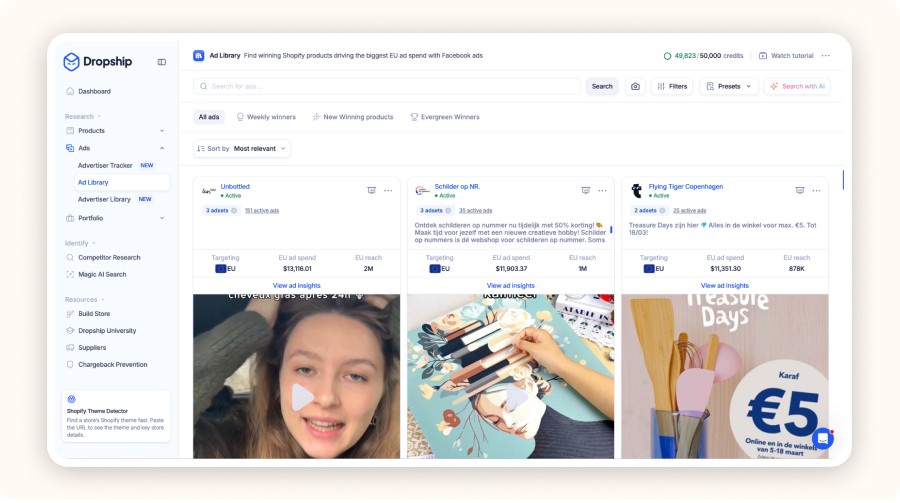
Dropship.io's core is sales estimation. It indexes Shopify stores, estimates their revenue, and exposes that as searchable data: product libraries, sales trackers, weekly best-seller lists, competitor research.
Its 2026 toolset also includes an ad library, an advertiser tracker and a TikTok creator library, an expansion beyond the sales-tracking origin.
The signal is retrospective and quantitative. A product appears because it has already sold. That is its strength: a revenue estimate is concrete in a way an ad impression is not. It is also its limit, by the time a product ranks in a best-seller list, the sellers who found it early have been running it for weeks.
What Minea actually does
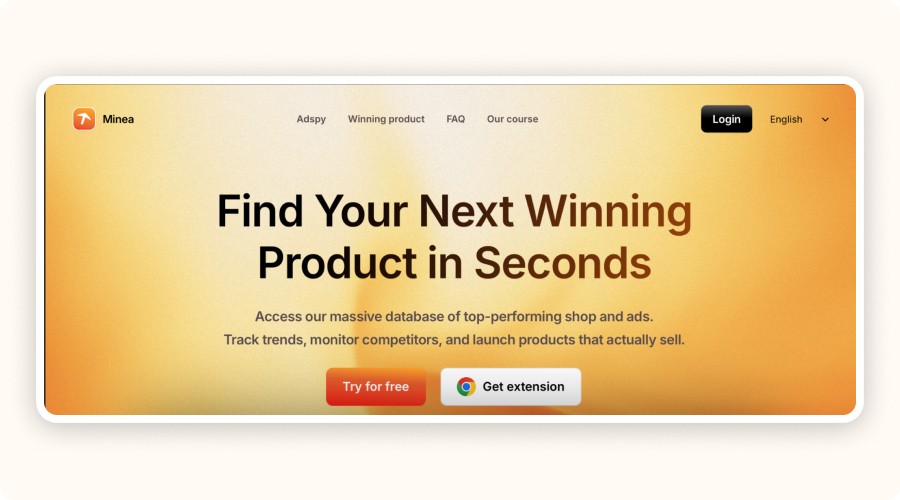
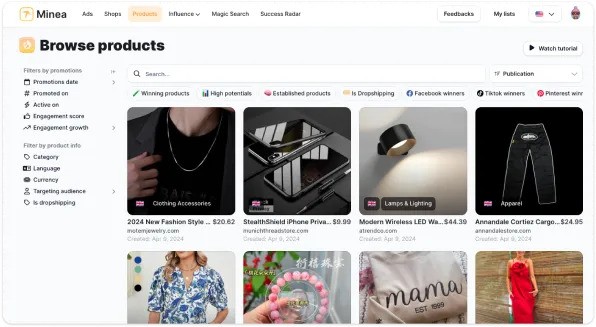
Minea indexes advertising rather than sales. Its ad spy covers Facebook, TikTok, Pinterest and other placements, and surfaces the ad itself: the creative, how long it has run, how engagement built.
The signal is leading and qualitative. An ad that has run for three weeks with rising engagement is a seller spending money repeatedly on something that is working. That shows up before the sales data does.
What that looks like in practice is documented rather than described. Minea's founder works through the filter sequence on camera, engagement band, recency, platform, whether the product is sourceable, in this product-research walkthrough (French); the thresholds themselves are covered in winning dropshipping products. The same walkthrough is blunt about the limit: the tool narrows a field, it does not identify a winner, and he says so directly, searching with one saved filter set returns the same products to everyone using it.
The tradeoff is symmetric: ad longevity is an inference about profitability, not a measurement of it. A well-funded advertiser can run a losing product longer than a bootstrapped one.


Pricing in 2026
Tier | Dropship.io |
|
|---|---|---|
Entry | $39/mo, $26/mo billed annually | Starter $49/mo, $39/mo billed quarterly |
Mid | $59/mo, $34/mo billed annually | Premium $99/mo, $79/mo billed quarterly |
Top | $99/mo, $49/mo billed annually | Business $199/mo, $158/mo billed quarterly |

Screenshot of dropship.io/pricing, 9 August 2026. The page defaults to annual billing, which is why the figures shown are the discounted ones.
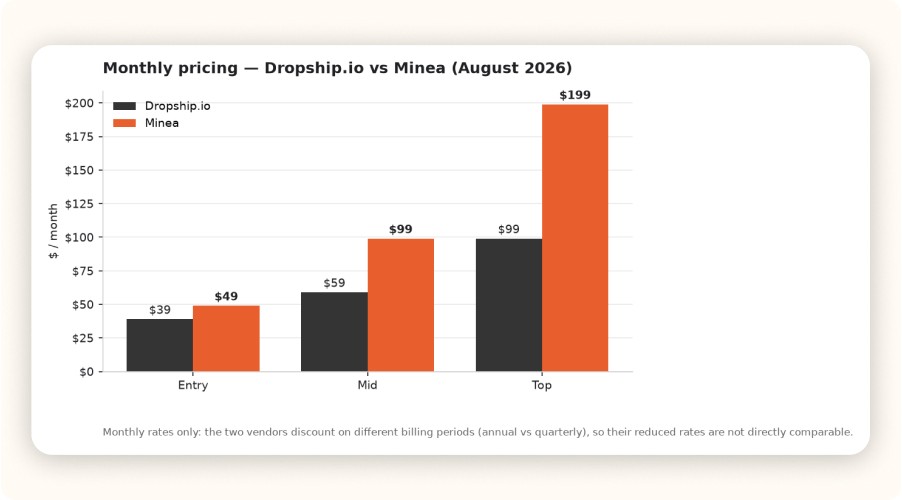
The discounted columns are not directly comparable: Dropship.io's lower rate is for annual prepayment, Minea's for quarterly. A quarterly commitment ties up less cash for less time, so the headline gap is wider than the monthly figures suggest and narrower than the discounted ones. Minea also offers annual billing at a further reduction.
Prices are as published in August 2026 and change. Verify both vendors' pricing pages before committing, tiers, limits and billing periods all move.
The more useful question than sticker price: how many product tests does the tool need to save you to pay for itself? A single avoided product test, creative, sample, and a few days of ad spend, typically costs more than a month of either subscription. Neither tool is expensive relative to what a bad launch costs. Both are expensive if they sit unused.
Product discovery: two different signals
The practical difference shows up in when a product surfaces.
Dropship.io surfaces it after the sales. Suited to a seller who wants evidence before committing: the product has moved units, at a knowable price, in a knowable store.
Minea surfaces it during the ad ramp. Suited to a seller who wants to be early, and who can read a creative to judge whether the angle is repeatable.
Neither is inherently better. A beginner with limited budget usually benefits more from Dropship.io's confirmation. A seller who can produce creative quickly benefits more from Minea's timing.
Sellers who take product research seriously often run both, one to spot, one to confirm, which is also why "which is better" is the wrong question.
Data accuracy: what neither tool can promise
Both platforms publish estimates, and it is worth being blunt about what that means.
Sales estimates are modelled, not reported. No third-party tool has access to a competitor's Shopify admin. Figures come from signals, inventory changes, review velocity, public counters, assembled into an estimate. Useful for ranking and comparison, not reliable as absolute revenue.
Ad data has the opposite profile: an ad's existence and duration are directly observable, but its profitability is not. A long-running ad is evidence of spend, and spend is evidence of something working, an inference, not a measurement.
Any tool in this category presenting either number as fact is overselling.
What the tool cannot fix
Product research decides which products cannot work. It does not decide which one will. That distinction matters more than the choice of tool, and it is where most subscriptions get wasted.
Three failure modes cost more than picking the wrong platform:
Treating a tool's output as a verdict. A product appearing in a best-seller list or a long-running ad is a candidate, not a decision. It still needs testing against your own audience, margin and delivery time.
Copying the offer instead of the mechanism. The same product with the same creative and a worse landing page is a losing campaign. What transfers is the angle, not the asset.
Ignoring timing. A product that met every criterion twelve months ago can be saturated now, and saturation is relative to who is running the ads, the full criteria and how to read them are covered in winning dropshipping products.
Who should choose Dropship.io
Sellers who want sales evidence before spending on creative.
Anyone working primarily in the Shopify ecosystem, where store-level tracking is most complete.
Beginners who want a shorter list with more confirmation behind it.
Who should choose Minea
Sellers who want to see a product while its ad spend is still scaling.
Anyone running multi-platform, TikTok, Pinterest and Facebook in one place.
Sellers who build their own creative and want reference material, not just a product name.
Sellers who work shop-first rather than product-first: the trending-shops view starts from stores rather than individual ads, which its founder demonstrates as the easiest entry point for beginners in this walkthrough (French).
The ad-side signal is the part worth judging first-hand rather than taking on description: Minea can be tried for free to see whether live ad data tells you something the sales data does not.
Verdict
Dropship.io for retrospective sales confirmation. Minea for leading ad signal across platforms.
The honest answer to "which is better" is that they measure different things. The seller who benefits most from Dropship.io wants proof; the seller who benefits most from Minea wants timing. Deciding which of those describes your workflow settles the question faster than any feature table.
If the budget covers only one, start with the signal that matches how you decide, then add the other when product research becomes the bottleneck rather than creative or fulfilment.
Minea
Reach $1,000 per day or get your money back

FAQ
Is Dropship.io legitimate?
Yes. It is an established product-research platform with a public pricing page, a documented feature set and third-party reviews on Trustpilot and Reddit. The fair caveat is about its data, not its legitimacy: revenue figures are estimates.
How much does Dropship.io cost in 2026?
$39, $59 and $99 per month across three tiers, falling to $26, $34 and $49 on annual billing. Check the vendor's pricing page for current limits.
What is the main difference between Minea and Dropship.io?
Dropship.io tracks sales and store revenue. Minea tracks advertising across Facebook, TikTok, Pinterest and other platforms. Sales data is retrospective and quantitative; ad data is leading and qualitative.
Is Dropship.io suitable for beginners?
Reasonably. Sales-based discovery gives a shorter, more confirmed list, which is easier to act on with no experience. The risk is treating a best-seller list as a guarantee rather than a shortlist.
Are there alternatives to Dropship.io?
Yes, Minea, PipiAds and several ad-spy and sales-tracking tools. The useful split is whether a tool tracks sales or ads, since that determines whether you learn what has already sold or what is being pushed right now.
Can you use both tools together?
Many sellers do. A common pattern is Minea to spot a product during its ad ramp, then Dropship.io to check whether sales data supports the signal before committing to creative and inventory.
Most comparisons of these two tools try to crown a winner. That framing is wrong, because Dropship.io and Minea answer different questions.
Dropship.io answers what is already selling. Minea answers what is being advertised right now. Those are different moments in a product's life, and the right tool depends on which moment a seller works in.
This comparison covers what each tool does, what each costs in 2026, and which signal fits which workflow.
One asymmetry, stated up front: the Minea side draws on years of documented usage by its founder, linked throughout so you can verify it. The Dropship.io side is built from public information, its own documentation, pricing and third-party reviews. That is an uneven evidence base, and worth knowing before weighing anything below.
TL;DR, Minea vs Dropship.io
Dropship.io is built around store and sales tracking: revenue estimates for Shopify stores, weekly best-seller lists, a sales tracker.
Minea is built around ad intelligence: ads across Facebook, TikTok, Pinterest and other placements, with the creative and its longevity attached.
Pricing (2026): Dropship.io runs $39 / $59 / $99 per month; Minea runs $49 / $99 / $199 per month. Both discount for longer commitments.
Use Dropship.io to validate a product that is already moving volume.
Use Minea to catch a product while the ad spend is still ramping.
The two overlap less than their marketing suggests, many sellers run both.
What Dropship.io actually does
Dropship.io's core is sales estimation. It indexes Shopify stores, estimates their revenue, and exposes that as searchable data: product libraries, sales trackers, weekly best-seller lists, competitor research.
Its 2026 toolset also includes an ad library, an advertiser tracker and a TikTok creator library, an expansion beyond the sales-tracking origin.
The signal is retrospective and quantitative. A product appears because it has already sold. That is its strength: a revenue estimate is concrete in a way an ad impression is not. It is also its limit, by the time a product ranks in a best-seller list, the sellers who found it early have been running it for weeks.
What Minea actually does
Minea indexes advertising rather than sales. Its ad spy covers Facebook, TikTok, Pinterest and other placements, and surfaces the ad itself: the creative, how long it has run, how engagement built.
The signal is leading and qualitative. An ad that has run for three weeks with rising engagement is a seller spending money repeatedly on something that is working. That shows up before the sales data does.
What that looks like in practice is documented rather than described. Minea's founder works through the filter sequence on camera, engagement band, recency, platform, whether the product is sourceable, in this product-research walkthrough (French); the thresholds themselves are covered in winning dropshipping products. The same walkthrough is blunt about the limit: the tool narrows a field, it does not identify a winner, and he says so directly, searching with one saved filter set returns the same products to everyone using it.
The tradeoff is symmetric: ad longevity is an inference about profitability, not a measurement of it. A well-funded advertiser can run a losing product longer than a bootstrapped one.
Pricing in 2026
Tier | Dropship.io |
|
|---|---|---|
Entry | $39/mo, $26/mo billed annually | Starter $49/mo, $39/mo billed quarterly |
Mid | $59/mo, $34/mo billed annually | Premium $99/mo, $79/mo billed quarterly |
Top | $99/mo, $49/mo billed annually | Business $199/mo, $158/mo billed quarterly |
Screenshot of dropship.io/pricing, 9 August 2026. The page defaults to annual billing, which is why the figures shown are the discounted ones.
The discounted columns are not directly comparable: Dropship.io's lower rate is for annual prepayment, Minea's for quarterly. A quarterly commitment ties up less cash for less time, so the headline gap is wider than the monthly figures suggest and narrower than the discounted ones. Minea also offers annual billing at a further reduction.
Prices are as published in August 2026 and change. Verify both vendors' pricing pages before committing, tiers, limits and billing periods all move.
The more useful question than sticker price: how many product tests does the tool need to save you to pay for itself? A single avoided product test, creative, sample, and a few days of ad spend, typically costs more than a month of either subscription. Neither tool is expensive relative to what a bad launch costs. Both are expensive if they sit unused.
Product discovery: two different signals
The practical difference shows up in when a product surfaces.
Dropship.io surfaces it after the sales. Suited to a seller who wants evidence before committing: the product has moved units, at a knowable price, in a knowable store.
Minea surfaces it during the ad ramp. Suited to a seller who wants to be early, and who can read a creative to judge whether the angle is repeatable.
Neither is inherently better. A beginner with limited budget usually benefits more from Dropship.io's confirmation. A seller who can produce creative quickly benefits more from Minea's timing.
Sellers who take product research seriously often run both, one to spot, one to confirm, which is also why "which is better" is the wrong question.
Data accuracy: what neither tool can promise
Both platforms publish estimates, and it is worth being blunt about what that means.
Sales estimates are modelled, not reported. No third-party tool has access to a competitor's Shopify admin. Figures come from signals, inventory changes, review velocity, public counters, assembled into an estimate. Useful for ranking and comparison, not reliable as absolute revenue.
Ad data has the opposite profile: an ad's existence and duration are directly observable, but its profitability is not. A long-running ad is evidence of spend, and spend is evidence of something working, an inference, not a measurement.
Any tool in this category presenting either number as fact is overselling.
What the tool cannot fix
Product research decides which products cannot work. It does not decide which one will. That distinction matters more than the choice of tool, and it is where most subscriptions get wasted.
Three failure modes cost more than picking the wrong platform:
Treating a tool's output as a verdict. A product appearing in a best-seller list or a long-running ad is a candidate, not a decision. It still needs testing against your own audience, margin and delivery time.
Copying the offer instead of the mechanism. The same product with the same creative and a worse landing page is a losing campaign. What transfers is the angle, not the asset.
Ignoring timing. A product that met every criterion twelve months ago can be saturated now, and saturation is relative to who is running the ads, the full criteria and how to read them are covered in winning dropshipping products.
Who should choose Dropship.io
Sellers who want sales evidence before spending on creative.
Anyone working primarily in the Shopify ecosystem, where store-level tracking is most complete.
Beginners who want a shorter list with more confirmation behind it.
Who should choose Minea
Sellers who want to see a product while its ad spend is still scaling.
Anyone running multi-platform, TikTok, Pinterest and Facebook in one place.
Sellers who build their own creative and want reference material, not just a product name.
Sellers who work shop-first rather than product-first: the trending-shops view starts from stores rather than individual ads, which its founder demonstrates as the easiest entry point for beginners in this walkthrough (French).
The ad-side signal is the part worth judging first-hand rather than taking on description: Minea can be tried for free to see whether live ad data tells you something the sales data does not.
Verdict
Dropship.io for retrospective sales confirmation. Minea for leading ad signal across platforms.
The honest answer to "which is better" is that they measure different things. The seller who benefits most from Dropship.io wants proof; the seller who benefits most from Minea wants timing. Deciding which of those describes your workflow settles the question faster than any feature table.
If the budget covers only one, start with the signal that matches how you decide, then add the other when product research becomes the bottleneck rather than creative or fulfilment.
Minea
Reach $1,000 per day or get your money back
FAQ
Is Dropship.io legitimate?
Yes. It is an established product-research platform with a public pricing page, a documented feature set and third-party reviews on Trustpilot and Reddit. The fair caveat is about its data, not its legitimacy: revenue figures are estimates.
How much does Dropship.io cost in 2026?
$39, $59 and $99 per month across three tiers, falling to $26, $34 and $49 on annual billing. Check the vendor's pricing page for current limits.
What is the main difference between Minea and Dropship.io?
Dropship.io tracks sales and store revenue. Minea tracks advertising across Facebook, TikTok, Pinterest and other platforms. Sales data is retrospective and quantitative; ad data is leading and qualitative.
Is Dropship.io suitable for beginners?
Reasonably. Sales-based discovery gives a shorter, more confirmed list, which is easier to act on with no experience. The risk is treating a best-seller list as a guarantee rather than a shortlist.
Are there alternatives to Dropship.io?
Yes, Minea, PipiAds and several ad-spy and sales-tracking tools. The useful split is whether a tool tracks sales or ads, since that determines whether you learn what has already sold or what is being pushed right now.
Can you use both tools together?
Many sellers do. A common pattern is Minea to spot a product during its ad ramp, then Dropship.io to check whether sales data supports the signal before committing to creative and inventory.
Most comparisons of these two tools try to crown a winner. That framing is wrong, because Dropship.io and Minea answer different questions.
Dropship.io answers what is already selling. Minea answers what is being advertised right now. Those are different moments in a product's life, and the right tool depends on which moment a seller works in.
This comparison covers what each tool does, what each costs in 2026, and which signal fits which workflow.
One asymmetry, stated up front: the Minea side draws on years of documented usage by its founder, linked throughout so you can verify it. The Dropship.io side is built from public information, its own documentation, pricing and third-party reviews. That is an uneven evidence base, and worth knowing before weighing anything below.
TL;DR, Minea vs Dropship.io
Dropship.io is built around store and sales tracking: revenue estimates for Shopify stores, weekly best-seller lists, a sales tracker.
Minea is built around ad intelligence: ads across Facebook, TikTok, Pinterest and other placements, with the creative and its longevity attached.
Pricing (2026): Dropship.io runs $39 / $59 / $99 per month; Minea runs $49 / $99 / $199 per month. Both discount for longer commitments.
Use Dropship.io to validate a product that is already moving volume.
Use Minea to catch a product while the ad spend is still ramping.
The two overlap less than their marketing suggests, many sellers run both.
What Dropship.io actually does
Dropship.io's core is sales estimation. It indexes Shopify stores, estimates their revenue, and exposes that as searchable data: product libraries, sales trackers, weekly best-seller lists, competitor research.
Its 2026 toolset also includes an ad library, an advertiser tracker and a TikTok creator library, an expansion beyond the sales-tracking origin.
The signal is retrospective and quantitative. A product appears because it has already sold. That is its strength: a revenue estimate is concrete in a way an ad impression is not. It is also its limit, by the time a product ranks in a best-seller list, the sellers who found it early have been running it for weeks.
What Minea actually does
Minea indexes advertising rather than sales. Its ad spy covers Facebook, TikTok, Pinterest and other placements, and surfaces the ad itself: the creative, how long it has run, how engagement built.
The signal is leading and qualitative. An ad that has run for three weeks with rising engagement is a seller spending money repeatedly on something that is working. That shows up before the sales data does.
What that looks like in practice is documented rather than described. Minea's founder works through the filter sequence on camera, engagement band, recency, platform, whether the product is sourceable, in this product-research walkthrough (French); the thresholds themselves are covered in winning dropshipping products. The same walkthrough is blunt about the limit: the tool narrows a field, it does not identify a winner, and he says so directly, searching with one saved filter set returns the same products to everyone using it.
The tradeoff is symmetric: ad longevity is an inference about profitability, not a measurement of it. A well-funded advertiser can run a losing product longer than a bootstrapped one.
Pricing in 2026
Tier | Dropship.io |
|
|---|---|---|
Entry | $39/mo, $26/mo billed annually | Starter $49/mo, $39/mo billed quarterly |
Mid | $59/mo, $34/mo billed annually | Premium $99/mo, $79/mo billed quarterly |
Top | $99/mo, $49/mo billed annually | Business $199/mo, $158/mo billed quarterly |
Screenshot of dropship.io/pricing, 9 August 2026. The page defaults to annual billing, which is why the figures shown are the discounted ones.
The discounted columns are not directly comparable: Dropship.io's lower rate is for annual prepayment, Minea's for quarterly. A quarterly commitment ties up less cash for less time, so the headline gap is wider than the monthly figures suggest and narrower than the discounted ones. Minea also offers annual billing at a further reduction.
Prices are as published in August 2026 and change. Verify both vendors' pricing pages before committing, tiers, limits and billing periods all move.
The more useful question than sticker price: how many product tests does the tool need to save you to pay for itself? A single avoided product test, creative, sample, and a few days of ad spend, typically costs more than a month of either subscription. Neither tool is expensive relative to what a bad launch costs. Both are expensive if they sit unused.
Product discovery: two different signals
The practical difference shows up in when a product surfaces.
Dropship.io surfaces it after the sales. Suited to a seller who wants evidence before committing: the product has moved units, at a knowable price, in a knowable store.
Minea surfaces it during the ad ramp. Suited to a seller who wants to be early, and who can read a creative to judge whether the angle is repeatable.
Neither is inherently better. A beginner with limited budget usually benefits more from Dropship.io's confirmation. A seller who can produce creative quickly benefits more from Minea's timing.
Sellers who take product research seriously often run both, one to spot, one to confirm, which is also why "which is better" is the wrong question.
Data accuracy: what neither tool can promise
Both platforms publish estimates, and it is worth being blunt about what that means.
Sales estimates are modelled, not reported. No third-party tool has access to a competitor's Shopify admin. Figures come from signals, inventory changes, review velocity, public counters, assembled into an estimate. Useful for ranking and comparison, not reliable as absolute revenue.
Ad data has the opposite profile: an ad's existence and duration are directly observable, but its profitability is not. A long-running ad is evidence of spend, and spend is evidence of something working, an inference, not a measurement.
Any tool in this category presenting either number as fact is overselling.
What the tool cannot fix
Product research decides which products cannot work. It does not decide which one will. That distinction matters more than the choice of tool, and it is where most subscriptions get wasted.
Three failure modes cost more than picking the wrong platform:
Treating a tool's output as a verdict. A product appearing in a best-seller list or a long-running ad is a candidate, not a decision. It still needs testing against your own audience, margin and delivery time.
Copying the offer instead of the mechanism. The same product with the same creative and a worse landing page is a losing campaign. What transfers is the angle, not the asset.
Ignoring timing. A product that met every criterion twelve months ago can be saturated now, and saturation is relative to who is running the ads, the full criteria and how to read them are covered in winning dropshipping products.
Who should choose Dropship.io
Sellers who want sales evidence before spending on creative.
Anyone working primarily in the Shopify ecosystem, where store-level tracking is most complete.
Beginners who want a shorter list with more confirmation behind it.
Who should choose Minea
Sellers who want to see a product while its ad spend is still scaling.
Anyone running multi-platform, TikTok, Pinterest and Facebook in one place.
Sellers who build their own creative and want reference material, not just a product name.
Sellers who work shop-first rather than product-first: the trending-shops view starts from stores rather than individual ads, which its founder demonstrates as the easiest entry point for beginners in this walkthrough (French).
The ad-side signal is the part worth judging first-hand rather than taking on description: Minea can be tried for free to see whether live ad data tells you something the sales data does not.
Verdict
Dropship.io for retrospective sales confirmation. Minea for leading ad signal across platforms.
The honest answer to "which is better" is that they measure different things. The seller who benefits most from Dropship.io wants proof; the seller who benefits most from Minea wants timing. Deciding which of those describes your workflow settles the question faster than any feature table.
If the budget covers only one, start with the signal that matches how you decide, then add the other when product research becomes the bottleneck rather than creative or fulfilment.
Minea
Reach $1,000 per day or get your money back
FAQ
Is Dropship.io legitimate?
Yes. It is an established product-research platform with a public pricing page, a documented feature set and third-party reviews on Trustpilot and Reddit. The fair caveat is about its data, not its legitimacy: revenue figures are estimates.
How much does Dropship.io cost in 2026?
$39, $59 and $99 per month across three tiers, falling to $26, $34 and $49 on annual billing. Check the vendor's pricing page for current limits.
What is the main difference between Minea and Dropship.io?
Dropship.io tracks sales and store revenue. Minea tracks advertising across Facebook, TikTok, Pinterest and other platforms. Sales data is retrospective and quantitative; ad data is leading and qualitative.
Is Dropship.io suitable for beginners?
Reasonably. Sales-based discovery gives a shorter, more confirmed list, which is easier to act on with no experience. The risk is treating a best-seller list as a guarantee rather than a shortlist.
Are there alternatives to Dropship.io?
Yes, Minea, PipiAds and several ad-spy and sales-tracking tools. The useful split is whether a tool tracks sales or ads, since that determines whether you learn what has already sold or what is being pushed right now.
Can you use both tools together?
Many sellers do. A common pattern is Minea to spot a product during its ad ramp, then Dropship.io to check whether sales data supports the signal before committing to creative and inventory.
Similar articles




Our Free Adspys

Find winning products on our Tiktok adspy today!
Find winning products on our Facebook adspy today!
Find winning products on our Tiktok adspy today!
Find winning products on our Facebook adspy today!
Find winning products on our Tiktok adspy today!
Find winning products on our Facebook adspy today!
Find winning products on our Tiktok adspy today!
Find winning products on our Facebook adspy today!
1 winning product everyday.
Follow us!






Find out more
Read more
Minea © 2026
Find out more
Read more
Minea © 2026
Find out more
Read more
Minea © 2026
Find out more
Read more
Minea © 2026
Find out more
Read more
Minea © 2026
Find out more
Read more
Minea © 2026