
BigSpy Alternatives in 2026: 6 Tools, and When Breadth Stops Being Enough
Competitor Spy Tools
Author:
Contents
BigSpy's pitch is breadth: many platforms, a very large advertised library, and a low entry price. For a certain kind of research that is exactly right, and switching away from it would be a downgrade.
The reason people look for alternatives is usually the same one: breadth came at the cost of depth. A search that returns thousands of results across six platforms is not obviously more useful than one that returns forty relevant ones on the platform you actually sell on.
This page covers six alternatives and, more usefully, when each one is worth the switch.
TL;DR, BigSpy alternatives at a glance
BigSpy is genuinely good at cheap, broad scanning. If that is your job, stay.
The common reason to leave is depth: too many results, not enough signal, on the one platform that matters to you.
For Meta depth, AdSpy. For TikTok depth, PiPiAds. Both are specialists and priced accordingly.
For ads plus product data in one place, Minea, and it has a free plan, so the comparison costs nothing to run.
Library size claims across this category are vendor-reported. Test the searches you actually run before believing any of them.
Free tools cover more than expected: the Meta Ad Library and TikTok Creative Center are official and cost nothing.
The comparison
Prices as listed on each vendor's public pricing page, September 2026. Verify before committing to an annual plan.
Tool | Entry price | Platforms | Depth | Product data | Best for |
|---|---|---|---|---|---|
From ~$9/mo | Many | Shallow | No | Cheap, broad scanning | |
Free plan available | Meta, TikTok, Pinterest | Good | Yes | Ads plus product data in one view | |
AdSpy | $149/mo | Meta-focused | Deep | No | Meta historical research |
From ~$77/mo | TikTok-focused | Deep | Partial | TikTok product research | |
$29.90/mo | Meta-focused | Moderate | No | Cheapest paid Meta option | |
Meta Ad Library | Free | Meta | Moderate | No | Checking a named competitor |
What "large library" actually means
Every tool in this category advertises a library size. Those numbers are vendor-reported, they are measured differently by each vendor, and none of them is auditable.
More importantly, total library size is close to irrelevant to your work. What matters is coverage of *your* niche, in *your* market, over the period you care about. A library of half a billion ads that holds forty results for your product category is worse than a smaller index that holds four hundred.
The practical test, before paying anyone: run five searches you would genuinely run, in your target country, and count the usable results. That number is your library size.
The six alternatives
1. Minea, depth on three platforms, with product data

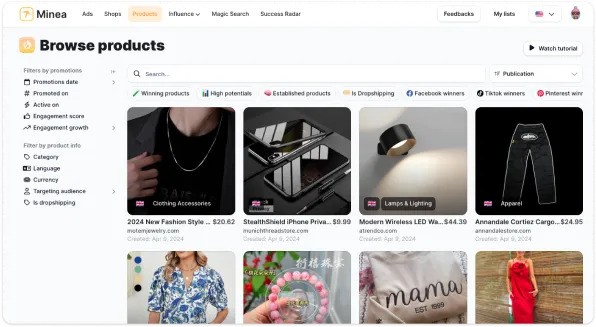
Minea indexes Facebook, TikTok and Pinterest and attaches product-level data. Against BigSpy the trade is explicit: fewer platforms, more signal per search, and commerce data that BigSpy does not carry.
The free plan makes this cheap to verify, run the same five searches in both and compare usable results rather than headline numbers.
Switch if: your searches return volume but not usable candidates, or you keep needing product data BigSpy does not have.
Stay with BigSpy if: you genuinely scan across many platforms and price is the binding constraint.

2. AdSpy, Meta depth

The specialist end of Meta research: deeper historical search, more precise filtering, $149/month with no cheaper tier. A real upgrade over BigSpy for Meta work, and a clear downgrade for everything else. Full field in AdSpy alternatives.
Switch if: all your buying is on Meta and you need historical depth.
3. PiPiAds, TikTok depth

Built around TikTok rather than extended to it. If your products break on TikTok, a specialist index beats a broad one. Comparison in PiPiAds alternatives.
Switch if: TikTok decides your products and BigSpy's TikTok coverage feels thin.
4. Dropispy, cheapest paid Meta option

$29.90/month, or $14.90/month billed annually (August 2026). Narrower than BigSpy in platform coverage, more focused on Meta. A lateral move rather than an upgrade, unless Meta is all you need.
5. The free libraries, Meta Ad Library and TikTok Creative Center
Both free, both official. If your actual usage is checking a handful of named competitors once a week, these cover it and BigSpy's subscription is not buying you anything. Method in how to check competitor ads.
Switch if: you only ever look up competitors you can already name.
6. Dropship.io, a different dataset

Store and product sales estimates rather than ad creatives. Named here because people confuse the two categories; it answers "does this sell", not "how is it sold".
Reading results: depth beats volume
The reason breadth disappoints is that the useful signal is not in how many ads you find, but in how long they have been running.

Most ads stop early. The survivors are being paid for repeatedly, which is the closest public evidence of profitability available. A tool that returns thousands of results but cannot tell you which have been running for six weeks has given you volume instead of an answer.
That is the concrete question to ask of any alternative: does it show longevity reliably, on the platform I sell on?
The filters that matter more than the tool
Whichever tool you land on, the filter recipe decides the output. Mine, explained step by step in my "10 minutes to find a product doing €10,000/day" video:
Ads created in the last 30 days.
Image or video, excluding carousels.
Redirect to a Shopify store.
Between 200 and 7,000 likes, above 200 proves traction, above roughly 10,000 you are late.
And the rule people skip: vary the filters. The same recipe as everyone else surfaces the same products as everyone else.
Then validate it
A tool narrows the field; it does not tell you the product will work. Even after years of this, I am never certain a product *will* sell, only that some definitively cannot, as I explain in this video on succeeding in dropshipping.

Once cost per acquisition passes gross margin, every further sale loses money. Structure detail in my Facebook Ads walkthrough.
Minea
Reach $1,000 per day or get your money back

FAQ
Is there a free BigSpy alternative?
Yes. The Meta Ad Library and TikTok Creative Center are free and official, and cover competitor research on their platforms. Minea offers a free plan spanning Meta, TikTok and Pinterest with product data attached.
What is the cheapest BigSpy alternative?
BigSpy is already among the cheapest paid tools in the category, so most alternatives cost more. The genuinely cheaper route is the free libraries, or a free plan, rather than another subscription.
Is BigSpy or Minea better?
They optimise for different things. BigSpy is broad and shallow across many platforms at a low price; Minea covers Meta, TikTok and Pinterest with more depth per search plus product data. If your searches return volume without usable candidates, the depth-first tool is the better fit.
Are BigSpy's library size claims accurate?
They are vendor-reported and not independently auditable, which is true across this entire category. Total library size also matters less than coverage of your specific niche and market, run five real searches and count usable results before paying.
Do I need to switch from BigSpy at all?
Not if cheap, broad scanning across many platforms is genuinely what you do. The reason to switch is depth on one platform, or product data BigSpy does not carry, not dissatisfaction with the price.
BigSpy's pitch is breadth: many platforms, a very large advertised library, and a low entry price. For a certain kind of research that is exactly right, and switching away from it would be a downgrade.
The reason people look for alternatives is usually the same one: breadth came at the cost of depth. A search that returns thousands of results across six platforms is not obviously more useful than one that returns forty relevant ones on the platform you actually sell on.
This page covers six alternatives and, more usefully, when each one is worth the switch.
TL;DR, BigSpy alternatives at a glance
BigSpy is genuinely good at cheap, broad scanning. If that is your job, stay.
The common reason to leave is depth: too many results, not enough signal, on the one platform that matters to you.
For Meta depth, AdSpy. For TikTok depth, PiPiAds. Both are specialists and priced accordingly.
For ads plus product data in one place, Minea, and it has a free plan, so the comparison costs nothing to run.
Library size claims across this category are vendor-reported. Test the searches you actually run before believing any of them.
Free tools cover more than expected: the Meta Ad Library and TikTok Creative Center are official and cost nothing.
The comparison
Prices as listed on each vendor's public pricing page, September 2026. Verify before committing to an annual plan.
Tool | Entry price | Platforms | Depth | Product data | Best for |
|---|---|---|---|---|---|
From ~$9/mo | Many | Shallow | No | Cheap, broad scanning | |
Free plan available | Meta, TikTok, Pinterest | Good | Yes | Ads plus product data in one view | |
AdSpy | $149/mo | Meta-focused | Deep | No | Meta historical research |
From ~$77/mo | TikTok-focused | Deep | Partial | TikTok product research | |
$29.90/mo | Meta-focused | Moderate | No | Cheapest paid Meta option | |
Meta Ad Library | Free | Meta | Moderate | No | Checking a named competitor |
What "large library" actually means
Every tool in this category advertises a library size. Those numbers are vendor-reported, they are measured differently by each vendor, and none of them is auditable.
More importantly, total library size is close to irrelevant to your work. What matters is coverage of *your* niche, in *your* market, over the period you care about. A library of half a billion ads that holds forty results for your product category is worse than a smaller index that holds four hundred.
The practical test, before paying anyone: run five searches you would genuinely run, in your target country, and count the usable results. That number is your library size.
The six alternatives
1. Minea, depth on three platforms, with product data
Minea indexes Facebook, TikTok and Pinterest and attaches product-level data. Against BigSpy the trade is explicit: fewer platforms, more signal per search, and commerce data that BigSpy does not carry.
The free plan makes this cheap to verify, run the same five searches in both and compare usable results rather than headline numbers.
Switch if: your searches return volume but not usable candidates, or you keep needing product data BigSpy does not have.
Stay with BigSpy if: you genuinely scan across many platforms and price is the binding constraint.
2. AdSpy, Meta depth
The specialist end of Meta research: deeper historical search, more precise filtering, $149/month with no cheaper tier. A real upgrade over BigSpy for Meta work, and a clear downgrade for everything else. Full field in AdSpy alternatives.
Switch if: all your buying is on Meta and you need historical depth.
3. PiPiAds, TikTok depth
Built around TikTok rather than extended to it. If your products break on TikTok, a specialist index beats a broad one. Comparison in PiPiAds alternatives.
Switch if: TikTok decides your products and BigSpy's TikTok coverage feels thin.
4. Dropispy, cheapest paid Meta option
$29.90/month, or $14.90/month billed annually (August 2026). Narrower than BigSpy in platform coverage, more focused on Meta. A lateral move rather than an upgrade, unless Meta is all you need.
5. The free libraries, Meta Ad Library and TikTok Creative Center
Both free, both official. If your actual usage is checking a handful of named competitors once a week, these cover it and BigSpy's subscription is not buying you anything. Method in how to check competitor ads.
Switch if: you only ever look up competitors you can already name.
6. Dropship.io, a different dataset
Store and product sales estimates rather than ad creatives. Named here because people confuse the two categories; it answers "does this sell", not "how is it sold".
Reading results: depth beats volume
The reason breadth disappoints is that the useful signal is not in how many ads you find, but in how long they have been running.
Most ads stop early. The survivors are being paid for repeatedly, which is the closest public evidence of profitability available. A tool that returns thousands of results but cannot tell you which have been running for six weeks has given you volume instead of an answer.
That is the concrete question to ask of any alternative: does it show longevity reliably, on the platform I sell on?
The filters that matter more than the tool
Whichever tool you land on, the filter recipe decides the output. Mine, explained step by step in my "10 minutes to find a product doing €10,000/day" video:
Ads created in the last 30 days.
Image or video, excluding carousels.
Redirect to a Shopify store.
Between 200 and 7,000 likes, above 200 proves traction, above roughly 10,000 you are late.
And the rule people skip: vary the filters. The same recipe as everyone else surfaces the same products as everyone else.
Then validate it
A tool narrows the field; it does not tell you the product will work. Even after years of this, I am never certain a product *will* sell, only that some definitively cannot, as I explain in this video on succeeding in dropshipping.
Once cost per acquisition passes gross margin, every further sale loses money. Structure detail in my Facebook Ads walkthrough.
Minea
Reach $1,000 per day or get your money back
FAQ
Is there a free BigSpy alternative?
Yes. The Meta Ad Library and TikTok Creative Center are free and official, and cover competitor research on their platforms. Minea offers a free plan spanning Meta, TikTok and Pinterest with product data attached.
What is the cheapest BigSpy alternative?
BigSpy is already among the cheapest paid tools in the category, so most alternatives cost more. The genuinely cheaper route is the free libraries, or a free plan, rather than another subscription.
Is BigSpy or Minea better?
They optimise for different things. BigSpy is broad and shallow across many platforms at a low price; Minea covers Meta, TikTok and Pinterest with more depth per search plus product data. If your searches return volume without usable candidates, the depth-first tool is the better fit.
Are BigSpy's library size claims accurate?
They are vendor-reported and not independently auditable, which is true across this entire category. Total library size also matters less than coverage of your specific niche and market, run five real searches and count usable results before paying.
Do I need to switch from BigSpy at all?
Not if cheap, broad scanning across many platforms is genuinely what you do. The reason to switch is depth on one platform, or product data BigSpy does not carry, not dissatisfaction with the price.
Similar articles





Our Free Adspys

Find winning products on our Tiktok adspy today!
Find winning products on our Facebook adspy today!
Find winning products on our Tiktok adspy today!
Find winning products on our Facebook adspy today!
Find winning products on our Tiktok adspy today!
Find winning products on our Facebook adspy today!
Find winning products on our Tiktok adspy today!
Find winning products on our Facebook adspy today!
1 winning product everyday.
Follow us!






Find out more
Read more
Minea © 2026
Find out more
Read more
Minea © 2026
Find out more
Read more
Minea © 2026
Find out more
Read more
Minea © 2026
Find out more
Read more
Minea © 2026
Find out more
Read more
Minea © 2026