Best Email + SMS Apps for Shopify Ecommerce in 2026: 6 Picks Compared
Best Email Marketing Tools
Author: Prince
Contents
If you run a Shopify store and feel like you’re leaving money in the cart, your email and SMS stack, especially your choice of best email marketing tools, is usually the culprit. The good news: you don’t need a dozen automations to see results. Start with 4 core flows, and you’ll get returns fast.
What drives the wins isn’t “more messages” it’s better timing, smarter targeting, and fewer texts/emails that feel like spam.
Here are the 6 tools I’d actually use on a Shopify ecommerce store in 2026, ranked based on how well they handle segmentation, automation, analytics, and Shopify-native data.
Quick verdict
Best overall: Klaviyo (deep segmentation + full lifecycle automation)
Best budget: Omnisend (starts at $16/month)
Best SMS add-on: Postscript ($0/month plan, with a $49/month minimum spend)
Quick comparison: Shopify email + SMS apps at a glance
If you want a single stack that works for most dropshipping and ecommerce stores, focus on a tool that:
Pulls Shopify events cleanly (browse, add-to-cart, checkout, purchase)
Supports behavior-based automation (not just basic autoresponders)
Makes revenue attribution clear and easy to trust
Tool | Price | Best for | Key differentiator | Rating |
|---|---|---|---|---|
Klaviyo | $0 per month free plan | Stores that scale with segmentation | Best-in-class targeting by behavior | 4.5/5 |
Omnisend | $16 per month | Budget-first ecommerce automation | Solid email and SMS for the price | 4.7/5 |
Privy | $30 per month | Simple list growth plus campaigns | Popups plus unlimited email sends | 4.5/5 |
Shopify Messaging | Free to install | Shopify-native basics and templates | Tight Shopify integration | 4.7/5 |
Postscript | $0 per month and $49 monthly minimum spend | SMS as a real revenue channel | SMS-first flows and compliance tooling | 4.7/5 |
Sendlane | $100 per month | High intent stores that want deliverability help | Strong support and ecommerce automation | N/A |
How I tested these apps for Shopify ecommerce
The fastest way to choose the right tool is to judge it on three things: Shopify event tracking, automation flexibility, and revenue attribution you can actually trust.
I reviewed each option using the same store workflow.
Shopify integration depth
A solid app should pull key events like product viewed, added to cart, checkout started, and purchased, without workarounds.
Automation coverage
At minimum, you need these 4 core flows:
Welcome series
Browse abandonment
Cart abandonment
Post-purchase cross-sell
Segmentation + analytics
For most dropshippers, the segments that scale are behavior-based segments, not vague demographics. That typically means:
Repeat buyers
High-intent sessions
Buyers of a specific product category
Operational friction
Finally, I looked at how annoying the tool is to run day-to-day. If you have to babysit deliverability, deal with confusing billing, or rebuild flows every time you add a new product line, it quickly turns into a tax.
Minea
Reach $1,000 per day or get your money back

Which Email + SMS Apps Are Best for Shopify Ecommerce in 2026?
Most Shopify stores don’t need more features they need a setup that plugs into Shopify events cleanly and shows revenue impact without guesswork. The apps below are compared on what actually matters day-to-day: segmentation, automation depth, analytics, and how well they use Shopify-native data.
Klaviyo : Best overall for segmentation and automation
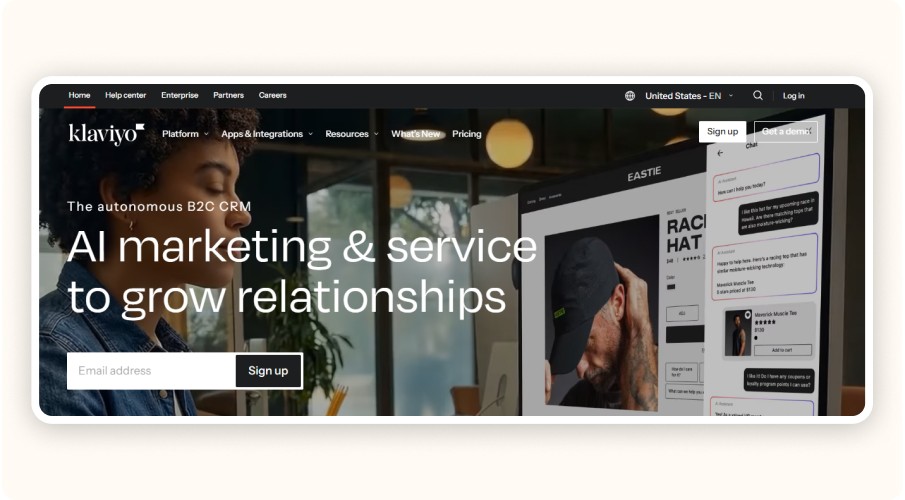
Klaviyo is the strongest all-around option when your Shopify store needs real customer segmentation, solid lifecycle automation, and revenue attribution tied to specific messages (not guesswork).
Price: $0/month free plan (up to 250 profiles, 500 emails/month, and 150 mobile message credits/month).
Klaviyo wins because it treats Shopify data as the core product — not “just another integration.” The practical result is segmentation that’s both precise and actually usable. For example, you can build a segment like: recent visitors who viewed a product twice, didn’t buy, and previously purchased within the last 90 days. That’s exactly where SMS tends to perform best.
The engine behind it is event-based triggers + profile properties:
Shopify events feed into Klaviyo
You trigger flows based on those events
You personalize using profile fields like last product purchased, AOV, and discount sensitivity
The catch: it can get heavy fast. A new store can burn weeks building 10 flows before it even has consistent traffic. For most dropshipping stores, four core flows plus two campaigns per week beats an overbuilt automation maze.
Choose Klaviyo if: you plan to scale, you want advanced segmentation, and you care about clearly seeing which messages drove revenue on your Shopify store.
Omnisend : Best budget option for email + SMS
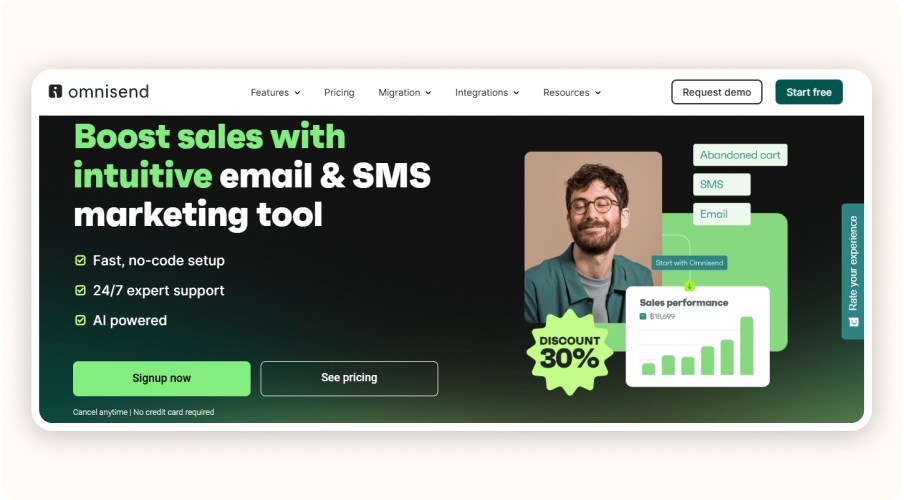
Omnisend is the value pick if you want solid Shopify email and SMS automation without paying extra for advanced segmentation you may not need (yet).
Price: paid plans start at $16/month.
Omnisend is a strong fit for Shopify sellers who want one dashboard for email + SMS, with prebuilt automations you can launch quickly. It’s especially good for stores still proving product–market fit and needing the basics to run reliably.
The core system is template-driven flows plus Shopify event triggers. You can set up welcome, cart recovery, and post-purchase sequences with minimal configuration. For many ecommerce stores, that’s enough to generate steady recovery revenue.
The catch: you’ll feel the limits as your strategy gets more sophisticated. If you rely on micro-segments and heavy personalization, you may outgrow it.
Choose Omnisend if: you want a cost-controlled stack for dropshipping or ecommerce, and you’d rather ship fast than spend weeks tuning a complex system.
Privy : Best for list growth + unlimited email sends
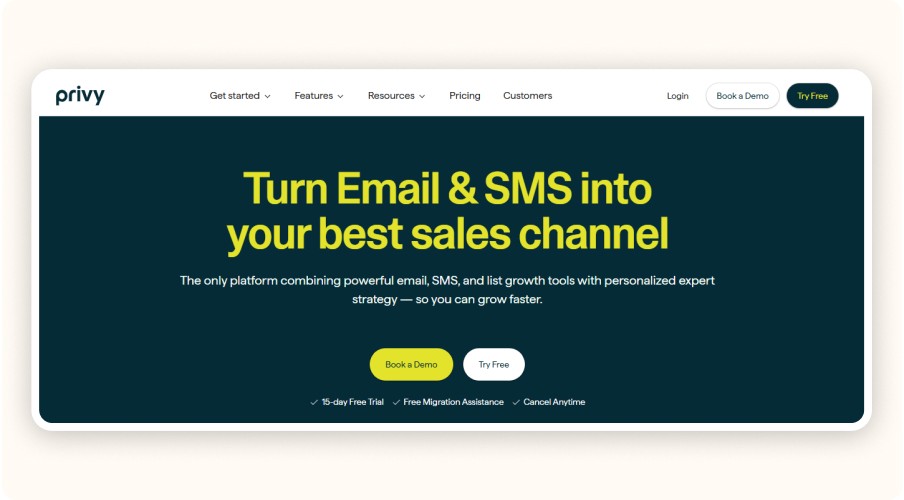
Privy is a strong fit if your main bottleneck is growing your list and improving onsite conversion, while still running email + SMS campaigns from the same platform.
Price: starts at $30/month, with 250 free SMS credits included.
Privy stands out because it treats onsite conversion as a first-class feature. Popups, embedded forms, and landing pages are the front door and email + SMS are how you monetize that traffic.
The setup is straightforward:
You collect emails and phone numbers on your Shopify store
Then you trigger automations based on sign-up and purchase behavior
For a dropshipper running paid ads, this is practical because every click is expensive. Capturing the lead on the first session lowers your break-even CPM and gives you more chances to convert later.
The catch: it’s not built for the deepest analytics. It’s built to execute fast and iterate.
Choose Privy if: you need better list capture on Shopify and you want email + SMS without adding three more apps.
Shopify Messaging : Best Shopify-native starting point
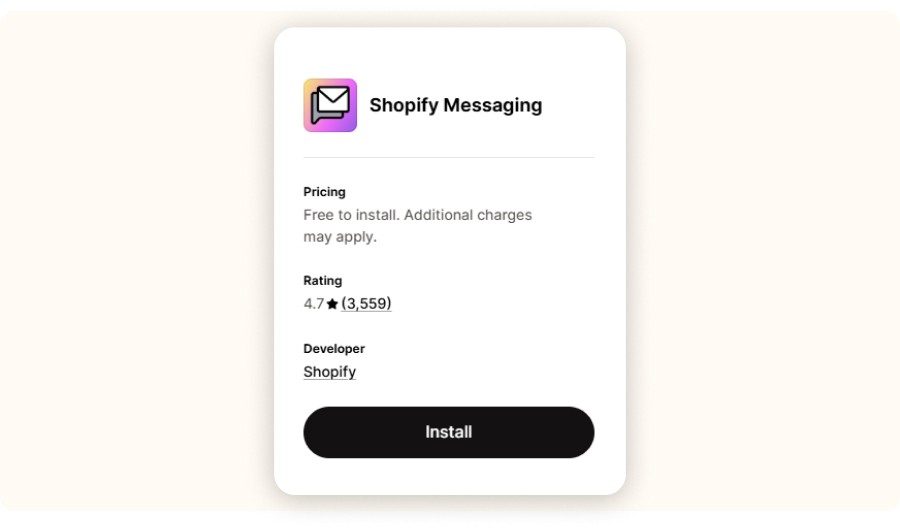
Shopify Messaging is the easiest option to start with if you want Shopify-native email + SMS templates with minimal setup.
Price: free to install.
This one is all about speed. If you live inside Shopify admin and just want a simple way to send campaigns, the native Shopify approach can be enough for early-stage ecommerce.
The system is straightforward: Shopify-first data + built-in templates. You build campaigns around the products and collections you already manage, then track results inside the Shopify ecosystem.
The catch: most Shopify stores that scale eventually want deeper segmentation and more control over SMS strategy. If you’re running dropshipping offers where timing really matters, you’ll probably add a specialist tool later.
Choose Shopify Messaging if: you’re starting from zero and want something that works inside Shopify before investing in a heavier platform.
Postscript : Best SMS-first app for serious revenue focus
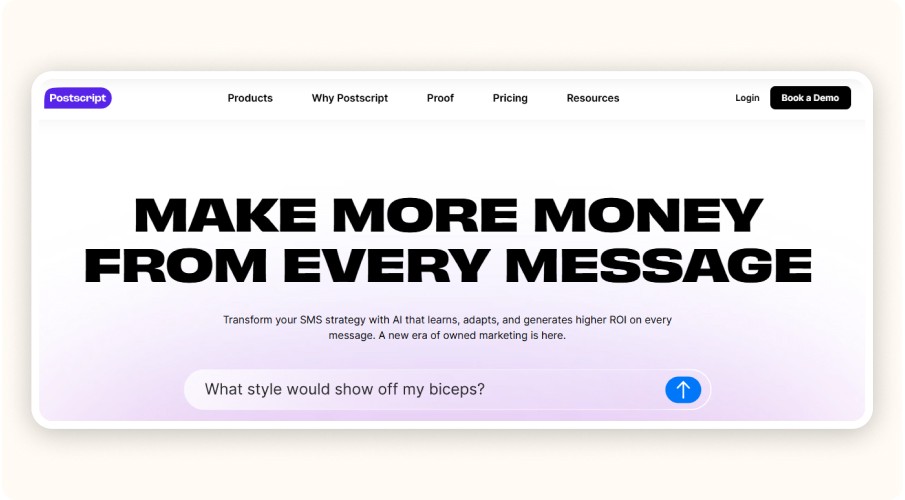
Postscript is the SMS specialist that makes sense when you treat SMS as a real revenue channel with its own compliance, segmentation, and testing needs.
Price: Starter is $0/month with a $49/month minimum spend. Growth is $100/month.
Postscript isn’t trying to replace your email platform. It’s built to make SMS perform without getting your store flagged or annoying customers. The practical advantage: it nudges you into a more disciplined SMS program.
The engine is SMS flows, segmentation, and message-level analytics tied to Shopify data. You can build automations for:
Cart recovery
Back in stock
Post-purchase upsell
…and then test message variants and track incremental revenue.
One friction point matters here: a lot of new dropshippers treat SMS like a free money button and blast the list. That burns the channel fast. The hidden cost shows up as unsubscribe spikes and deliverability issues.
Choose Postscript if: SMS is a core part of your retention plan, and you want a specialist built around compliance + testing.
Minea
Minea takes care of everything for you
Access winning ads, products, and stores in real time, get inspired, learn, then get started.
Sendlane : Best for sellers who want support + deliverability focus
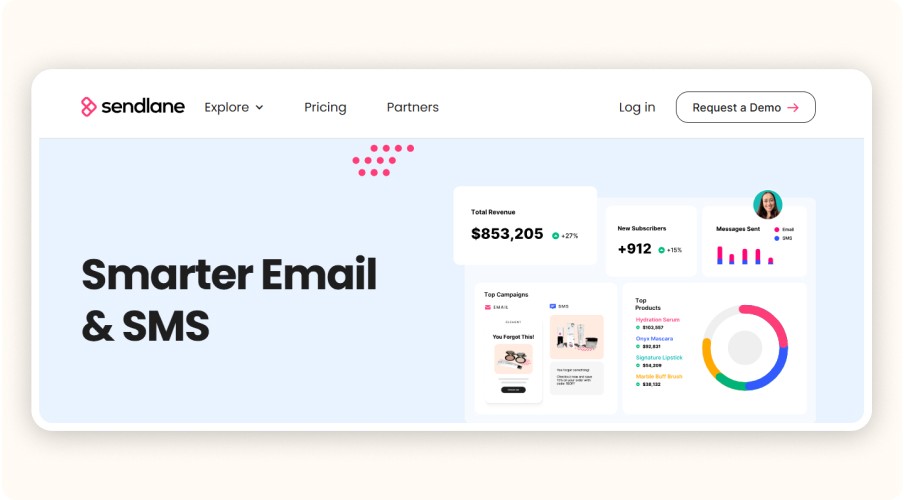
Sendlane is a solid option if you want ecommerce automation plus a heavier support layer and you’re willing to pay for it.
Price: $100/month.
Sendlane positions itself around ecommerce execution and deliverability support. If you’ve struggled with emails landing in Promotions or Spam, the difference isn’t just templates. It’s consistent list hygiene, predictable sending behavior, and clean segmentation.
The system is automated workflows tied to ecommerce events, plus deliverability monitoring and more hands-on support than most budget tools.
The catch: it’s not the cheapest way to start. If your Shopify store is still early, you’ll often get more ROI by fixing your offer and landing page before paying $100/month.
Choose Sendlane if: you already have steady traffic, and you want deliverability + support as part of the product.
If you run a Shopify store and feel like you’re leaving money in the cart, your email and SMS stack, especially your choice of best email marketing tools, is usually the culprit. The good news: you don’t need a dozen automations to see results. Start with 4 core flows, and you’ll get returns fast.
What drives the wins isn’t “more messages” it’s better timing, smarter targeting, and fewer texts/emails that feel like spam.
Here are the 6 tools I’d actually use on a Shopify ecommerce store in 2026, ranked based on how well they handle segmentation, automation, analytics, and Shopify-native data.
Quick verdict
Best overall: Klaviyo (deep segmentation + full lifecycle automation)
Best budget: Omnisend (starts at $16/month)
Best SMS add-on: Postscript ($0/month plan, with a $49/month minimum spend)
Quick comparison: Shopify email + SMS apps at a glance
If you want a single stack that works for most dropshipping and ecommerce stores, focus on a tool that:
Pulls Shopify events cleanly (browse, add-to-cart, checkout, purchase)
Supports behavior-based automation (not just basic autoresponders)
Makes revenue attribution clear and easy to trust
Tool | Price | Best for | Key differentiator | Rating |
|---|---|---|---|---|
Klaviyo | $0 per month free plan | Stores that scale with segmentation | Best-in-class targeting by behavior | 4.5/5 |
Omnisend | $16 per month | Budget-first ecommerce automation | Solid email and SMS for the price | 4.7/5 |
Privy | $30 per month | Simple list growth plus campaigns | Popups plus unlimited email sends | 4.5/5 |
Shopify Messaging | Free to install | Shopify-native basics and templates | Tight Shopify integration | 4.7/5 |
Postscript | $0 per month and $49 monthly minimum spend | SMS as a real revenue channel | SMS-first flows and compliance tooling | 4.7/5 |
Sendlane | $100 per month | High intent stores that want deliverability help | Strong support and ecommerce automation | N/A |
How I tested these apps for Shopify ecommerce
The fastest way to choose the right tool is to judge it on three things: Shopify event tracking, automation flexibility, and revenue attribution you can actually trust.
I reviewed each option using the same store workflow.
Shopify integration depth
A solid app should pull key events like product viewed, added to cart, checkout started, and purchased, without workarounds.
Automation coverage
At minimum, you need these 4 core flows:
Welcome series
Browse abandonment
Cart abandonment
Post-purchase cross-sell
Segmentation + analytics
For most dropshippers, the segments that scale are behavior-based segments, not vague demographics. That typically means:
Repeat buyers
High-intent sessions
Buyers of a specific product category
Operational friction
Finally, I looked at how annoying the tool is to run day-to-day. If you have to babysit deliverability, deal with confusing billing, or rebuild flows every time you add a new product line, it quickly turns into a tax.
Minea
Reach $1,000 per day or get your money back
Which Email + SMS Apps Are Best for Shopify Ecommerce in 2026?
Most Shopify stores don’t need more features they need a setup that plugs into Shopify events cleanly and shows revenue impact without guesswork. The apps below are compared on what actually matters day-to-day: segmentation, automation depth, analytics, and how well they use Shopify-native data.
Klaviyo : Best overall for segmentation and automation
Klaviyo is the strongest all-around option when your Shopify store needs real customer segmentation, solid lifecycle automation, and revenue attribution tied to specific messages (not guesswork).
Price: $0/month free plan (up to 250 profiles, 500 emails/month, and 150 mobile message credits/month).
Klaviyo wins because it treats Shopify data as the core product — not “just another integration.” The practical result is segmentation that’s both precise and actually usable. For example, you can build a segment like: recent visitors who viewed a product twice, didn’t buy, and previously purchased within the last 90 days. That’s exactly where SMS tends to perform best.
The engine behind it is event-based triggers + profile properties:
Shopify events feed into Klaviyo
You trigger flows based on those events
You personalize using profile fields like last product purchased, AOV, and discount sensitivity
The catch: it can get heavy fast. A new store can burn weeks building 10 flows before it even has consistent traffic. For most dropshipping stores, four core flows plus two campaigns per week beats an overbuilt automation maze.
Choose Klaviyo if: you plan to scale, you want advanced segmentation, and you care about clearly seeing which messages drove revenue on your Shopify store.
Omnisend : Best budget option for email + SMS
Omnisend is the value pick if you want solid Shopify email and SMS automation without paying extra for advanced segmentation you may not need (yet).
Price: paid plans start at $16/month.
Omnisend is a strong fit for Shopify sellers who want one dashboard for email + SMS, with prebuilt automations you can launch quickly. It’s especially good for stores still proving product–market fit and needing the basics to run reliably.
The core system is template-driven flows plus Shopify event triggers. You can set up welcome, cart recovery, and post-purchase sequences with minimal configuration. For many ecommerce stores, that’s enough to generate steady recovery revenue.
The catch: you’ll feel the limits as your strategy gets more sophisticated. If you rely on micro-segments and heavy personalization, you may outgrow it.
Choose Omnisend if: you want a cost-controlled stack for dropshipping or ecommerce, and you’d rather ship fast than spend weeks tuning a complex system.
Privy : Best for list growth + unlimited email sends
Privy is a strong fit if your main bottleneck is growing your list and improving onsite conversion, while still running email + SMS campaigns from the same platform.
Price: starts at $30/month, with 250 free SMS credits included.
Privy stands out because it treats onsite conversion as a first-class feature. Popups, embedded forms, and landing pages are the front door and email + SMS are how you monetize that traffic.
The setup is straightforward:
You collect emails and phone numbers on your Shopify store
Then you trigger automations based on sign-up and purchase behavior
For a dropshipper running paid ads, this is practical because every click is expensive. Capturing the lead on the first session lowers your break-even CPM and gives you more chances to convert later.
The catch: it’s not built for the deepest analytics. It’s built to execute fast and iterate.
Choose Privy if: you need better list capture on Shopify and you want email + SMS without adding three more apps.
Shopify Messaging : Best Shopify-native starting point
Shopify Messaging is the easiest option to start with if you want Shopify-native email + SMS templates with minimal setup.
Price: free to install.
This one is all about speed. If you live inside Shopify admin and just want a simple way to send campaigns, the native Shopify approach can be enough for early-stage ecommerce.
The system is straightforward: Shopify-first data + built-in templates. You build campaigns around the products and collections you already manage, then track results inside the Shopify ecosystem.
The catch: most Shopify stores that scale eventually want deeper segmentation and more control over SMS strategy. If you’re running dropshipping offers where timing really matters, you’ll probably add a specialist tool later.
Choose Shopify Messaging if: you’re starting from zero and want something that works inside Shopify before investing in a heavier platform.
Postscript : Best SMS-first app for serious revenue focus
Postscript is the SMS specialist that makes sense when you treat SMS as a real revenue channel with its own compliance, segmentation, and testing needs.
Price: Starter is $0/month with a $49/month minimum spend. Growth is $100/month.
Postscript isn’t trying to replace your email platform. It’s built to make SMS perform without getting your store flagged or annoying customers. The practical advantage: it nudges you into a more disciplined SMS program.
The engine is SMS flows, segmentation, and message-level analytics tied to Shopify data. You can build automations for:
Cart recovery
Back in stock
Post-purchase upsell
…and then test message variants and track incremental revenue.
One friction point matters here: a lot of new dropshippers treat SMS like a free money button and blast the list. That burns the channel fast. The hidden cost shows up as unsubscribe spikes and deliverability issues.
Choose Postscript if: SMS is a core part of your retention plan, and you want a specialist built around compliance + testing.
Minea
Minea takes care of everything for you
Access winning ads, products, and stores in real time, get inspired, learn, then get started.
Sendlane : Best for sellers who want support + deliverability focus
Sendlane is a solid option if you want ecommerce automation plus a heavier support layer and you’re willing to pay for it.
Price: $100/month.
Sendlane positions itself around ecommerce execution and deliverability support. If you’ve struggled with emails landing in Promotions or Spam, the difference isn’t just templates. It’s consistent list hygiene, predictable sending behavior, and clean segmentation.
The system is automated workflows tied to ecommerce events, plus deliverability monitoring and more hands-on support than most budget tools.
The catch: it’s not the cheapest way to start. If your Shopify store is still early, you’ll often get more ROI by fixing your offer and landing page before paying $100/month.
Choose Sendlane if: you already have steady traffic, and you want deliverability + support as part of the product.
If you run a Shopify store and feel like you’re leaving money in the cart, your email and SMS stack, especially your choice of best email marketing tools, is usually the culprit. The good news: you don’t need a dozen automations to see results. Start with 4 core flows, and you’ll get returns fast.
What drives the wins isn’t “more messages” it’s better timing, smarter targeting, and fewer texts/emails that feel like spam.
Here are the 6 tools I’d actually use on a Shopify ecommerce store in 2026, ranked based on how well they handle segmentation, automation, analytics, and Shopify-native data.
Quick verdict
Best overall: Klaviyo (deep segmentation + full lifecycle automation)
Best budget: Omnisend (starts at $16/month)
Best SMS add-on: Postscript ($0/month plan, with a $49/month minimum spend)
Quick comparison: Shopify email + SMS apps at a glance
If you want a single stack that works for most dropshipping and ecommerce stores, focus on a tool that:
Pulls Shopify events cleanly (browse, add-to-cart, checkout, purchase)
Supports behavior-based automation (not just basic autoresponders)
Makes revenue attribution clear and easy to trust
Tool | Price | Best for | Key differentiator | Rating |
|---|---|---|---|---|
Klaviyo | $0 per month free plan | Stores that scale with segmentation | Best-in-class targeting by behavior | 4.5/5 |
Omnisend | $16 per month | Budget-first ecommerce automation | Solid email and SMS for the price | 4.7/5 |
Privy | $30 per month | Simple list growth plus campaigns | Popups plus unlimited email sends | 4.5/5 |
Shopify Messaging | Free to install | Shopify-native basics and templates | Tight Shopify integration | 4.7/5 |
Postscript | $0 per month and $49 monthly minimum spend | SMS as a real revenue channel | SMS-first flows and compliance tooling | 4.7/5 |
Sendlane | $100 per month | High intent stores that want deliverability help | Strong support and ecommerce automation | N/A |
How I tested these apps for Shopify ecommerce
The fastest way to choose the right tool is to judge it on three things: Shopify event tracking, automation flexibility, and revenue attribution you can actually trust.
I reviewed each option using the same store workflow.
Shopify integration depth
A solid app should pull key events like product viewed, added to cart, checkout started, and purchased, without workarounds.
Automation coverage
At minimum, you need these 4 core flows:
Welcome series
Browse abandonment
Cart abandonment
Post-purchase cross-sell
Segmentation + analytics
For most dropshippers, the segments that scale are behavior-based segments, not vague demographics. That typically means:
Repeat buyers
High-intent sessions
Buyers of a specific product category
Operational friction
Finally, I looked at how annoying the tool is to run day-to-day. If you have to babysit deliverability, deal with confusing billing, or rebuild flows every time you add a new product line, it quickly turns into a tax.
Minea
Reach $1,000 per day or get your money back
Which Email + SMS Apps Are Best for Shopify Ecommerce in 2026?
Most Shopify stores don’t need more features they need a setup that plugs into Shopify events cleanly and shows revenue impact without guesswork. The apps below are compared on what actually matters day-to-day: segmentation, automation depth, analytics, and how well they use Shopify-native data.
Klaviyo : Best overall for segmentation and automation
Klaviyo is the strongest all-around option when your Shopify store needs real customer segmentation, solid lifecycle automation, and revenue attribution tied to specific messages (not guesswork).
Price: $0/month free plan (up to 250 profiles, 500 emails/month, and 150 mobile message credits/month).
Klaviyo wins because it treats Shopify data as the core product — not “just another integration.” The practical result is segmentation that’s both precise and actually usable. For example, you can build a segment like: recent visitors who viewed a product twice, didn’t buy, and previously purchased within the last 90 days. That’s exactly where SMS tends to perform best.
The engine behind it is event-based triggers + profile properties:
Shopify events feed into Klaviyo
You trigger flows based on those events
You personalize using profile fields like last product purchased, AOV, and discount sensitivity
The catch: it can get heavy fast. A new store can burn weeks building 10 flows before it even has consistent traffic. For most dropshipping stores, four core flows plus two campaigns per week beats an overbuilt automation maze.
Choose Klaviyo if: you plan to scale, you want advanced segmentation, and you care about clearly seeing which messages drove revenue on your Shopify store.
Omnisend : Best budget option for email + SMS
Omnisend is the value pick if you want solid Shopify email and SMS automation without paying extra for advanced segmentation you may not need (yet).
Price: paid plans start at $16/month.
Omnisend is a strong fit for Shopify sellers who want one dashboard for email + SMS, with prebuilt automations you can launch quickly. It’s especially good for stores still proving product–market fit and needing the basics to run reliably.
The core system is template-driven flows plus Shopify event triggers. You can set up welcome, cart recovery, and post-purchase sequences with minimal configuration. For many ecommerce stores, that’s enough to generate steady recovery revenue.
The catch: you’ll feel the limits as your strategy gets more sophisticated. If you rely on micro-segments and heavy personalization, you may outgrow it.
Choose Omnisend if: you want a cost-controlled stack for dropshipping or ecommerce, and you’d rather ship fast than spend weeks tuning a complex system.
Privy : Best for list growth + unlimited email sends
Privy is a strong fit if your main bottleneck is growing your list and improving onsite conversion, while still running email + SMS campaigns from the same platform.
Price: starts at $30/month, with 250 free SMS credits included.
Privy stands out because it treats onsite conversion as a first-class feature. Popups, embedded forms, and landing pages are the front door and email + SMS are how you monetize that traffic.
The setup is straightforward:
You collect emails and phone numbers on your Shopify store
Then you trigger automations based on sign-up and purchase behavior
For a dropshipper running paid ads, this is practical because every click is expensive. Capturing the lead on the first session lowers your break-even CPM and gives you more chances to convert later.
The catch: it’s not built for the deepest analytics. It’s built to execute fast and iterate.
Choose Privy if: you need better list capture on Shopify and you want email + SMS without adding three more apps.
Shopify Messaging : Best Shopify-native starting point
Shopify Messaging is the easiest option to start with if you want Shopify-native email + SMS templates with minimal setup.
Price: free to install.
This one is all about speed. If you live inside Shopify admin and just want a simple way to send campaigns, the native Shopify approach can be enough for early-stage ecommerce.
The system is straightforward: Shopify-first data + built-in templates. You build campaigns around the products and collections you already manage, then track results inside the Shopify ecosystem.
The catch: most Shopify stores that scale eventually want deeper segmentation and more control over SMS strategy. If you’re running dropshipping offers where timing really matters, you’ll probably add a specialist tool later.
Choose Shopify Messaging if: you’re starting from zero and want something that works inside Shopify before investing in a heavier platform.
Postscript : Best SMS-first app for serious revenue focus
Postscript is the SMS specialist that makes sense when you treat SMS as a real revenue channel with its own compliance, segmentation, and testing needs.
Price: Starter is $0/month with a $49/month minimum spend. Growth is $100/month.
Postscript isn’t trying to replace your email platform. It’s built to make SMS perform without getting your store flagged or annoying customers. The practical advantage: it nudges you into a more disciplined SMS program.
The engine is SMS flows, segmentation, and message-level analytics tied to Shopify data. You can build automations for:
Cart recovery
Back in stock
Post-purchase upsell
…and then test message variants and track incremental revenue.
One friction point matters here: a lot of new dropshippers treat SMS like a free money button and blast the list. That burns the channel fast. The hidden cost shows up as unsubscribe spikes and deliverability issues.
Choose Postscript if: SMS is a core part of your retention plan, and you want a specialist built around compliance + testing.
Minea
Minea takes care of everything for you
Access winning ads, products, and stores in real time, get inspired, learn, then get started.
Sendlane : Best for sellers who want support + deliverability focus
Sendlane is a solid option if you want ecommerce automation plus a heavier support layer and you’re willing to pay for it.
Price: $100/month.
Sendlane positions itself around ecommerce execution and deliverability support. If you’ve struggled with emails landing in Promotions or Spam, the difference isn’t just templates. It’s consistent list hygiene, predictable sending behavior, and clean segmentation.
The system is automated workflows tied to ecommerce events, plus deliverability monitoring and more hands-on support than most budget tools.
The catch: it’s not the cheapest way to start. If your Shopify store is still early, you’ll often get more ROI by fixing your offer and landing page before paying $100/month.
Choose Sendlane if: you already have steady traffic, and you want deliverability + support as part of the product.
How to choose the right email + SMS app for your Shopify store?
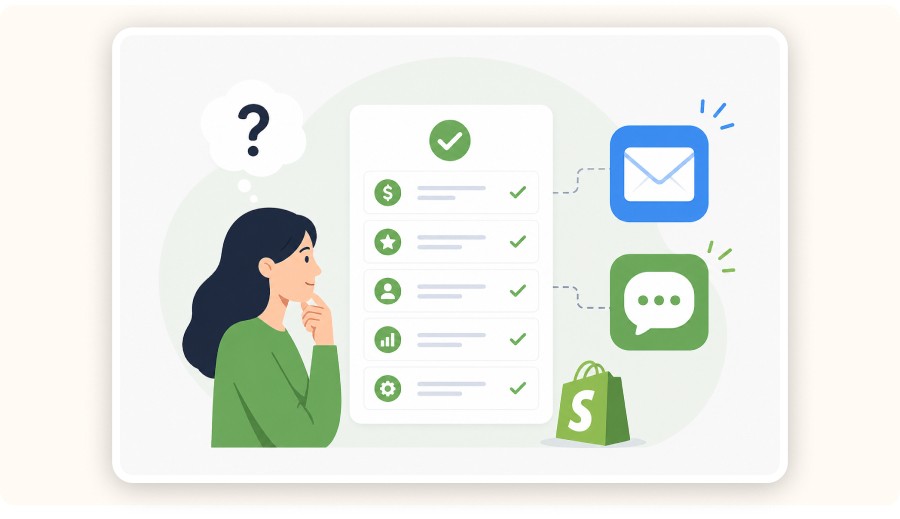
The right choice depends on where your ecommerce store is in its lifecycle: proving demand, scaling, or protecting margin through retention.
Use this decision framework:
Budget under $50/month: start with Omnisend ($16/month) or Privy ($30/month). Pick Privy if list growth is your main bottleneck.
Best long-term stack: go with Klaviyo. It’s the default choice for stores that rely on segmentation and lifecycle automation.
SMS as a real channel: add Postscript. Treat SMS like a scalpel, not a megaphone.
Shopify-native simplicity: use Shopify Messaging until you outgrow it, then level up to a heavier platform.
Support + deliverability baked in: consider Sendlane if you want more hands-on help and deliverability focus.
A practical dropshipping workflow that ties email and SMS to winning products
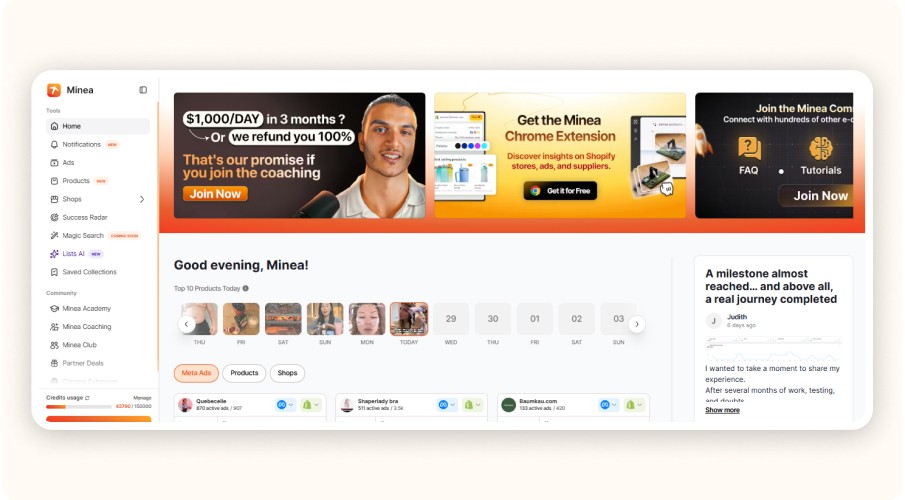
Your email and SMS performance improves when your messages match what your ads already proved people want.
This is where many ecommerce stores burn budget: they pick a tool first, then guess what to send.
A better workflow starts with product and angle selection, then maps your lifecycle messages to the same product narrative that’s already converting.
If you use Minea as your starting point, the workflow is simple, use :
Ads Library to find products already being promoted,
Success Radar to spot strong sales signals,
Magic Research to understand winning angles.
Then, mirror those angles in your retention messages.
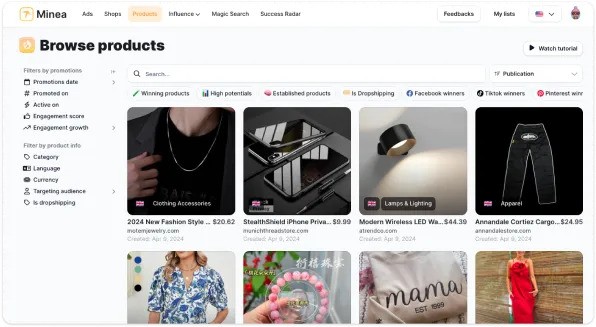
For example, Minea trend tracking can surface products like a posture corrector belt (trend score: 92), an LED face mask (trend score: 88), and a portable blender (trend score: 85). In this kind of sample set, the average product price is around $29.99, and common supplier countries include China, Turkey, and Vietnam. These are the kinds of offers where retention can really protect margin.
A practical segmentation plan looks like this:
Segment buyers by product category (not just discount behavior).
A buyer of a smart ring fitness tracker will behave differently than a buyer of a heated eyelash curler and your lifecycle messaging should reflect that.Run post-purchase SMS only when it adds real value.
Send shipping reassurance for long-distance routes, and send usage tips that reduce refunds.Use email for education and bundles.
Use SMS for high-intent moments like cart recovery and back in stock.
This is the store-management move that actually lifts revenue: use the same product story that won in ads, then reinforce it through retention.


What I did not include (and why)

Good curation means leaving things out. If a platform hides pricing or pushes you into a sales call, it’s hard to recommend for the typical Shopify dropshipper.
Attentive: strong platform, but pricing is volume-based and usually comes with a sales process.
Mailchimp: solid for email, but SMS and Shopify-first ecommerce depth aren’t on the same level as the tools above.
Generic SMS gateways: often cheaper, but you lose the ecommerce workflow and clear revenue attribution.
Final verdict
For the keyword “best email SMS app for Shopify”, the most reliable default in 2026 is Klaviyo because segmentation and automation quality matter more than an extra feature checkbox.
If you’re price-sensitive, start with Omnisend at $16/month and upgrade later. If SMS is your main profit lever, add Postscript and keep your SMS program disciplined.
Your next step is simple. Pick one stack, build four core flows, and run two campaigns per week for a month. Then improve based on revenue attribution, not vibes.
If you want to tighten this loop for dropshipping, use Minea to validate products and angles first, then mirror those angles in your email and SMS flows.
FAQ
What is the best SMS marketing app for Shopify?
Klaviyo is the best all-in-one option for many Shopify stores because it combines segmentation, automation, and revenue attribution. If you want an SMS specialist, Postscript is a strong fit when SMS is treated as its own revenue channel.
How do I integrate SMS marketing with my Shopify store?
Install an SMS app that reads Shopify events, then connect it to your customer list collection points like checkout and popups. Build a cart recovery flow first, then add post-purchase messages that reduce refunds and increase repeat orders.
What key features should I look for in an email and SMS app for Shopify?
Look for Shopify event tracking, flexible automation triggers, customer segmentation based on behavior, and clear revenue attribution per message. Also prioritize compliance and deliverability support if SMS is part of your core strategy.
Is email and SMS marketing effective for dropshipping and ecommerce stores?
Email and SMS are effective when the message matches buyer intent and timing. Email works well for education, bundles, and retention. SMS works best for high intent moments like cart recovery and back in stock.
What is the cost of using an email and SMS app for Shopify?
Costs vary based on list size and sending volume, but you can start with tools like Omnisend from $16 per month or Privy from $30 per month. SMS programs often add usage costs per message, so monitor cost per recovered order, not just subscription price.
How to choose the right email + SMS app for your Shopify store?
The right choice depends on where your ecommerce store is in its lifecycle: proving demand, scaling, or protecting margin through retention.
Use this decision framework:
Budget under $50/month: start with Omnisend ($16/month) or Privy ($30/month). Pick Privy if list growth is your main bottleneck.
Best long-term stack: go with Klaviyo. It’s the default choice for stores that rely on segmentation and lifecycle automation.
SMS as a real channel: add Postscript. Treat SMS like a scalpel, not a megaphone.
Shopify-native simplicity: use Shopify Messaging until you outgrow it, then level up to a heavier platform.
Support + deliverability baked in: consider Sendlane if you want more hands-on help and deliverability focus.
A practical dropshipping workflow that ties email and SMS to winning products
Your email and SMS performance improves when your messages match what your ads already proved people want.
This is where many ecommerce stores burn budget: they pick a tool first, then guess what to send.
A better workflow starts with product and angle selection, then maps your lifecycle messages to the same product narrative that’s already converting.
If you use Minea as your starting point, the workflow is simple, use :
Ads Library to find products already being promoted,
Success Radar to spot strong sales signals,
Magic Research to understand winning angles.
Then, mirror those angles in your retention messages.
For example, Minea trend tracking can surface products like a posture corrector belt (trend score: 92), an LED face mask (trend score: 88), and a portable blender (trend score: 85). In this kind of sample set, the average product price is around $29.99, and common supplier countries include China, Turkey, and Vietnam. These are the kinds of offers where retention can really protect margin.
A practical segmentation plan looks like this:
Segment buyers by product category (not just discount behavior).
A buyer of a smart ring fitness tracker will behave differently than a buyer of a heated eyelash curler and your lifecycle messaging should reflect that.Run post-purchase SMS only when it adds real value.
Send shipping reassurance for long-distance routes, and send usage tips that reduce refunds.Use email for education and bundles.
Use SMS for high-intent moments like cart recovery and back in stock.
This is the store-management move that actually lifts revenue: use the same product story that won in ads, then reinforce it through retention.
What I did not include (and why)
Good curation means leaving things out. If a platform hides pricing or pushes you into a sales call, it’s hard to recommend for the typical Shopify dropshipper.
Attentive: strong platform, but pricing is volume-based and usually comes with a sales process.
Mailchimp: solid for email, but SMS and Shopify-first ecommerce depth aren’t on the same level as the tools above.
Generic SMS gateways: often cheaper, but you lose the ecommerce workflow and clear revenue attribution.
Final verdict
For the keyword “best email SMS app for Shopify”, the most reliable default in 2026 is Klaviyo because segmentation and automation quality matter more than an extra feature checkbox.
If you’re price-sensitive, start with Omnisend at $16/month and upgrade later. If SMS is your main profit lever, add Postscript and keep your SMS program disciplined.
Your next step is simple. Pick one stack, build four core flows, and run two campaigns per week for a month. Then improve based on revenue attribution, not vibes.
If you want to tighten this loop for dropshipping, use Minea to validate products and angles first, then mirror those angles in your email and SMS flows.
FAQ
What is the best SMS marketing app for Shopify?
Klaviyo is the best all-in-one option for many Shopify stores because it combines segmentation, automation, and revenue attribution. If you want an SMS specialist, Postscript is a strong fit when SMS is treated as its own revenue channel.
How do I integrate SMS marketing with my Shopify store?
Install an SMS app that reads Shopify events, then connect it to your customer list collection points like checkout and popups. Build a cart recovery flow first, then add post-purchase messages that reduce refunds and increase repeat orders.
What key features should I look for in an email and SMS app for Shopify?
Look for Shopify event tracking, flexible automation triggers, customer segmentation based on behavior, and clear revenue attribution per message. Also prioritize compliance and deliverability support if SMS is part of your core strategy.
Is email and SMS marketing effective for dropshipping and ecommerce stores?
Email and SMS are effective when the message matches buyer intent and timing. Email works well for education, bundles, and retention. SMS works best for high intent moments like cart recovery and back in stock.
What is the cost of using an email and SMS app for Shopify?
Costs vary based on list size and sending volume, but you can start with tools like Omnisend from $16 per month or Privy from $30 per month. SMS programs often add usage costs per message, so monitor cost per recovered order, not just subscription price.
How to choose the right email + SMS app for your Shopify store?
The right choice depends on where your ecommerce store is in its lifecycle: proving demand, scaling, or protecting margin through retention.
Use this decision framework:
Budget under $50/month: start with Omnisend ($16/month) or Privy ($30/month). Pick Privy if list growth is your main bottleneck.
Best long-term stack: go with Klaviyo. It’s the default choice for stores that rely on segmentation and lifecycle automation.
SMS as a real channel: add Postscript. Treat SMS like a scalpel, not a megaphone.
Shopify-native simplicity: use Shopify Messaging until you outgrow it, then level up to a heavier platform.
Support + deliverability baked in: consider Sendlane if you want more hands-on help and deliverability focus.
A practical dropshipping workflow that ties email and SMS to winning products
Your email and SMS performance improves when your messages match what your ads already proved people want.
This is where many ecommerce stores burn budget: they pick a tool first, then guess what to send.
A better workflow starts with product and angle selection, then maps your lifecycle messages to the same product narrative that’s already converting.
If you use Minea as your starting point, the workflow is simple, use :
Ads Library to find products already being promoted,
Success Radar to spot strong sales signals,
Magic Research to understand winning angles.
Then, mirror those angles in your retention messages.
For example, Minea trend tracking can surface products like a posture corrector belt (trend score: 92), an LED face mask (trend score: 88), and a portable blender (trend score: 85). In this kind of sample set, the average product price is around $29.99, and common supplier countries include China, Turkey, and Vietnam. These are the kinds of offers where retention can really protect margin.
A practical segmentation plan looks like this:
Segment buyers by product category (not just discount behavior).
A buyer of a smart ring fitness tracker will behave differently than a buyer of a heated eyelash curler and your lifecycle messaging should reflect that.Run post-purchase SMS only when it adds real value.
Send shipping reassurance for long-distance routes, and send usage tips that reduce refunds.Use email for education and bundles.
Use SMS for high-intent moments like cart recovery and back in stock.
This is the store-management move that actually lifts revenue: use the same product story that won in ads, then reinforce it through retention.
What I did not include (and why)
Good curation means leaving things out. If a platform hides pricing or pushes you into a sales call, it’s hard to recommend for the typical Shopify dropshipper.
Attentive: strong platform, but pricing is volume-based and usually comes with a sales process.
Mailchimp: solid for email, but SMS and Shopify-first ecommerce depth aren’t on the same level as the tools above.
Generic SMS gateways: often cheaper, but you lose the ecommerce workflow and clear revenue attribution.
Final verdict
For the keyword “best email SMS app for Shopify”, the most reliable default in 2026 is Klaviyo because segmentation and automation quality matter more than an extra feature checkbox.
If you’re price-sensitive, start with Omnisend at $16/month and upgrade later. If SMS is your main profit lever, add Postscript and keep your SMS program disciplined.
Your next step is simple. Pick one stack, build four core flows, and run two campaigns per week for a month. Then improve based on revenue attribution, not vibes.
If you want to tighten this loop for dropshipping, use Minea to validate products and angles first, then mirror those angles in your email and SMS flows.
FAQ
What is the best SMS marketing app for Shopify?
Klaviyo is the best all-in-one option for many Shopify stores because it combines segmentation, automation, and revenue attribution. If you want an SMS specialist, Postscript is a strong fit when SMS is treated as its own revenue channel.
How do I integrate SMS marketing with my Shopify store?
Install an SMS app that reads Shopify events, then connect it to your customer list collection points like checkout and popups. Build a cart recovery flow first, then add post-purchase messages that reduce refunds and increase repeat orders.
What key features should I look for in an email and SMS app for Shopify?
Look for Shopify event tracking, flexible automation triggers, customer segmentation based on behavior, and clear revenue attribution per message. Also prioritize compliance and deliverability support if SMS is part of your core strategy.
Is email and SMS marketing effective for dropshipping and ecommerce stores?
Email and SMS are effective when the message matches buyer intent and timing. Email works well for education, bundles, and retention. SMS works best for high intent moments like cart recovery and back in stock.
What is the cost of using an email and SMS app for Shopify?
Costs vary based on list size and sending volume, but you can start with tools like Omnisend from $16 per month or Privy from $30 per month. SMS programs often add usage costs per message, so monitor cost per recovered order, not just subscription price.
Similar articles
Omnisend Email Marketing for a Dropshipping Business : Setup That Actually Sells
Best Email Marketing Tools
Omnisend Email Marketing for a Dropshipping Business : Setup That Actually Sells
Best Email Marketing Tools
Omnisend Email Marketing for a Dropshipping Business : Setup That Actually Sells
Best Email Marketing Tools
Omnisend Email Marketing for a Dropshipping Business : Setup That Actually Sells
Best Email Marketing Tools
How to Use Privy Email Marketing for a Dropshipping Store in 60 Minutes (2026)
Best Email Marketing Tools
How to Use Privy Email Marketing for a Dropshipping Store in 60 Minutes (2026)
Best Email Marketing Tools
How to Use Privy Email Marketing for a Dropshipping Store in 60 Minutes (2026)
Best Email Marketing Tools
How to Use Privy Email Marketing for a Dropshipping Store in 60 Minutes (2026)
Best Email Marketing Tools


Our Free Adspys

Find winning products on our Tiktok adspy today!
Find winning products on our Facebook adspy today!
Find winning products on our Tiktok adspy today!
Find winning products on our Facebook adspy today!
Find winning products on our Tiktok adspy today!
Find winning products on our Facebook adspy today!
Find winning products on our Tiktok adspy today!
Find winning products on our Facebook adspy today!
1 winning product everyday.
Follow us!





Find out more
Read more
Minea © 2026
Find out more
Read more
Minea © 2026
Find out more
Read more
Minea © 2026
Find out more
Read more
Minea © 2026
Find out more
Read more
Minea © 2026
Find out more
Read more
Minea © 2026