Fulfillman Dropshipping Services Review (2026): Speed, Costs, and Fit
Best Ecommerce Fulfillment Center
Author: Baptiste
Contents
If you’re a US dropshipper who’s tired of 15–30 day AliExpress delivery windows (and the constant refund pressure that comes with them), Fulfillman is the kind of agent + fulfillment center service you look into when you want faster shipping and more control over packaging.
Fulfillman presents itself as a global dropshipping + order fulfillment partner handling the full chain: product sourcing, warehousing, picking/packing, private labeling, and shipping via private lines or carriers like DHL/FedEx, with integrations for most common e-commerce platforms.
Key takeaways
Fulfillman is a dropshipping fulfillment service that combines product sourcing + warehousing + shipping under one account.
Their marketing puts 3–8 day shipping front and center as the core value prop (it still depends on destination, shipping line, and product).
You’ll get the most value if you already have steady demand (consistent orders) and want branding (custom packaging) with fewer fulfillment headaches.
Before committing, make sure you validate the total landed cost (product + pick/pack + shipping + returns handling) on 3–5 SKUs.
What is Fulfillman (and what “fulfillment dropshipping” really means)?
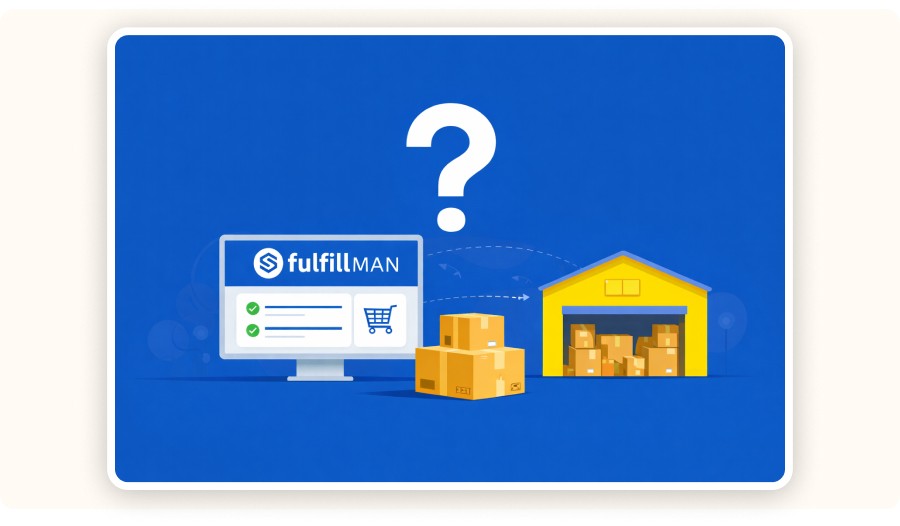
Fulfillman is a dropshipping fulfillment provider that helps you source products, store inventory (or handle orders on demand), and ship to customers using faster shipping lines than what you usually get from typical marketplace suppliers.
In plain terms, “fulfillment dropshipping” means you’re outsourcing the operational side, supplier coordination, packing, tracking, and sometimes returns. So you can stay focused on product testing and marketing.
A lot of sellers mix up a “dropshipping supplier” and a “fulfillment partner.”
A supplier sells you the item. A fulfillment partner runs the system that gets orders shipped consistently and reliably.
With Fulfillman, you’re usually paying for a bundle of services, such as:
Product sourcing (finding suppliers, negotiating price, confirming specs)
Quality checks (basic inspection, photo/video confirmation)
Warehousing (stocking fast movers so shipping is faster)
Pick/pack + bundling (multi-item orders, kitting)
Shipping execution (label creation, handoff to private lines/DHL/FedEx, tracking updates)
The main reason sellers switch is straightforward: when shipping is slow, you end up paying for it elsewhere, chargebacks, PayPal disputes, and even ad performance decay (your offer stops converting once the comments fill up with “where’s my order?”).
Feature | What Fulfillman says it includes | Why it matters | What to confirm before scaling |
|---|---|---|---|
Full order management | They handle sourcing → fulfillment → shipping while you focus on marketing. | Fewer moving parts vs juggling multiple suppliers. | Who does what (you vs them) once orders sync. |
Product sourcing | Team sources items and aims for quality + lower rates. | Better supply options than marketplace sourcing (in theory). | Spec accuracy, supplier stability, sample/QC evidence. |
Purchasing on your behalf | They “do the shopping for you.” | Removes daily manual ordering workload. | Payment flow (how you fund orders) + proof of purchase process. |
Free warehouse storage (conditional) | Free storage mentioned, especially for “hot products.” | Can speed up delivery if inventory is ready. | Storage eligibility rules, aging limits, and restock workflow. |
Quality check (QC) | They quality check items for compatibility/satisfaction. | Reduces wrong/damaged item incidents. | Whether QC photos/videos are standard or paid add-ons. |
Worldwide shipping | Ships worldwide via Private Line or other carriers. | Broader destination coverage. | Which lanes are fastest for your top countries/states. |
Private Line shipping | Promotes fast shipping via Private Line (direct from China). | Often the core “speed” promise. | Real delivery ranges by lane + peak-season behavior. |
Automatic tracking updates | Tracking numbers updated automatically. | Fewer “Where is my order?” tickets if tracking is clean. | Label-to-scan time + tracking event quality (real scans). |
Order visibility (Google Sheet) | Orders automatically pushed to a shared Google Sheet. | Operational clarity without manual spreadsheets. | What fields are included, update frequency, exception reporting. |
Bundling / kitting | Supports bundling: multiple items shipped together. | Helps AOV, reduces split shipments. | Bundle pricing rules (pick/pack, extra handling, weight impacts). |
Branding options | Branding: logo on packages, flyers, cards, custom boxes, etc. | Better perceived value + brand control. | MOQs, setup costs, lead times, packaging quality. |
Return / refund policy | Mentions refunds/resends for damaged/wrong/lost + returns to warehouse. | Returns are where margins often leak. | Exact conditions, evidence required, and who pays each scenario. |
Communication/support | Mentions immediate response via Microsoft Teams. | Faster issue resolution when volume grows. | Actual response SLAs, escalation path, and ticket workflow. |
Supported platforms | Lists: Shopify, Amazon, eBay, WooCommerce, BigCommerce, Magento. | Easier order flow if integration is stable. | Variant/SKU mapping, split shipments, cancellations/edits after sync. |
How Fulfillman works for a Shopify dropshipping store (step-by-step)
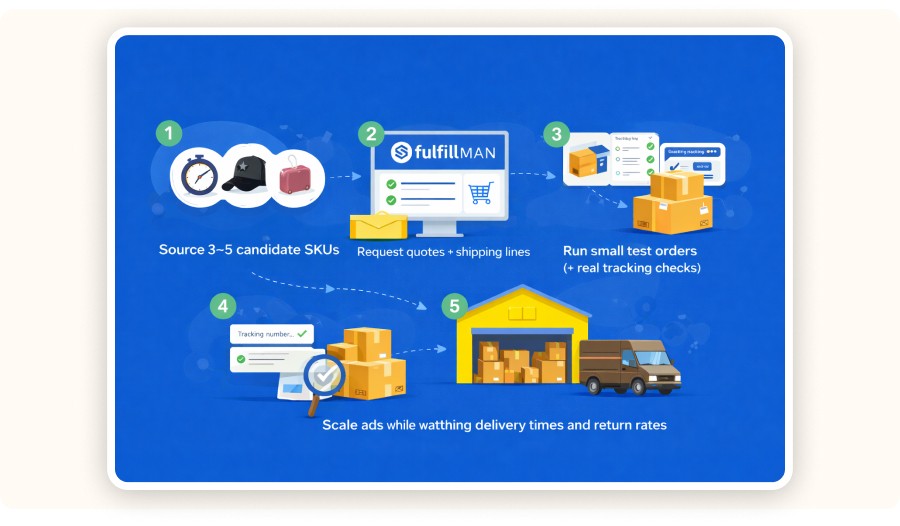
If you’re running Shopify, the cleanest Fulfillman workflow usually looks like this: source 3–5 candidate SKUs → request quotes + shipping lines → run small test orders (with real tracking checks) → warehouse the winner → scale ads while watching delivery times and return rates.
A practical flow that matches how most Minea readers operate:
1) Pick a product that already shows demand
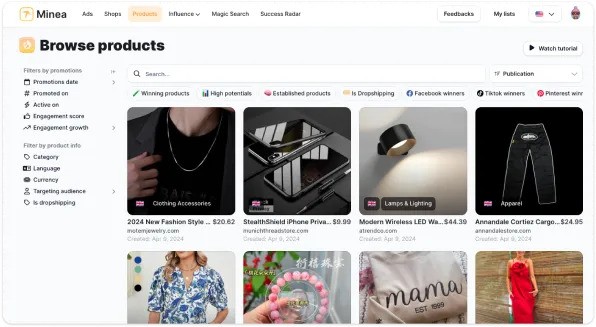
Use an ad intelligence tool like Minea to spot repeat advertisers and stable creatives.
You’re looking for staying power, not a 48-hour spike.


2) Ask Fulfillman to source it (with constraints)
Send:
Target material/specs (avoid the classic “same as AliExpress” vagueness)
Target cost range
Required packaging (neutral vs custom)
Your main shipping destinations (US, CA, EU)
3) Request quotes as “landed cost,” not product cost
Your real unit economics is:
Product cost
pick/pack
shipping line cost
any handling/label fees
a reserve for expected replacement/refund rate
4) Run test orders you can measure
3–5 orders to different states (or countries)
Track: label creation time, in-transit time, scan events, and delivery confirmation
5) Warehouse the winner (only after demand is proven)
Warehousing makes sense when you have consistent volume. If you warehouse too early, you’re basically paying for inventory risk.
Fulfillman shipping: are 3–8 days realistic?
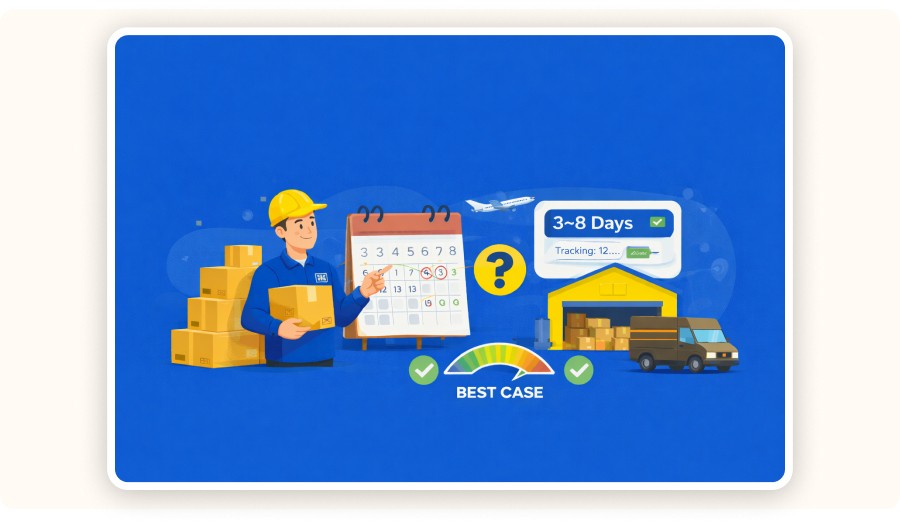
Fulfillman’s public positioning often highlights 3–8 day shipping for many lanes. Treat that as an achievable best-case range on well-served destinations, with the right shipping line and stocked inventory, not as a guaranteed SLA for every SKU, every season, or every country.
Fast shipping is usually unlocked by one (or more) of these mechanisms:
Inventory pre-positioning (your best sellers are already stocked)
Private shipping lines optimized for e-commerce parcels
Carrier options like DHL/FedEx on certain lanes
Better operational batching (labels + pickups handled as a process, not ad hoc)
What to verify before you scale
Label-to-scan time (if labels are created fast but packages don’t move, you still lose trust)
Tracking event quality (real scans vs long “pre-shipment” gaps)
Peak season behavior (Q4 delays can blow up your support inbox)
If you sell in the US, the key question isn’t really “how fast on average?”
It’s: “How often are deliveries late enough to trigger disputes?”
Even a 10–15% late rate can seriously damage a new ad account.
Fulfillman product sourcing and private labeling (where the margin is)
Fulfillman can be especially useful once you’re moving past generic products and want private label, custom inserts, or custom packaging, because the real blocker for most sellers isn’t the idea, it’s the operational overhead and the supplier coordination that comes with branding.
Sourcing isn’t just “find the cheapest supplier.” The real levers are:
Spec fidelity (same photo doesn’t mean same build)
Batch consistency (one supplier today, a different one next week = customer complaints)
Packaging control (less damage, better perceived value)
If you’re using Minea for product research, here’s a concrete way to connect the two:
Identify repeat-winning categories (example dataset): posture corrector belt (trend score 92), LED face mask (88), portable blender (85).
Use those as your shortlist and ask Fulfillman for 2 options per product: a baseline version and a brandable version.
Compare landed cost vs expected selling price. The sample average price point in the brief dataset is $29.99, which is a realistic “impulse-to-consideration” range for many TikTok/Meta offers.
Integrations: what you should expect in 2026
Fulfillman advertises integrations with major commerce platforms (including Shopify and WooCommerce) so orders can sync automatically. The goal is simple: reduce manual CSV work and avoid fulfillment mistakes as volume grows.
When “integration” matters most
You’re running more than ~10–20 orders/day and mistakes start creeping in.
You sell bundles or variants where SKU mapping gets fragile.
You need automatic tracking updates pushed back to Shopify to reduce “where is my order?” tickets.
What to ask for (specific, measurable)
How often inventory sync updates (every 15 min vs daily)
How variant mapping is handled (color/size)
How split shipments are tracked
Whether order edits/cancellations can be handled after sync
Minea
Reach $1,000 per day or get your money back

If you’re a US dropshipper who’s tired of 15–30 day AliExpress delivery windows (and the constant refund pressure that comes with them), Fulfillman is the kind of agent + fulfillment center service you look into when you want faster shipping and more control over packaging.
Fulfillman presents itself as a global dropshipping + order fulfillment partner handling the full chain: product sourcing, warehousing, picking/packing, private labeling, and shipping via private lines or carriers like DHL/FedEx, with integrations for most common e-commerce platforms.
Key takeaways
Fulfillman is a dropshipping fulfillment service that combines product sourcing + warehousing + shipping under one account.
Their marketing puts 3–8 day shipping front and center as the core value prop (it still depends on destination, shipping line, and product).
You’ll get the most value if you already have steady demand (consistent orders) and want branding (custom packaging) with fewer fulfillment headaches.
Before committing, make sure you validate the total landed cost (product + pick/pack + shipping + returns handling) on 3–5 SKUs.
What is Fulfillman (and what “fulfillment dropshipping” really means)?
Fulfillman is a dropshipping fulfillment provider that helps you source products, store inventory (or handle orders on demand), and ship to customers using faster shipping lines than what you usually get from typical marketplace suppliers.
In plain terms, “fulfillment dropshipping” means you’re outsourcing the operational side, supplier coordination, packing, tracking, and sometimes returns. So you can stay focused on product testing and marketing.
A lot of sellers mix up a “dropshipping supplier” and a “fulfillment partner.”
A supplier sells you the item. A fulfillment partner runs the system that gets orders shipped consistently and reliably.
With Fulfillman, you’re usually paying for a bundle of services, such as:
Product sourcing (finding suppliers, negotiating price, confirming specs)
Quality checks (basic inspection, photo/video confirmation)
Warehousing (stocking fast movers so shipping is faster)
Pick/pack + bundling (multi-item orders, kitting)
Shipping execution (label creation, handoff to private lines/DHL/FedEx, tracking updates)
The main reason sellers switch is straightforward: when shipping is slow, you end up paying for it elsewhere, chargebacks, PayPal disputes, and even ad performance decay (your offer stops converting once the comments fill up with “where’s my order?”).
Feature | What Fulfillman says it includes | Why it matters | What to confirm before scaling |
|---|---|---|---|
Full order management | They handle sourcing → fulfillment → shipping while you focus on marketing. | Fewer moving parts vs juggling multiple suppliers. | Who does what (you vs them) once orders sync. |
Product sourcing | Team sources items and aims for quality + lower rates. | Better supply options than marketplace sourcing (in theory). | Spec accuracy, supplier stability, sample/QC evidence. |
Purchasing on your behalf | They “do the shopping for you.” | Removes daily manual ordering workload. | Payment flow (how you fund orders) + proof of purchase process. |
Free warehouse storage (conditional) | Free storage mentioned, especially for “hot products.” | Can speed up delivery if inventory is ready. | Storage eligibility rules, aging limits, and restock workflow. |
Quality check (QC) | They quality check items for compatibility/satisfaction. | Reduces wrong/damaged item incidents. | Whether QC photos/videos are standard or paid add-ons. |
Worldwide shipping | Ships worldwide via Private Line or other carriers. | Broader destination coverage. | Which lanes are fastest for your top countries/states. |
Private Line shipping | Promotes fast shipping via Private Line (direct from China). | Often the core “speed” promise. | Real delivery ranges by lane + peak-season behavior. |
Automatic tracking updates | Tracking numbers updated automatically. | Fewer “Where is my order?” tickets if tracking is clean. | Label-to-scan time + tracking event quality (real scans). |
Order visibility (Google Sheet) | Orders automatically pushed to a shared Google Sheet. | Operational clarity without manual spreadsheets. | What fields are included, update frequency, exception reporting. |
Bundling / kitting | Supports bundling: multiple items shipped together. | Helps AOV, reduces split shipments. | Bundle pricing rules (pick/pack, extra handling, weight impacts). |
Branding options | Branding: logo on packages, flyers, cards, custom boxes, etc. | Better perceived value + brand control. | MOQs, setup costs, lead times, packaging quality. |
Return / refund policy | Mentions refunds/resends for damaged/wrong/lost + returns to warehouse. | Returns are where margins often leak. | Exact conditions, evidence required, and who pays each scenario. |
Communication/support | Mentions immediate response via Microsoft Teams. | Faster issue resolution when volume grows. | Actual response SLAs, escalation path, and ticket workflow. |
Supported platforms | Lists: Shopify, Amazon, eBay, WooCommerce, BigCommerce, Magento. | Easier order flow if integration is stable. | Variant/SKU mapping, split shipments, cancellations/edits after sync. |
How Fulfillman works for a Shopify dropshipping store (step-by-step)
If you’re running Shopify, the cleanest Fulfillman workflow usually looks like this: source 3–5 candidate SKUs → request quotes + shipping lines → run small test orders (with real tracking checks) → warehouse the winner → scale ads while watching delivery times and return rates.
A practical flow that matches how most Minea readers operate:
1) Pick a product that already shows demand
Use an ad intelligence tool like Minea to spot repeat advertisers and stable creatives.
You’re looking for staying power, not a 48-hour spike.
2) Ask Fulfillman to source it (with constraints)
Send:
Target material/specs (avoid the classic “same as AliExpress” vagueness)
Target cost range
Required packaging (neutral vs custom)
Your main shipping destinations (US, CA, EU)
3) Request quotes as “landed cost,” not product cost
Your real unit economics is:
Product cost
pick/pack
shipping line cost
any handling/label fees
a reserve for expected replacement/refund rate
4) Run test orders you can measure
3–5 orders to different states (or countries)
Track: label creation time, in-transit time, scan events, and delivery confirmation
5) Warehouse the winner (only after demand is proven)
Warehousing makes sense when you have consistent volume. If you warehouse too early, you’re basically paying for inventory risk.
Fulfillman shipping: are 3–8 days realistic?
Fulfillman’s public positioning often highlights 3–8 day shipping for many lanes. Treat that as an achievable best-case range on well-served destinations, with the right shipping line and stocked inventory, not as a guaranteed SLA for every SKU, every season, or every country.
Fast shipping is usually unlocked by one (or more) of these mechanisms:
Inventory pre-positioning (your best sellers are already stocked)
Private shipping lines optimized for e-commerce parcels
Carrier options like DHL/FedEx on certain lanes
Better operational batching (labels + pickups handled as a process, not ad hoc)
What to verify before you scale
Label-to-scan time (if labels are created fast but packages don’t move, you still lose trust)
Tracking event quality (real scans vs long “pre-shipment” gaps)
Peak season behavior (Q4 delays can blow up your support inbox)
If you sell in the US, the key question isn’t really “how fast on average?”
It’s: “How often are deliveries late enough to trigger disputes?”
Even a 10–15% late rate can seriously damage a new ad account.
Fulfillman product sourcing and private labeling (where the margin is)
Fulfillman can be especially useful once you’re moving past generic products and want private label, custom inserts, or custom packaging, because the real blocker for most sellers isn’t the idea, it’s the operational overhead and the supplier coordination that comes with branding.
Sourcing isn’t just “find the cheapest supplier.” The real levers are:
Spec fidelity (same photo doesn’t mean same build)
Batch consistency (one supplier today, a different one next week = customer complaints)
Packaging control (less damage, better perceived value)
If you’re using Minea for product research, here’s a concrete way to connect the two:
Identify repeat-winning categories (example dataset): posture corrector belt (trend score 92), LED face mask (88), portable blender (85).
Use those as your shortlist and ask Fulfillman for 2 options per product: a baseline version and a brandable version.
Compare landed cost vs expected selling price. The sample average price point in the brief dataset is $29.99, which is a realistic “impulse-to-consideration” range for many TikTok/Meta offers.
Integrations: what you should expect in 2026
Fulfillman advertises integrations with major commerce platforms (including Shopify and WooCommerce) so orders can sync automatically. The goal is simple: reduce manual CSV work and avoid fulfillment mistakes as volume grows.
When “integration” matters most
You’re running more than ~10–20 orders/day and mistakes start creeping in.
You sell bundles or variants where SKU mapping gets fragile.
You need automatic tracking updates pushed back to Shopify to reduce “where is my order?” tickets.
What to ask for (specific, measurable)
How often inventory sync updates (every 15 min vs daily)
How variant mapping is handled (color/size)
How split shipments are tracked
Whether order edits/cancellations can be handled after sync
Minea
Reach $1,000 per day or get your money back
If you’re a US dropshipper who’s tired of 15–30 day AliExpress delivery windows (and the constant refund pressure that comes with them), Fulfillman is the kind of agent + fulfillment center service you look into when you want faster shipping and more control over packaging.
Fulfillman presents itself as a global dropshipping + order fulfillment partner handling the full chain: product sourcing, warehousing, picking/packing, private labeling, and shipping via private lines or carriers like DHL/FedEx, with integrations for most common e-commerce platforms.
Key takeaways
Fulfillman is a dropshipping fulfillment service that combines product sourcing + warehousing + shipping under one account.
Their marketing puts 3–8 day shipping front and center as the core value prop (it still depends on destination, shipping line, and product).
You’ll get the most value if you already have steady demand (consistent orders) and want branding (custom packaging) with fewer fulfillment headaches.
Before committing, make sure you validate the total landed cost (product + pick/pack + shipping + returns handling) on 3–5 SKUs.
What is Fulfillman (and what “fulfillment dropshipping” really means)?
Fulfillman is a dropshipping fulfillment provider that helps you source products, store inventory (or handle orders on demand), and ship to customers using faster shipping lines than what you usually get from typical marketplace suppliers.
In plain terms, “fulfillment dropshipping” means you’re outsourcing the operational side, supplier coordination, packing, tracking, and sometimes returns. So you can stay focused on product testing and marketing.
A lot of sellers mix up a “dropshipping supplier” and a “fulfillment partner.”
A supplier sells you the item. A fulfillment partner runs the system that gets orders shipped consistently and reliably.
With Fulfillman, you’re usually paying for a bundle of services, such as:
Product sourcing (finding suppliers, negotiating price, confirming specs)
Quality checks (basic inspection, photo/video confirmation)
Warehousing (stocking fast movers so shipping is faster)
Pick/pack + bundling (multi-item orders, kitting)
Shipping execution (label creation, handoff to private lines/DHL/FedEx, tracking updates)
The main reason sellers switch is straightforward: when shipping is slow, you end up paying for it elsewhere, chargebacks, PayPal disputes, and even ad performance decay (your offer stops converting once the comments fill up with “where’s my order?”).
Feature | What Fulfillman says it includes | Why it matters | What to confirm before scaling |
|---|---|---|---|
Full order management | They handle sourcing → fulfillment → shipping while you focus on marketing. | Fewer moving parts vs juggling multiple suppliers. | Who does what (you vs them) once orders sync. |
Product sourcing | Team sources items and aims for quality + lower rates. | Better supply options than marketplace sourcing (in theory). | Spec accuracy, supplier stability, sample/QC evidence. |
Purchasing on your behalf | They “do the shopping for you.” | Removes daily manual ordering workload. | Payment flow (how you fund orders) + proof of purchase process. |
Free warehouse storage (conditional) | Free storage mentioned, especially for “hot products.” | Can speed up delivery if inventory is ready. | Storage eligibility rules, aging limits, and restock workflow. |
Quality check (QC) | They quality check items for compatibility/satisfaction. | Reduces wrong/damaged item incidents. | Whether QC photos/videos are standard or paid add-ons. |
Worldwide shipping | Ships worldwide via Private Line or other carriers. | Broader destination coverage. | Which lanes are fastest for your top countries/states. |
Private Line shipping | Promotes fast shipping via Private Line (direct from China). | Often the core “speed” promise. | Real delivery ranges by lane + peak-season behavior. |
Automatic tracking updates | Tracking numbers updated automatically. | Fewer “Where is my order?” tickets if tracking is clean. | Label-to-scan time + tracking event quality (real scans). |
Order visibility (Google Sheet) | Orders automatically pushed to a shared Google Sheet. | Operational clarity without manual spreadsheets. | What fields are included, update frequency, exception reporting. |
Bundling / kitting | Supports bundling: multiple items shipped together. | Helps AOV, reduces split shipments. | Bundle pricing rules (pick/pack, extra handling, weight impacts). |
Branding options | Branding: logo on packages, flyers, cards, custom boxes, etc. | Better perceived value + brand control. | MOQs, setup costs, lead times, packaging quality. |
Return / refund policy | Mentions refunds/resends for damaged/wrong/lost + returns to warehouse. | Returns are where margins often leak. | Exact conditions, evidence required, and who pays each scenario. |
Communication/support | Mentions immediate response via Microsoft Teams. | Faster issue resolution when volume grows. | Actual response SLAs, escalation path, and ticket workflow. |
Supported platforms | Lists: Shopify, Amazon, eBay, WooCommerce, BigCommerce, Magento. | Easier order flow if integration is stable. | Variant/SKU mapping, split shipments, cancellations/edits after sync. |
How Fulfillman works for a Shopify dropshipping store (step-by-step)
If you’re running Shopify, the cleanest Fulfillman workflow usually looks like this: source 3–5 candidate SKUs → request quotes + shipping lines → run small test orders (with real tracking checks) → warehouse the winner → scale ads while watching delivery times and return rates.
A practical flow that matches how most Minea readers operate:
1) Pick a product that already shows demand
Use an ad intelligence tool like Minea to spot repeat advertisers and stable creatives.
You’re looking for staying power, not a 48-hour spike.
2) Ask Fulfillman to source it (with constraints)
Send:
Target material/specs (avoid the classic “same as AliExpress” vagueness)
Target cost range
Required packaging (neutral vs custom)
Your main shipping destinations (US, CA, EU)
3) Request quotes as “landed cost,” not product cost
Your real unit economics is:
Product cost
pick/pack
shipping line cost
any handling/label fees
a reserve for expected replacement/refund rate
4) Run test orders you can measure
3–5 orders to different states (or countries)
Track: label creation time, in-transit time, scan events, and delivery confirmation
5) Warehouse the winner (only after demand is proven)
Warehousing makes sense when you have consistent volume. If you warehouse too early, you’re basically paying for inventory risk.
Fulfillman shipping: are 3–8 days realistic?
Fulfillman’s public positioning often highlights 3–8 day shipping for many lanes. Treat that as an achievable best-case range on well-served destinations, with the right shipping line and stocked inventory, not as a guaranteed SLA for every SKU, every season, or every country.
Fast shipping is usually unlocked by one (or more) of these mechanisms:
Inventory pre-positioning (your best sellers are already stocked)
Private shipping lines optimized for e-commerce parcels
Carrier options like DHL/FedEx on certain lanes
Better operational batching (labels + pickups handled as a process, not ad hoc)
What to verify before you scale
Label-to-scan time (if labels are created fast but packages don’t move, you still lose trust)
Tracking event quality (real scans vs long “pre-shipment” gaps)
Peak season behavior (Q4 delays can blow up your support inbox)
If you sell in the US, the key question isn’t really “how fast on average?”
It’s: “How often are deliveries late enough to trigger disputes?”
Even a 10–15% late rate can seriously damage a new ad account.
Fulfillman product sourcing and private labeling (where the margin is)
Fulfillman can be especially useful once you’re moving past generic products and want private label, custom inserts, or custom packaging, because the real blocker for most sellers isn’t the idea, it’s the operational overhead and the supplier coordination that comes with branding.
Sourcing isn’t just “find the cheapest supplier.” The real levers are:
Spec fidelity (same photo doesn’t mean same build)
Batch consistency (one supplier today, a different one next week = customer complaints)
Packaging control (less damage, better perceived value)
If you’re using Minea for product research, here’s a concrete way to connect the two:
Identify repeat-winning categories (example dataset): posture corrector belt (trend score 92), LED face mask (88), portable blender (85).
Use those as your shortlist and ask Fulfillman for 2 options per product: a baseline version and a brandable version.
Compare landed cost vs expected selling price. The sample average price point in the brief dataset is $29.99, which is a realistic “impulse-to-consideration” range for many TikTok/Meta offers.
Integrations: what you should expect in 2026
Fulfillman advertises integrations with major commerce platforms (including Shopify and WooCommerce) so orders can sync automatically. The goal is simple: reduce manual CSV work and avoid fulfillment mistakes as volume grows.
When “integration” matters most
You’re running more than ~10–20 orders/day and mistakes start creeping in.
You sell bundles or variants where SKU mapping gets fragile.
You need automatic tracking updates pushed back to Shopify to reduce “where is my order?” tickets.
What to ask for (specific, measurable)
How often inventory sync updates (every 15 min vs daily)
How variant mapping is handled (color/size)
How split shipments are tracked
Whether order edits/cancellations can be handled after sync
Minea
Reach $1,000 per day or get your money back
Pricing: how to estimate Fulfillman costs without guessing?

Fulfillman doesn’t publish a fixed pricing table on its dropshipping service page. Pricing is quote-based, and what you pay depends on a few variables:
The exact SKU (size, weight, variants)
The shipping line you choose (Private Line vs carrier options)
Whether you ship on demand or from stocked inventory
In practice, you top up a Fulfillman balance (used to purchase items on your behalf). So the real “pricing” question isn’t a subscription, it’s your total landed cost per unit.
How to evaluate costs (fast)
Request a clean breakdown for 3–5 SKUs (different weights/sizes) shipped to your top destinations. Ask for:
Product cost
Pick/pack fee
Shipping line price (clearly labeled by lane)
Any branding add-ons (custom packaging, inserts, labeling)
The two “hidden lines” that decide profitability
These are where margins usually leak when you scale:
Returns/refunds (wrong item, damaged item, lost parcel, returns)
Replacement/reship rules (who pays, when, and what proof is required)
If those terms aren’t crystal clear, your “good” quote can turn into expensive support problems later.
Inventory and storage
Finally, confirm inventory terms. Fulfillman mentions free storage in certain cases, and that can help delivery speed, but warehousing too early can add risk if demand isn’t proven.
Customer support and operational reliability (what actually breaks at scale)

The biggest failure mode in dropshipping fulfillment isn’t just “shipping is slow.” It’s: support and process don’t keep up with volume, and small issues turn into daily fires.
Here’s what to pressure-test:
Response time: hours, not days
Evidence workflow: do they provide photos for QC issues and wrong items?
Out-of-stock handling: do they proactively propose substitutes, or do they stall orders?
Refund/replacement process: who pays, and under what conditions?
A reliable partner has a boring, repeatable process: Ticket created → evidence attached → decision rule applied → replacement/refund triggered → tracking shared
If the process stays vague, you’ll often end up eating costs just to keep your ad account safe.
Pros and cons of Fulfillman dropshipping services
Pros
Potentially faster shipping than marketplace suppliers on many lanes
Bundling and kitting for multi-item orders
Private label options if you want branding
Operational consolidation (fewer moving parts than juggling 5 suppliers)
Cons
Your results depend on the exact shipping line + SKU + stocking setup
Pricing can be hard to compare if quotes aren’t standardized as landed cost
Returns handling can become the hidden cost center for US/EU buyers
Switching costs (SKU mapping, inventory moves, process learning curve)
Who should use Fulfillman (and who shouldn’t)

Fulfillman is usually a better fit when you already have proof of demand and want to scale with fewer fulfillment problems. If you’re still testing random products with $100 and no clear winner, a lighter supplier stack often makes more sense.
Best fit
You have 1–3 products that are already selling and want faster delivery + brand control.
You’re getting comments/chargebacks tied to shipping delays.
You want to bundle products or add inserts to improve AOV and retention.
Not a great fit
You’re still at the “$100 test budget” stage and don’t have a repeatable offer yet.
You change products weekly and don’t want warehousing or extra process overhead.
Fulfillman alternatives

If Fulfillman doesn’t match your constraints, the best alternative depends on what you’re optimizing for: US delivery speed, hands-off automation, or supplier breadth.
A practical way to think about alternatives:
If you need US-first delivery speed: look for providers with US warehousing and clear domestic lanes.
If you want automation: lean toward tools that sync orders, inventory, tracking, and supplier routing with fewer manual steps.
If you need breadth: prioritize networks with deeper catalogs (just expect more variance from product to product).
Examples to consider (based on your use case):
Zendrop: often positioned for faster shipping options and a smoother beginner-to-scale path.
CJ Dropshipping: broad catalog + sourcing, but you’ll want to validate consistency lane-by-lane.
AutoDS (fulfillment automation layer): useful if your main pain is operational automation across multiple suppliers.
Checklist: 12 questions to ask Fulfillman before you scale

If you treat Fulfillman like a black box, you’ll usually discover the real constraints only after you’ve already spent money on ads. A short checklist up front protects your margin and your support workload.
Ask these before you move meaningful volume:
What are the available shipping lines for US delivery, and what’s the expected delivery range for each?
What’s the typical label-to-scan time (same day vs 48+ hours)?
Do you offer free storage, and what counts as “fast-selling” for storage eligibility?
What’s the exact pick/pack fee and how do bundles get priced?
Can you provide QC photos before shipping (and what’s the fee, if any)?
How do you handle out-of-stock items: auto-hold, substitution options, or cancellation?
What’s the returns process for US customers (address, fees, restocking rules)?
Do you offer custom packaging and inserts, and what are the MOQs or setup costs?
How does inventory sync work (frequency, oversell protection, variant mapping)?
What’s your escalation path when parcels are stuck (who contacts the carrier and when)?
Can you ship from multiple supplier countries if needed (the dataset here lists China, Turkey, and Vietnam as common sourcing origins)?
What reporting do you provide weekly (shipping time distribution, exception rate, replacements)?
Minea
Top 100 best-performing products this month
Detected in real time by our AI from market signals: real sales, advertising statistics, and performance
Final verdict
Fulfillman can be a strong fit if you already have 1–3 proven winners and your bottleneck is shipping speed, support load, or brand control. The value is in consolidation (sourcing, QC, pick/pack, shipping, packaging) and the ability to unlock faster US lanes, if you have the right SKU, the right line, and stocked inventory. Before you scale, demand quotes in total landed cost, run 3–5 real test orders, and measure label-to-scan time, tracking quality, and returns handling. If pricing stays vague or performance varies, don’t commit. Use a lighter setup until you’re stable. This is where margins are protected.
FAQ
What are the benefits of using Fulfillman for dropshipping?
Fulfillman’s main benefits are speed and operational consolidation: product sourcing, order fulfillment, and shipping can sit under one process. The upside is fewer delayed parcels and fewer “where is my order?” tickets when the workflow is stable. The trade-off: you still need to validate real landed costs and returns handling before scaling.
How does Fulfillman handle order fulfillment for dropshipping businesses?
Fulfillman typically connects to your store (for example Shopify), receives orders, picks and packs items, then ships them using the selected shipping line. Tracking updates should flow back to your store so customers see progress. The details that matter most are label-to-scan time, variant accuracy, and how exceptions (out of stock, address issues) are handled.
What are the shipping costs associated with Fulfillman’s dropshipping services?
Shipping costs depend on destination, parcel weight/size, and the line you choose (private line vs carriers like DHL/FedEx). The right way to evaluate costs is to request landed-cost quotes on 3–5 SKUs and your top destinations, then compute gross margin after pick/pack and any packaging add-ons.
Does Fulfillman offer product sourcing for dropshipping?
Yes, Fulfillman positions product sourcing as part of the service, not just shipping. The sourcing value comes from spec control (materials, variants), quality checks, and the ability to bundle or brand products. You should still verify samples and consistency if you plan to scale.
How do I integrate my e-commerce store with Fulfillman for dropshipping?
Start by confirming your platform (Shopify, WooCommerce, or another supported platform) and how order syncing works. Map SKUs/variants carefully, then run a small batch of test orders to validate tracking updates and exception handling. Only after that should you stock inventory for faster shipping.
Is $100 enough for dropshipping with a fulfillment partner like Fulfillman?
$100 can be enough to test ad creatives or a product page, but it’s usually not enough to properly validate a fulfillment partner. If your budget is that tight, focus on proving one offer first. Then use a fulfillment partner once you have consistent orders and the shipping/support problem is actually costing you money.
Pricing: how to estimate Fulfillman costs without guessing?
Fulfillman doesn’t publish a fixed pricing table on its dropshipping service page. Pricing is quote-based, and what you pay depends on a few variables:
The exact SKU (size, weight, variants)
The shipping line you choose (Private Line vs carrier options)
Whether you ship on demand or from stocked inventory
In practice, you top up a Fulfillman balance (used to purchase items on your behalf). So the real “pricing” question isn’t a subscription, it’s your total landed cost per unit.
How to evaluate costs (fast)
Request a clean breakdown for 3–5 SKUs (different weights/sizes) shipped to your top destinations. Ask for:
Product cost
Pick/pack fee
Shipping line price (clearly labeled by lane)
Any branding add-ons (custom packaging, inserts, labeling)
The two “hidden lines” that decide profitability
These are where margins usually leak when you scale:
Returns/refunds (wrong item, damaged item, lost parcel, returns)
Replacement/reship rules (who pays, when, and what proof is required)
If those terms aren’t crystal clear, your “good” quote can turn into expensive support problems later.
Inventory and storage
Finally, confirm inventory terms. Fulfillman mentions free storage in certain cases, and that can help delivery speed, but warehousing too early can add risk if demand isn’t proven.
Customer support and operational reliability (what actually breaks at scale)
The biggest failure mode in dropshipping fulfillment isn’t just “shipping is slow.” It’s: support and process don’t keep up with volume, and small issues turn into daily fires.
Here’s what to pressure-test:
Response time: hours, not days
Evidence workflow: do they provide photos for QC issues and wrong items?
Out-of-stock handling: do they proactively propose substitutes, or do they stall orders?
Refund/replacement process: who pays, and under what conditions?
A reliable partner has a boring, repeatable process: Ticket created → evidence attached → decision rule applied → replacement/refund triggered → tracking shared
If the process stays vague, you’ll often end up eating costs just to keep your ad account safe.
Pros and cons of Fulfillman dropshipping services
Pros
Potentially faster shipping than marketplace suppliers on many lanes
Bundling and kitting for multi-item orders
Private label options if you want branding
Operational consolidation (fewer moving parts than juggling 5 suppliers)
Cons
Your results depend on the exact shipping line + SKU + stocking setup
Pricing can be hard to compare if quotes aren’t standardized as landed cost
Returns handling can become the hidden cost center for US/EU buyers
Switching costs (SKU mapping, inventory moves, process learning curve)
Who should use Fulfillman (and who shouldn’t)
Fulfillman is usually a better fit when you already have proof of demand and want to scale with fewer fulfillment problems. If you’re still testing random products with $100 and no clear winner, a lighter supplier stack often makes more sense.
Best fit
You have 1–3 products that are already selling and want faster delivery + brand control.
You’re getting comments/chargebacks tied to shipping delays.
You want to bundle products or add inserts to improve AOV and retention.
Not a great fit
You’re still at the “$100 test budget” stage and don’t have a repeatable offer yet.
You change products weekly and don’t want warehousing or extra process overhead.
Fulfillman alternatives
If Fulfillman doesn’t match your constraints, the best alternative depends on what you’re optimizing for: US delivery speed, hands-off automation, or supplier breadth.
A practical way to think about alternatives:
If you need US-first delivery speed: look for providers with US warehousing and clear domestic lanes.
If you want automation: lean toward tools that sync orders, inventory, tracking, and supplier routing with fewer manual steps.
If you need breadth: prioritize networks with deeper catalogs (just expect more variance from product to product).
Examples to consider (based on your use case):
Zendrop: often positioned for faster shipping options and a smoother beginner-to-scale path.
CJ Dropshipping: broad catalog + sourcing, but you’ll want to validate consistency lane-by-lane.
AutoDS (fulfillment automation layer): useful if your main pain is operational automation across multiple suppliers.
Checklist: 12 questions to ask Fulfillman before you scale
If you treat Fulfillman like a black box, you’ll usually discover the real constraints only after you’ve already spent money on ads. A short checklist up front protects your margin and your support workload.
Ask these before you move meaningful volume:
What are the available shipping lines for US delivery, and what’s the expected delivery range for each?
What’s the typical label-to-scan time (same day vs 48+ hours)?
Do you offer free storage, and what counts as “fast-selling” for storage eligibility?
What’s the exact pick/pack fee and how do bundles get priced?
Can you provide QC photos before shipping (and what’s the fee, if any)?
How do you handle out-of-stock items: auto-hold, substitution options, or cancellation?
What’s the returns process for US customers (address, fees, restocking rules)?
Do you offer custom packaging and inserts, and what are the MOQs or setup costs?
How does inventory sync work (frequency, oversell protection, variant mapping)?
What’s your escalation path when parcels are stuck (who contacts the carrier and when)?
Can you ship from multiple supplier countries if needed (the dataset here lists China, Turkey, and Vietnam as common sourcing origins)?
What reporting do you provide weekly (shipping time distribution, exception rate, replacements)?
Minea
Top 100 best-performing products this month
Detected in real time by our AI from market signals: real sales, advertising statistics, and performance
Final verdict
Fulfillman can be a strong fit if you already have 1–3 proven winners and your bottleneck is shipping speed, support load, or brand control. The value is in consolidation (sourcing, QC, pick/pack, shipping, packaging) and the ability to unlock faster US lanes, if you have the right SKU, the right line, and stocked inventory. Before you scale, demand quotes in total landed cost, run 3–5 real test orders, and measure label-to-scan time, tracking quality, and returns handling. If pricing stays vague or performance varies, don’t commit. Use a lighter setup until you’re stable. This is where margins are protected.
FAQ
What are the benefits of using Fulfillman for dropshipping?
Fulfillman’s main benefits are speed and operational consolidation: product sourcing, order fulfillment, and shipping can sit under one process. The upside is fewer delayed parcels and fewer “where is my order?” tickets when the workflow is stable. The trade-off: you still need to validate real landed costs and returns handling before scaling.
How does Fulfillman handle order fulfillment for dropshipping businesses?
Fulfillman typically connects to your store (for example Shopify), receives orders, picks and packs items, then ships them using the selected shipping line. Tracking updates should flow back to your store so customers see progress. The details that matter most are label-to-scan time, variant accuracy, and how exceptions (out of stock, address issues) are handled.
What are the shipping costs associated with Fulfillman’s dropshipping services?
Shipping costs depend on destination, parcel weight/size, and the line you choose (private line vs carriers like DHL/FedEx). The right way to evaluate costs is to request landed-cost quotes on 3–5 SKUs and your top destinations, then compute gross margin after pick/pack and any packaging add-ons.
Does Fulfillman offer product sourcing for dropshipping?
Yes, Fulfillman positions product sourcing as part of the service, not just shipping. The sourcing value comes from spec control (materials, variants), quality checks, and the ability to bundle or brand products. You should still verify samples and consistency if you plan to scale.
How do I integrate my e-commerce store with Fulfillman for dropshipping?
Start by confirming your platform (Shopify, WooCommerce, or another supported platform) and how order syncing works. Map SKUs/variants carefully, then run a small batch of test orders to validate tracking updates and exception handling. Only after that should you stock inventory for faster shipping.
Is $100 enough for dropshipping with a fulfillment partner like Fulfillman?
$100 can be enough to test ad creatives or a product page, but it’s usually not enough to properly validate a fulfillment partner. If your budget is that tight, focus on proving one offer first. Then use a fulfillment partner once you have consistent orders and the shipping/support problem is actually costing you money.
Pricing: how to estimate Fulfillman costs without guessing?
Fulfillman doesn’t publish a fixed pricing table on its dropshipping service page. Pricing is quote-based, and what you pay depends on a few variables:
The exact SKU (size, weight, variants)
The shipping line you choose (Private Line vs carrier options)
Whether you ship on demand or from stocked inventory
In practice, you top up a Fulfillman balance (used to purchase items on your behalf). So the real “pricing” question isn’t a subscription, it’s your total landed cost per unit.
How to evaluate costs (fast)
Request a clean breakdown for 3–5 SKUs (different weights/sizes) shipped to your top destinations. Ask for:
Product cost
Pick/pack fee
Shipping line price (clearly labeled by lane)
Any branding add-ons (custom packaging, inserts, labeling)
The two “hidden lines” that decide profitability
These are where margins usually leak when you scale:
Returns/refunds (wrong item, damaged item, lost parcel, returns)
Replacement/reship rules (who pays, when, and what proof is required)
If those terms aren’t crystal clear, your “good” quote can turn into expensive support problems later.
Inventory and storage
Finally, confirm inventory terms. Fulfillman mentions free storage in certain cases, and that can help delivery speed, but warehousing too early can add risk if demand isn’t proven.
Customer support and operational reliability (what actually breaks at scale)
The biggest failure mode in dropshipping fulfillment isn’t just “shipping is slow.” It’s: support and process don’t keep up with volume, and small issues turn into daily fires.
Here’s what to pressure-test:
Response time: hours, not days
Evidence workflow: do they provide photos for QC issues and wrong items?
Out-of-stock handling: do they proactively propose substitutes, or do they stall orders?
Refund/replacement process: who pays, and under what conditions?
A reliable partner has a boring, repeatable process: Ticket created → evidence attached → decision rule applied → replacement/refund triggered → tracking shared
If the process stays vague, you’ll often end up eating costs just to keep your ad account safe.
Pros and cons of Fulfillman dropshipping services
Pros
Potentially faster shipping than marketplace suppliers on many lanes
Bundling and kitting for multi-item orders
Private label options if you want branding
Operational consolidation (fewer moving parts than juggling 5 suppliers)
Cons
Your results depend on the exact shipping line + SKU + stocking setup
Pricing can be hard to compare if quotes aren’t standardized as landed cost
Returns handling can become the hidden cost center for US/EU buyers
Switching costs (SKU mapping, inventory moves, process learning curve)
Who should use Fulfillman (and who shouldn’t)
Fulfillman is usually a better fit when you already have proof of demand and want to scale with fewer fulfillment problems. If you’re still testing random products with $100 and no clear winner, a lighter supplier stack often makes more sense.
Best fit
You have 1–3 products that are already selling and want faster delivery + brand control.
You’re getting comments/chargebacks tied to shipping delays.
You want to bundle products or add inserts to improve AOV and retention.
Not a great fit
You’re still at the “$100 test budget” stage and don’t have a repeatable offer yet.
You change products weekly and don’t want warehousing or extra process overhead.
Fulfillman alternatives
If Fulfillman doesn’t match your constraints, the best alternative depends on what you’re optimizing for: US delivery speed, hands-off automation, or supplier breadth.
A practical way to think about alternatives:
If you need US-first delivery speed: look for providers with US warehousing and clear domestic lanes.
If you want automation: lean toward tools that sync orders, inventory, tracking, and supplier routing with fewer manual steps.
If you need breadth: prioritize networks with deeper catalogs (just expect more variance from product to product).
Examples to consider (based on your use case):
Zendrop: often positioned for faster shipping options and a smoother beginner-to-scale path.
CJ Dropshipping: broad catalog + sourcing, but you’ll want to validate consistency lane-by-lane.
AutoDS (fulfillment automation layer): useful if your main pain is operational automation across multiple suppliers.
Checklist: 12 questions to ask Fulfillman before you scale
If you treat Fulfillman like a black box, you’ll usually discover the real constraints only after you’ve already spent money on ads. A short checklist up front protects your margin and your support workload.
Ask these before you move meaningful volume:
What are the available shipping lines for US delivery, and what’s the expected delivery range for each?
What’s the typical label-to-scan time (same day vs 48+ hours)?
Do you offer free storage, and what counts as “fast-selling” for storage eligibility?
What’s the exact pick/pack fee and how do bundles get priced?
Can you provide QC photos before shipping (and what’s the fee, if any)?
How do you handle out-of-stock items: auto-hold, substitution options, or cancellation?
What’s the returns process for US customers (address, fees, restocking rules)?
Do you offer custom packaging and inserts, and what are the MOQs or setup costs?
How does inventory sync work (frequency, oversell protection, variant mapping)?
What’s your escalation path when parcels are stuck (who contacts the carrier and when)?
Can you ship from multiple supplier countries if needed (the dataset here lists China, Turkey, and Vietnam as common sourcing origins)?
What reporting do you provide weekly (shipping time distribution, exception rate, replacements)?
Minea
Top 100 best-performing products this month
Detected in real time by our AI from market signals: real sales, advertising statistics, and performance
Final verdict
Fulfillman can be a strong fit if you already have 1–3 proven winners and your bottleneck is shipping speed, support load, or brand control. The value is in consolidation (sourcing, QC, pick/pack, shipping, packaging) and the ability to unlock faster US lanes, if you have the right SKU, the right line, and stocked inventory. Before you scale, demand quotes in total landed cost, run 3–5 real test orders, and measure label-to-scan time, tracking quality, and returns handling. If pricing stays vague or performance varies, don’t commit. Use a lighter setup until you’re stable. This is where margins are protected.
FAQ
What are the benefits of using Fulfillman for dropshipping?
Fulfillman’s main benefits are speed and operational consolidation: product sourcing, order fulfillment, and shipping can sit under one process. The upside is fewer delayed parcels and fewer “where is my order?” tickets when the workflow is stable. The trade-off: you still need to validate real landed costs and returns handling before scaling.
How does Fulfillman handle order fulfillment for dropshipping businesses?
Fulfillman typically connects to your store (for example Shopify), receives orders, picks and packs items, then ships them using the selected shipping line. Tracking updates should flow back to your store so customers see progress. The details that matter most are label-to-scan time, variant accuracy, and how exceptions (out of stock, address issues) are handled.
What are the shipping costs associated with Fulfillman’s dropshipping services?
Shipping costs depend on destination, parcel weight/size, and the line you choose (private line vs carriers like DHL/FedEx). The right way to evaluate costs is to request landed-cost quotes on 3–5 SKUs and your top destinations, then compute gross margin after pick/pack and any packaging add-ons.
Does Fulfillman offer product sourcing for dropshipping?
Yes, Fulfillman positions product sourcing as part of the service, not just shipping. The sourcing value comes from spec control (materials, variants), quality checks, and the ability to bundle or brand products. You should still verify samples and consistency if you plan to scale.
How do I integrate my e-commerce store with Fulfillman for dropshipping?
Start by confirming your platform (Shopify, WooCommerce, or another supported platform) and how order syncing works. Map SKUs/variants carefully, then run a small batch of test orders to validate tracking updates and exception handling. Only after that should you stock inventory for faster shipping.
Is $100 enough for dropshipping with a fulfillment partner like Fulfillman?
$100 can be enough to test ad creatives or a product page, but it’s usually not enough to properly validate a fulfillment partner. If your budget is that tight, focus on proving one offer first. Then use a fulfillment partner once you have consistent orders and the shipping/support problem is actually costing you money.
Similar articles
Easyship Fulfillment Review 2026: A Practical Ecommerce Pick for Dropshipping
Best Ecommerce Fulfillment Center
Easyship Fulfillment Review 2026: A Practical Ecommerce Pick for Dropshipping
Best Ecommerce Fulfillment Center
Easyship Fulfillment Review 2026: A Practical Ecommerce Pick for Dropshipping
Best Ecommerce Fulfillment Center
Easyship Fulfillment Review 2026: A Practical Ecommerce Pick for Dropshipping
Best Ecommerce Fulfillment Center
Amazon Fulfillment (FBA) in 2026: How It Works, Real Costs, Fulfillment Centers & TikTok Shop
Best Ecommerce Fulfillment Center
Amazon Fulfillment (FBA) in 2026: How It Works, Real Costs, Fulfillment Centers & TikTok Shop
Best Ecommerce Fulfillment Center
Amazon Fulfillment (FBA) in 2026: How It Works, Real Costs, Fulfillment Centers & TikTok Shop
Best Ecommerce Fulfillment Center
Amazon Fulfillment (FBA) in 2026: How It Works, Real Costs, Fulfillment Centers & TikTok Shop
Best Ecommerce Fulfillment Center
Deliverr Fulfillment Review 2026 for Dropshipping: The Flexport Reality
Best Ecommerce Fulfillment Center
Deliverr Fulfillment Review 2026 for Dropshipping: The Flexport Reality
Best Ecommerce Fulfillment Center
Deliverr Fulfillment Review 2026 for Dropshipping: The Flexport Reality
Best Ecommerce Fulfillment Center
Deliverr Fulfillment Review 2026 for Dropshipping: The Flexport Reality
Best Ecommerce Fulfillment Center


Our Free Adspys

Find winning products on our Tiktok adspy today!
Find winning products on our Facebook adspy today!
Find winning products on our Tiktok adspy today!
Find winning products on our Facebook adspy today!
Find winning products on our Tiktok adspy today!
Find winning products on our Facebook adspy today!
Find winning products on our Tiktok adspy today!
Find winning products on our Facebook adspy today!
1 winning product everyday.
Follow us!






Find out more
Read more
Minea © 2026
Find out more
Read more
Minea © 2026
Find out more
Read more
Minea © 2026
Find out more
Read more
Minea © 2026
Find out more
Read more
Minea © 2026
Find out more
Read more
Minea © 2026