Discover the most profitable dropshipping products of 2026, winning items backed by real market data and trending e-commerce demand.
With Minea, you do it yourself. Find the products and ads already driving sales to build a data-driven store and increase your profit margins.

Discover the most profitable dropshipping products of 2026, winning items backed by real market data and trending e-commerce demand.
With Minea, you do it yourself. Find the products and ads already driving sales to build a data-driven store and increase your profit margins.
Discover the most profitable dropshipping products of 2026, winning items backed by real market data and trending e-commerce demand.
With Minea, you do it yourself. Find the products and ads already driving sales to build a data-driven store and increase your profit margins.
Discover the most profitable dropshipping products of 2026, winning items backed by real market data and trending e-commerce demand.
With Minea, you do it yourself. Find the products and ads already driving sales to build a data-driven store and increase your profit margins.
Discover the most profitable dropshipping products of 2026, winning items backed by real market data and trending e-commerce demand.
With Minea, you do it yourself. Find the products and ads already driving sales to build a data-driven store and increase your profit margins.
Discover the most profitable dropshipping products of 2026, winning items backed by real market data and trending e-commerce demand.
With Minea, you do it yourself. Find the products and ads already driving sales to build a data-driven store and increase your profit margins.
Author: Baptistin
Contents
Winning Dropshipping Products in 2026: The Criteria I Use Before I Spend a Euro
Most lists of winning products are written as if picking the right item settles the outcome. It does not. I can tell you whether a product can work or definitively cannot, never whether it will.
That distinction is the whole job. Product research is elimination: cut the certain losers, and what remains is the pool worth testing. This page covers the criteria I apply before spending anything, which categories are trending in 2026, and where to look for candidates.
TL;DR, What makes a winning product
Perceived value decides the margin, not product cost. The question is what the product is worth to the buyer, not what it costs you.
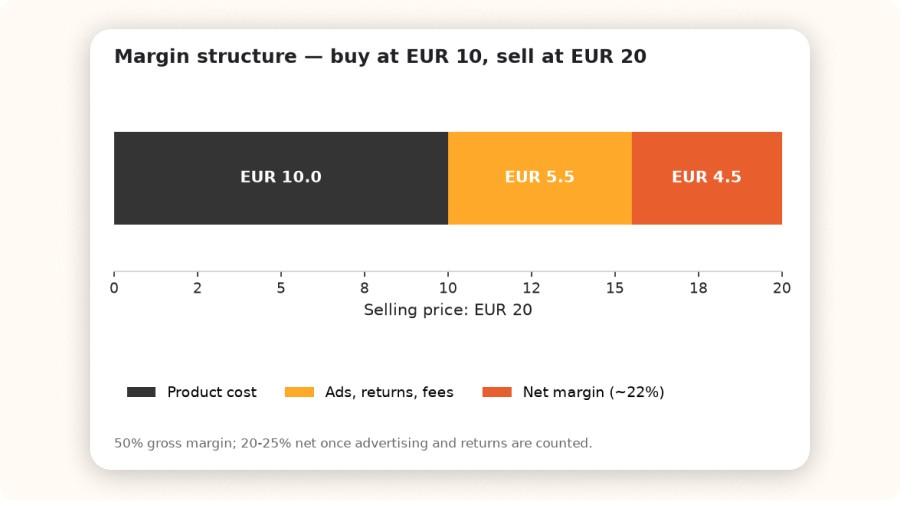
Buy at 10, sell at 20 is a workable floor, a 50% margin is already solid. Net, after ads and returns, the realistic band is 20–25%.
Wow effect matters, but timing matters more. A product everyone already knows is hard to price well.
Trending is a window, not a verdict. A category can be trending and still be wrong for you if you cannot source it or fund the test.
The tool narrows the field; it does not pick the winner. Searching with one saved filter set returns the same products to everyone using it.
Dropshipping is not reselling €1 goods at €50. That model is dishonest and it does not survive a refund rate.
The criteria that actually eliminate products
Perceived value comes before cost
The mistake I see most often is reasoning from product cost upward. The useful question is the opposite: what is this worth to the person buying it?
Some objects carry almost no perceived value however well they are made. Others carry a great deal, and the gap between the two is where a margin lives. Ask what makes this product feel worth more than its parts, a real problem solved, a visible result, a quality of finish, before asking what it costs to source.
Margin: the arithmetic floor
If I buy a product at €10, I can sell it at €15 or €20 and make a small margin. At €20 that is a 50% margin, which is already very good.
Buyers are now used to certain price points, which is what caps the top end. Selling a €25 product that costs €5 does not leave €20 of clear margin once ads, returns and fees are counted, in dropshipping, the realistic band is roughly 20–25% net, as I break down in this video (French).
High margin and low competition rarely coexist for long. When they do, it is usually because the product is hard to source, hard to ship, or hard to advertise compliantly, check which of the three applies before assuming you found a gap nobody noticed.
Sell price and margin are also where I stop most products. A product that cannot carry both is not a candidate, whatever else it has going for it.
Wow effect, and why timing beats it
Wow effect matters. But a product everyone has already seen is hard to price well and hard to be profitable on, and by then the margin has usually gone.
Saturation is relative to who is running the ads. An established seller with a mature pixel, custom creative and a tight supply chain can stay profitable on a product that would sink a beginner. The same product is a different proposition depending on who launches it.
Sourceability
A product that cannot be sourced reliably is not a product, it is a problem waiting for a refund request. Check availability before falling in love with an angle. When volume justifies it, moving from a marketplace to a sourcing agent improves packaging, shipping time and the variants you can offer, which is what lets a dropshipping store become a brand rather than a middleman.
This is the honest version of the model: improved products, better packaging, faster delivery, variants a marketplace does not carry. I have bought from brands doing exactly that, paying €30 for something available elsewhere at €3, because the whole experience was worth it. What is not the model is reselling €1 goods at €50 for a product that does not solve the problem it claims to. That is a scam, and I have no interest in defending it.
Want to learn more about this topic?
Discover our Related Subcategories
find-winning-products-aliexpress
Find Winning Products on AliExpress
How to find winning products on AliExpress: the order-count trap, supplier vetting, the margin test, and why the best products are found before AliExpress.

ebay-product-research
eBay Product Research
How to do eBay product research without guessing: demand signals, sell-through rate, margin maths, and the free methods that work before you pay for a tool.

tiktok-products
Tiktok Products
Dive into the world of viral products seen on TikTok and find the must-haves of the moment in one convenient and reliable place.
See more Categories
find-winning-products-aliexpress
Find Winning Products on AliExpress
How to find winning products on AliExpress: the order-count trap, supplier vetting, the margin test, and why the best products are found before AliExpress.
See more Categories
find-winning-products-aliexpress
Find Winning Products on AliExpress
How to find winning products on AliExpress: the order-count trap, supplier vetting, the margin test, and why the best products are found before AliExpress.
ebay-product-research
eBay Product Research
How to do eBay product research without guessing: demand signals, sell-through rate, margin maths, and the free methods that work before you pay for a tool.
See more Categories
Trending products in 2026: how to read a trend

A trending product is one whose demand is climbing right now. That is a timing signal, not a quality signal, and the two get confused constantly.
What a trend actually tells you. Rising search and ad volume means a market is forming. It does not tell you whether margin survives at scale, whether the supply chain holds, or whether you are early or late. A product trending for six weeks with fifty sellers already running it is a market you are late to.
Reading the curve. Three things separate a trend worth entering from one worth skipping:
Where it is in the cycle. Early means few advertisers and rising engagement. Late means many advertisers, falling engagement, discounting.
Whether it is seasonal or structural. Fitness spikes every January and collapses in March. A structural shift, a new device category, a regulation change, does not revert.
Whether the trend is the product or the angle. Often the object is ordinary and the creative is what spread. That transfers; the product alone does not.
A trend does not exempt a product from the criteria above. A trending item with no perceived value, no margin, or no reliable supplier is still a losing campaign. The trend only decides when, never whether.
Where to watch. Ad platforms show a trend before search does, because advertisers commit budget before consumers search a term. That is why I work from ad data: an ad spy surfaces a product while spend is ramping, several weeks before it shows up in search-volume tools.
Best sellers: what "already selling" is worth
A best-seller list is the opposite signal to a trend. It is retrospective, and it is the safest starting point if you have not launched before, because the product has demonstrably moved units.
The trade-off is symmetric. A product on a best-seller list has already been found, by definition, since that is what put it there. You are entering with proof and without timing advantage, which usually means competing on price, creative or delivery rather than on discovery.
Use best sellers to validate a candidate you found elsewhere, not to source candidates. Sellers who work the other way round tend to arrive last.
Where to find candidates
I use an ad spy because scrolling a public ad library surfaces plenty that is not dropshipping at all, unrelated ads, brands, noise. Filtering removes that.
Two things worth being clear about, both of which I say on camera:
The filters narrow a field; they do not identify a winner. If you always search with the same saved filters, you will always see the same products, and so will everyone else using them. The value is in varying the angle, not in finding one magic configuration. I walk through the full sequence in this product-research video (French).
Product research is one use, not the only one. The same data supports competitor analysis and shop tracking later in the process, which is where the trending-shops view earns its place, it starts from stores rather than individual ads, and it is the easiest entry point if you are starting out.
For the step-by-step method rather than the criteria, see how to find dropshipping products.
Which platform to watch
Products surface on different platforms at different points, and the platform you monitor determines how early you see them.
TikTok is where impulse and demonstration products break first. Short-form rewards a visible before/after, so a product that shows well on camera can go from nothing to saturated in weeks. Monitoring it is how you catch a curve early, and how you avoid entering one that has already peaked. TikTok ad data is the fastest signal available, and also the noisiest.
Facebook and Instagram run slower and older. A product working on Meta usually has a longer profitable life than a TikTok breakout, and the audience converts at higher price points. Meta is where you check whether a TikTok product has staying power beyond its first cohort, Facebook ad data is the better read for durability.
The practical rule: find on TikTok, validate on Meta, look to Pinterest for what everyone else missed. Watching only one platform gives you a partial view of saturation, a product can look untouched on one and be thoroughly worked on another.
Marketplace best-seller data
Marketplace rankings are a free, retrospective cross-check. If a product ranks well on a large marketplace, demand is real and quantified.
Two limits worth knowing before leaning on it. Marketplace demand is search-led, people arrive already looking, whereas ads are interruption-led, so a marketplace best-seller does not always translate to a product you can sell cold on a feed. And a marketplace ranking says nothing about your margin, because the listed price is usually already compressed by competition.
Use it to confirm that demand exists, then price against your own ad cost rather than against the marketplace.
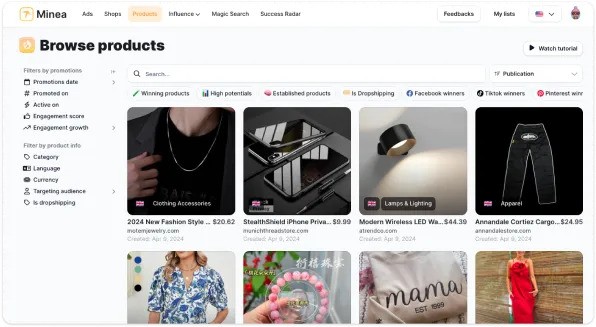
Minea
Top 100 best-performing products this month
Detected in real time by our AI from market signals: real sales, advertising statistics, and performance

Trending categories in 2026
These hold up because they combine repeat demand with room for perceived value. None of them is a shortcut, every product below still has to clear the criteria above.
Pet accessories

Owners buy repeatedly and buy emotionally, which supports both margin and lifetime value. Favour items solving a visible daily annoyance over novelty.
Baby and parenting products
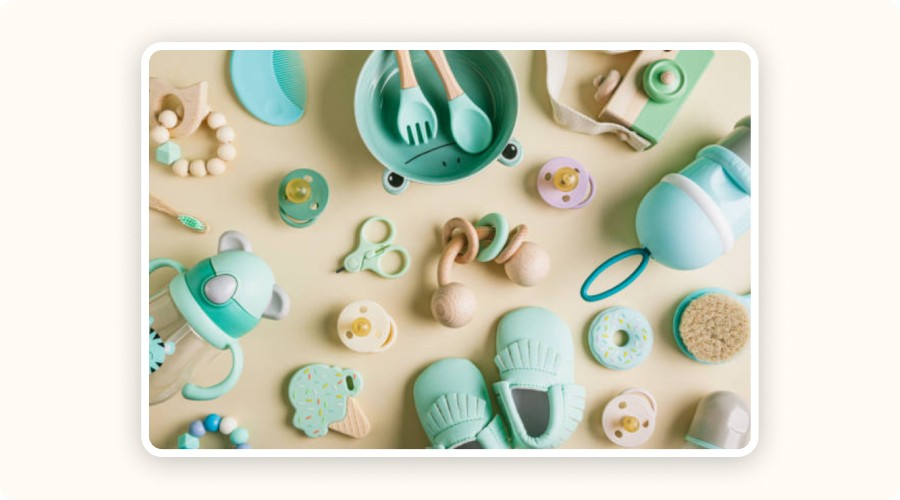
High trust requirement, high repeat purchase. Safety and finish carry disproportionate weight, so quality of sourcing shows up directly in refund rate.
Home and interior decoration

Strong visual appeal, which makes creative straightforward. The risk is saturation on anything that photographs well and ships flat, differentiate on variants or bundles.
Eco-friendly and reusable goods
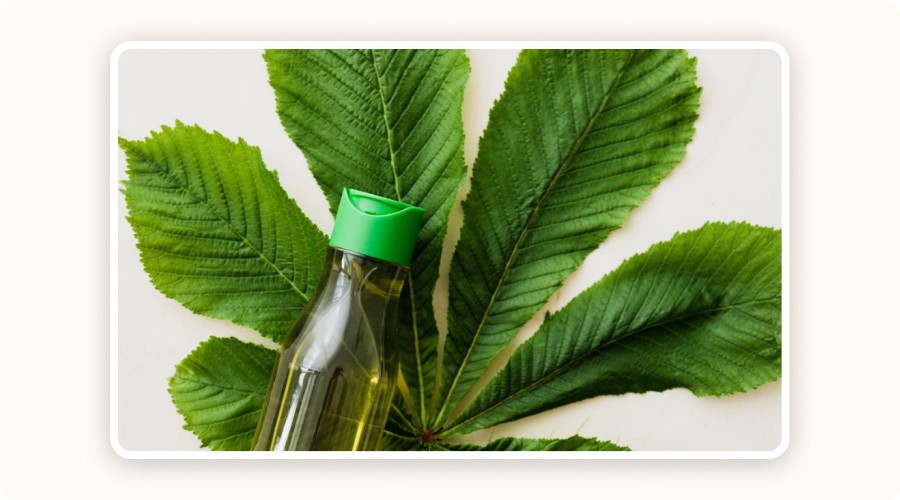
Buyers accept a higher price point when the reasoning is legible. Works best where the alternative it replaces is a recurring cost.
Fitness and home training

Steady demand, strongly seasonal at the start of the year. Perceived value depends on the result implied, so the creative matters more than the object.
Beauty and skincare

High repeat rate and high perceived value, but the most crowded category here. Only worth entering with a genuine angle, a specific concern, a specific routine, rather than a generic product.
Health and wellbeing
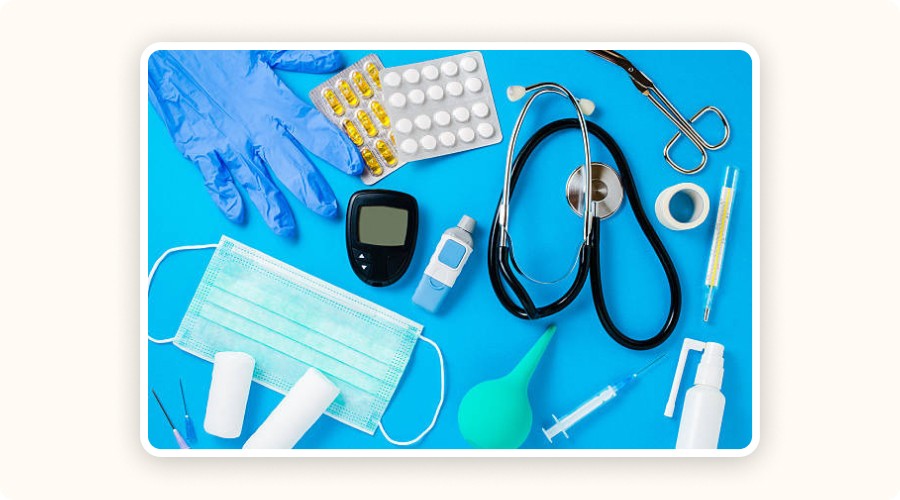
Wide demand, but the tightest advertising rules. Check platform policy before building anything, because a compliant angle is the constraint, not the product.
High-ticket and premium
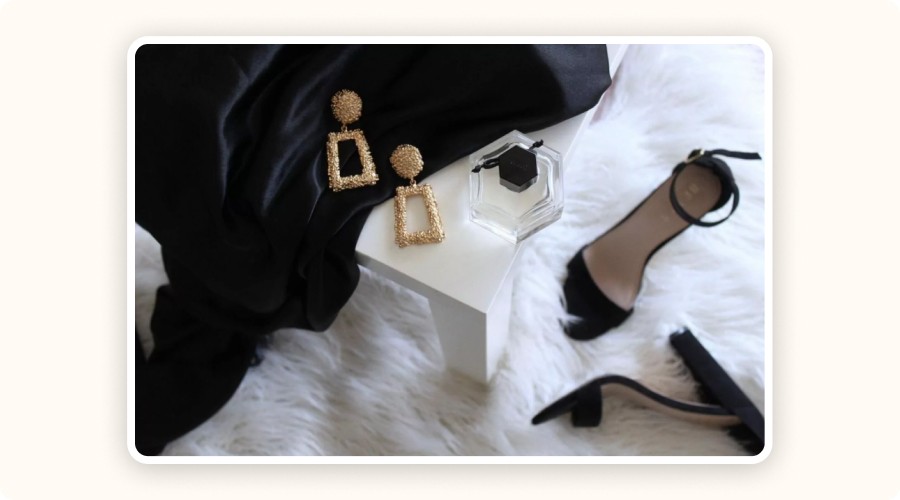
Fewer orders, more margin per order, and a longer decision. Suits sellers who can support the purchase properly. A single refund costs materially more here.
Tech and accessories
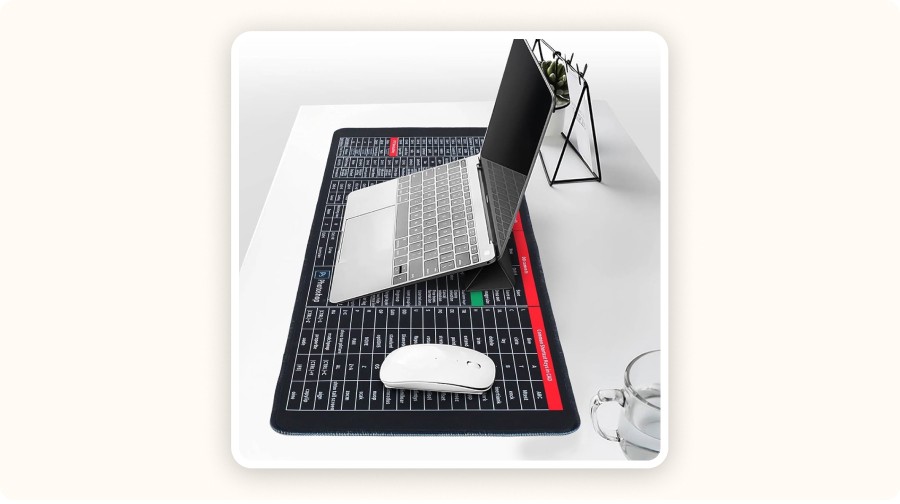
Constant renewal and easy demonstration. Compatibility questions drive support load, so specify precisely in the listing.
What I would do differently as a beginner
Three things cost more than picking the wrong category:
Treating a shortlist as a decision. A product appearing under good filters is a candidate. It still has to clear your margin, your delivery time and your audience.
Copying the asset instead of the angle. The same product with the same creative and a worse page is a losing campaign. What transfers is the mechanism.
Launching at the wrong moment. A product that met every criterion a year ago can be saturated now.


FAQ
What types of products sell best in dropshipping?
Products with high perceived value relative to cost, solving a visible problem, that can be sourced reliably. Category matters less than that combination, pet, baby, home and tech accessories recur because they tend to satisfy it.
What are the trending dropshipping products in 2026?
Trending shifts faster than any page can be updated, which is why this one gives you the categories and the reading method rather than a product list with a shelf life of three weeks. The categories above are where demand is durable; for what is moving this week, ad data is the current source and marketplace rankings are the retrospective one.
What margin should I target?
Around 20–25% net is the realistic band in dropshipping once ads and returns are counted, according to the margin breakdown in this video (French). On the raw arithmetic, buying at €10 and selling at €20 is a 50% gross margin and a reasonable floor to work from.
Which dropshipping niches should I avoid?
Anything you cannot source reliably, anything where advertising policy blocks a straightforward angle, and any product whose perceived value collapses once the buyer sees it. Saturated products are not automatically excluded, but they are, in practice, for a beginner without a mature pixel or custom creative.
How do I know if a product is saturated?
Saturation is relative to who is advertising. Look at how long competing ads have run, how many sellers are active, and whether they are established operations. A product that is saturated for you can still be profitable for a seller with better sourcing and a warmed pixel.
Are best-selling products a good starting point?
They are a good validation step and a weak discovery step. A best-seller has already been found by everyone reading the same list, so you enter with proof and no timing advantage. Find candidates from ad data, then check them against best-seller rankings.
Is dropshipping still worth it in 2026?
Yes, as a way to sell without holding stock, provided the product is genuinely improved, the delivery is honest, and the margin survives the ad cost. As "cheap goods resold at a large multiple", no.
Do I need a paid tool to find products?
No. Free ad libraries work, they are just noisier. A paid tool pays for itself when it saves a single product test, since creative, samples and a few days of ad spend cost more than a month of subscription. You can try Minea for free to see whether the filtered view tells you something the free version does not.
Trending products in 2026: how to read a trend
A trending product is one whose demand is climbing right now. That is a timing signal, not a quality signal, and the two get confused constantly.
What a trend actually tells you. Rising search and ad volume means a market is forming. It does not tell you whether margin survives at scale, whether the supply chain holds, or whether you are early or late. A product trending for six weeks with fifty sellers already running it is a market you are late to.
Reading the curve. Three things separate a trend worth entering from one worth skipping:
Where it is in the cycle. Early means few advertisers and rising engagement. Late means many advertisers, falling engagement, discounting.
Whether it is seasonal or structural. Fitness spikes every January and collapses in March. A structural shift, a new device category, a regulation change, does not revert.
Whether the trend is the product or the angle. Often the object is ordinary and the creative is what spread. That transfers; the product alone does not.
A trend does not exempt a product from the criteria above. A trending item with no perceived value, no margin, or no reliable supplier is still a losing campaign. The trend only decides when, never whether.
Where to watch. Ad platforms show a trend before search does, because advertisers commit budget before consumers search a term. That is why I work from ad data: an ad spy surfaces a product while spend is ramping, several weeks before it shows up in search-volume tools.
Best sellers: what "already selling" is worth
A best-seller list is the opposite signal to a trend. It is retrospective, and it is the safest starting point if you have not launched before, because the product has demonstrably moved units.
The trade-off is symmetric. A product on a best-seller list has already been found, by definition, since that is what put it there. You are entering with proof and without timing advantage, which usually means competing on price, creative or delivery rather than on discovery.
Use best sellers to validate a candidate you found elsewhere, not to source candidates. Sellers who work the other way round tend to arrive last.
Where to find candidates
I use an ad spy because scrolling a public ad library surfaces plenty that is not dropshipping at all, unrelated ads, brands, noise. Filtering removes that.
Two things worth being clear about, both of which I say on camera:
The filters narrow a field; they do not identify a winner. If you always search with the same saved filters, you will always see the same products, and so will everyone else using them. The value is in varying the angle, not in finding one magic configuration. I walk through the full sequence in this product-research video (French).
Product research is one use, not the only one. The same data supports competitor analysis and shop tracking later in the process, which is where the trending-shops view earns its place, it starts from stores rather than individual ads, and it is the easiest entry point if you are starting out.
For the step-by-step method rather than the criteria, see how to find dropshipping products.
Which platform to watch
Products surface on different platforms at different points, and the platform you monitor determines how early you see them.
TikTok is where impulse and demonstration products break first. Short-form rewards a visible before/after, so a product that shows well on camera can go from nothing to saturated in weeks. Monitoring it is how you catch a curve early, and how you avoid entering one that has already peaked. TikTok ad data is the fastest signal available, and also the noisiest.
Facebook and Instagram run slower and older. A product working on Meta usually has a longer profitable life than a TikTok breakout, and the audience converts at higher price points. Meta is where you check whether a TikTok product has staying power beyond its first cohort, Facebook ad data is the better read for durability.
The practical rule: find on TikTok, validate on Meta, look to Pinterest for what everyone else missed. Watching only one platform gives you a partial view of saturation, a product can look untouched on one and be thoroughly worked on another.
Marketplace best-seller data
Marketplace rankings are a free, retrospective cross-check. If a product ranks well on a large marketplace, demand is real and quantified.
Two limits worth knowing before leaning on it. Marketplace demand is search-led, people arrive already looking, whereas ads are interruption-led, so a marketplace best-seller does not always translate to a product you can sell cold on a feed. And a marketplace ranking says nothing about your margin, because the listed price is usually already compressed by competition.
Use it to confirm that demand exists, then price against your own ad cost rather than against the marketplace.
Minea
Top 100 best-performing products this month
Detected in real time by our AI from market signals: real sales, advertising statistics, and performance
Trending categories in 2026
These hold up because they combine repeat demand with room for perceived value. None of them is a shortcut, every product below still has to clear the criteria above.
Pet accessories
Owners buy repeatedly and buy emotionally, which supports both margin and lifetime value. Favour items solving a visible daily annoyance over novelty.
Baby and parenting products
High trust requirement, high repeat purchase. Safety and finish carry disproportionate weight, so quality of sourcing shows up directly in refund rate.
Home and interior decoration
Strong visual appeal, which makes creative straightforward. The risk is saturation on anything that photographs well and ships flat, differentiate on variants or bundles.
Eco-friendly and reusable goods
Buyers accept a higher price point when the reasoning is legible. Works best where the alternative it replaces is a recurring cost.
Fitness and home training
Steady demand, strongly seasonal at the start of the year. Perceived value depends on the result implied, so the creative matters more than the object.
Beauty and skincare
High repeat rate and high perceived value, but the most crowded category here. Only worth entering with a genuine angle, a specific concern, a specific routine, rather than a generic product.
Health and wellbeing
Wide demand, but the tightest advertising rules. Check platform policy before building anything, because a compliant angle is the constraint, not the product.
High-ticket and premium
Fewer orders, more margin per order, and a longer decision. Suits sellers who can support the purchase properly. A single refund costs materially more here.
Tech and accessories
Constant renewal and easy demonstration. Compatibility questions drive support load, so specify precisely in the listing.
What I would do differently as a beginner
Three things cost more than picking the wrong category:
Treating a shortlist as a decision. A product appearing under good filters is a candidate. It still has to clear your margin, your delivery time and your audience.
Copying the asset instead of the angle. The same product with the same creative and a worse page is a losing campaign. What transfers is the mechanism.
Launching at the wrong moment. A product that met every criterion a year ago can be saturated now.
FAQ
What types of products sell best in dropshipping?
Products with high perceived value relative to cost, solving a visible problem, that can be sourced reliably. Category matters less than that combination, pet, baby, home and tech accessories recur because they tend to satisfy it.
What are the trending dropshipping products in 2026?
Trending shifts faster than any page can be updated, which is why this one gives you the categories and the reading method rather than a product list with a shelf life of three weeks. The categories above are where demand is durable; for what is moving this week, ad data is the current source and marketplace rankings are the retrospective one.
What margin should I target?
Around 20–25% net is the realistic band in dropshipping once ads and returns are counted, according to the margin breakdown in this video (French). On the raw arithmetic, buying at €10 and selling at €20 is a 50% gross margin and a reasonable floor to work from.
Which dropshipping niches should I avoid?
Anything you cannot source reliably, anything where advertising policy blocks a straightforward angle, and any product whose perceived value collapses once the buyer sees it. Saturated products are not automatically excluded, but they are, in practice, for a beginner without a mature pixel or custom creative.
How do I know if a product is saturated?
Saturation is relative to who is advertising. Look at how long competing ads have run, how many sellers are active, and whether they are established operations. A product that is saturated for you can still be profitable for a seller with better sourcing and a warmed pixel.
Are best-selling products a good starting point?
They are a good validation step and a weak discovery step. A best-seller has already been found by everyone reading the same list, so you enter with proof and no timing advantage. Find candidates from ad data, then check them against best-seller rankings.
Is dropshipping still worth it in 2026?
Yes, as a way to sell without holding stock, provided the product is genuinely improved, the delivery is honest, and the margin survives the ad cost. As "cheap goods resold at a large multiple", no.
Do I need a paid tool to find products?
No. Free ad libraries work, they are just noisier. A paid tool pays for itself when it saves a single product test, since creative, samples and a few days of ad spend cost more than a month of subscription. You can try Minea for free to see whether the filtered view tells you something the free version does not.
Trending products in 2026: how to read a trend
A trending product is one whose demand is climbing right now. That is a timing signal, not a quality signal, and the two get confused constantly.
What a trend actually tells you. Rising search and ad volume means a market is forming. It does not tell you whether margin survives at scale, whether the supply chain holds, or whether you are early or late. A product trending for six weeks with fifty sellers already running it is a market you are late to.
Reading the curve. Three things separate a trend worth entering from one worth skipping:
Where it is in the cycle. Early means few advertisers and rising engagement. Late means many advertisers, falling engagement, discounting.
Whether it is seasonal or structural. Fitness spikes every January and collapses in March. A structural shift, a new device category, a regulation change, does not revert.
Whether the trend is the product or the angle. Often the object is ordinary and the creative is what spread. That transfers; the product alone does not.
A trend does not exempt a product from the criteria above. A trending item with no perceived value, no margin, or no reliable supplier is still a losing campaign. The trend only decides when, never whether.
Where to watch. Ad platforms show a trend before search does, because advertisers commit budget before consumers search a term. That is why I work from ad data: an ad spy surfaces a product while spend is ramping, several weeks before it shows up in search-volume tools.
Best sellers: what "already selling" is worth
A best-seller list is the opposite signal to a trend. It is retrospective, and it is the safest starting point if you have not launched before, because the product has demonstrably moved units.
The trade-off is symmetric. A product on a best-seller list has already been found, by definition, since that is what put it there. You are entering with proof and without timing advantage, which usually means competing on price, creative or delivery rather than on discovery.
Use best sellers to validate a candidate you found elsewhere, not to source candidates. Sellers who work the other way round tend to arrive last.
Where to find candidates
I use an ad spy because scrolling a public ad library surfaces plenty that is not dropshipping at all, unrelated ads, brands, noise. Filtering removes that.
Two things worth being clear about, both of which I say on camera:
The filters narrow a field; they do not identify a winner. If you always search with the same saved filters, you will always see the same products, and so will everyone else using them. The value is in varying the angle, not in finding one magic configuration. I walk through the full sequence in this product-research video (French).
Product research is one use, not the only one. The same data supports competitor analysis and shop tracking later in the process, which is where the trending-shops view earns its place, it starts from stores rather than individual ads, and it is the easiest entry point if you are starting out.
For the step-by-step method rather than the criteria, see how to find dropshipping products.
Which platform to watch
Products surface on different platforms at different points, and the platform you monitor determines how early you see them.
TikTok is where impulse and demonstration products break first. Short-form rewards a visible before/after, so a product that shows well on camera can go from nothing to saturated in weeks. Monitoring it is how you catch a curve early, and how you avoid entering one that has already peaked. TikTok ad data is the fastest signal available, and also the noisiest.
Facebook and Instagram run slower and older. A product working on Meta usually has a longer profitable life than a TikTok breakout, and the audience converts at higher price points. Meta is where you check whether a TikTok product has staying power beyond its first cohort, Facebook ad data is the better read for durability.
The practical rule: find on TikTok, validate on Meta, look to Pinterest for what everyone else missed. Watching only one platform gives you a partial view of saturation, a product can look untouched on one and be thoroughly worked on another.
Marketplace best-seller data
Marketplace rankings are a free, retrospective cross-check. If a product ranks well on a large marketplace, demand is real and quantified.
Two limits worth knowing before leaning on it. Marketplace demand is search-led, people arrive already looking, whereas ads are interruption-led, so a marketplace best-seller does not always translate to a product you can sell cold on a feed. And a marketplace ranking says nothing about your margin, because the listed price is usually already compressed by competition.
Use it to confirm that demand exists, then price against your own ad cost rather than against the marketplace.
Minea
Top 100 best-performing products this month
Detected in real time by our AI from market signals: real sales, advertising statistics, and performance
Trending categories in 2026
These hold up because they combine repeat demand with room for perceived value. None of them is a shortcut, every product below still has to clear the criteria above.
Pet accessories
Owners buy repeatedly and buy emotionally, which supports both margin and lifetime value. Favour items solving a visible daily annoyance over novelty.
Baby and parenting products
High trust requirement, high repeat purchase. Safety and finish carry disproportionate weight, so quality of sourcing shows up directly in refund rate.
Home and interior decoration
Strong visual appeal, which makes creative straightforward. The risk is saturation on anything that photographs well and ships flat, differentiate on variants or bundles.
Eco-friendly and reusable goods
Buyers accept a higher price point when the reasoning is legible. Works best where the alternative it replaces is a recurring cost.
Fitness and home training
Steady demand, strongly seasonal at the start of the year. Perceived value depends on the result implied, so the creative matters more than the object.
Beauty and skincare
High repeat rate and high perceived value, but the most crowded category here. Only worth entering with a genuine angle, a specific concern, a specific routine, rather than a generic product.
Health and wellbeing
Wide demand, but the tightest advertising rules. Check platform policy before building anything, because a compliant angle is the constraint, not the product.
High-ticket and premium
Fewer orders, more margin per order, and a longer decision. Suits sellers who can support the purchase properly. A single refund costs materially more here.
Tech and accessories
Constant renewal and easy demonstration. Compatibility questions drive support load, so specify precisely in the listing.
What I would do differently as a beginner
Three things cost more than picking the wrong category:
Treating a shortlist as a decision. A product appearing under good filters is a candidate. It still has to clear your margin, your delivery time and your audience.
Copying the asset instead of the angle. The same product with the same creative and a worse page is a losing campaign. What transfers is the mechanism.
Launching at the wrong moment. A product that met every criterion a year ago can be saturated now.
FAQ
What types of products sell best in dropshipping?
Products with high perceived value relative to cost, solving a visible problem, that can be sourced reliably. Category matters less than that combination, pet, baby, home and tech accessories recur because they tend to satisfy it.
What are the trending dropshipping products in 2026?
Trending shifts faster than any page can be updated, which is why this one gives you the categories and the reading method rather than a product list with a shelf life of three weeks. The categories above are where demand is durable; for what is moving this week, ad data is the current source and marketplace rankings are the retrospective one.
What margin should I target?
Around 20–25% net is the realistic band in dropshipping once ads and returns are counted, according to the margin breakdown in this video (French). On the raw arithmetic, buying at €10 and selling at €20 is a 50% gross margin and a reasonable floor to work from.
Which dropshipping niches should I avoid?
Anything you cannot source reliably, anything where advertising policy blocks a straightforward angle, and any product whose perceived value collapses once the buyer sees it. Saturated products are not automatically excluded, but they are, in practice, for a beginner without a mature pixel or custom creative.
How do I know if a product is saturated?
Saturation is relative to who is advertising. Look at how long competing ads have run, how many sellers are active, and whether they are established operations. A product that is saturated for you can still be profitable for a seller with better sourcing and a warmed pixel.
Are best-selling products a good starting point?
They are a good validation step and a weak discovery step. A best-seller has already been found by everyone reading the same list, so you enter with proof and no timing advantage. Find candidates from ad data, then check them against best-seller rankings.
Is dropshipping still worth it in 2026?
Yes, as a way to sell without holding stock, provided the product is genuinely improved, the delivery is honest, and the margin survives the ad cost. As "cheap goods resold at a large multiple", no.
Do I need a paid tool to find products?
No. Free ad libraries work, they are just noisier. A paid tool pays for itself when it saves a single product test, since creative, samples and a few days of ad spend cost more than a month of subscription. You can try Minea for free to see whether the filtered view tells you something the free version does not.
Want to learn more about this topic?
Discover our Related Subcategories
find-winning-products-aliexpress
Find Winning Products on AliExpress
How to find winning products on AliExpress: the order-count trap, supplier vetting, the margin test, and why the best products are found before AliExpress.
ebay-product-research
eBay Product Research
How to do eBay product research without guessing: demand signals, sell-through rate, margin maths, and the free methods that work before you pay for a tool.
tiktok-products
Tiktok Products
Dive into the world of viral products seen on TikTok and find the must-haves of the moment in one convenient and reliable place.
See more Categories
find-winning-products-aliexpress
Find Winning Products on AliExpress
How to find winning products on AliExpress: the order-count trap, supplier vetting, the margin test, and why the best products are found before AliExpress.
See more Categories
find-winning-products-aliexpress
Find Winning Products on AliExpress
How to find winning products on AliExpress: the order-count trap, supplier vetting, the margin test, and why the best products are found before AliExpress.
ebay-product-research
eBay Product Research
How to do eBay product research without guessing: demand signals, sell-through rate, margin maths, and the free methods that work before you pay for a tool.
See more Categories


Our Free Adspys

Find winning products on our Tiktok adspy today!
Find winning products on our Facebook adspy today!
Find winning products on our Tiktok adspy today!
Find winning products on our Facebook adspy today!
Find winning products on our Tiktok adspy today!
Find winning products on our Facebook adspy today!
Find winning products on our Tiktok adspy today!
Find winning products on our Facebook adspy today!
1 winning product everyday.
Follow us!






Find out more
Read more
Minea © 2026
Find out more
Read more
Minea © 2026
Find out more
Read more
Minea © 2026
Find out more
Read more
Minea © 2026
Find out more
Read more
Minea © 2026
Find out more
Read more
Minea © 2026